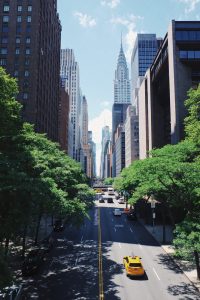
Yellow Car Running on the Street Between the Building During Daytime. Photo Credit: Robert Bye
“]
]you will remember
]for we in our youth
did these things
yes many and beautiful things
]
]
]”
― Sappho, If Not, Winter: Fragments of Sappho
It is a well-known fact that Columbia University exists as an extension of New York City. Student residence halls tower above the smog-engulfed traffic on Amsterdam Avenue; familiar scents of cooking gyro waft over the campus gates from the halal cart on 116th Street; and many Lions opt to take advantage of discounted tickets to museums, athletic events, and Broadway performances. To attend Columbia, even with its sprawling fields and historical architecture, is to live in the proverbial “City That Never Sleeps.” And, in many ways, this adage holds true.
The Core Curriculum is perhaps the greatest embodiment of the relationship between Columbia and the City. I can remember a trip that my Literature Humanities class took to the Metropolitan Museum of Art in Fall 2019, in order to analyze famous art inspired by the texts we were engaging with in the classroom. The tour guide was herself a Barnard graduate, well-versed in providing insight to Columbians who toured the galleries as part of their Core requirements. We spent minutes observing sculptural renderings of Herodotus’s Histories, followed by a retrospective on Rembrandt’s invocation of Homer in his own painting. In the same way that tourists moved through the exhibits to perhaps share a fleeting moment with an artist they revered, we found allusions to the figures and moments we had come to know through our Core texts.
In a similar way, a trip to the Metropolitan Opera to see a production of Mozart’s The Marriage of Figaro allowed the curriculum from my section of Art Humanities to come to life through sweeping orchestrations and the resonance of voices as rich as syrup. With New York City present in the many concert-goers who filled the venue, and further personified through the hot dogs we ate to satiate our hunger at the conclusion of the three-hour opera, another cohort of Columbia students were able to use the Core to again interact with the city they now called home.
The Core Curriculum, then, is as much a historical campus tradition as it is an opportunity for New York to appear as a centerpoint of one’s humanities education at Columbia. Whether it be through the brushstrokes made immortal on the walls of the Met, the food eaten outside the Lincoln Center fountain, or the tuning of an orchestra as the residents of Manhattan take their places in a crowded atrium, the Core has a profoundly unique way of introducing Columbia undergraduates to the city that waits just beyond the gates of campus. In this way, the Core manages to remind students of diverse backgrounds of their own commonalities–their academic coursework, their grounding interest in the human experience, and their attendance at a university constructed under the careful eye of New York herself.