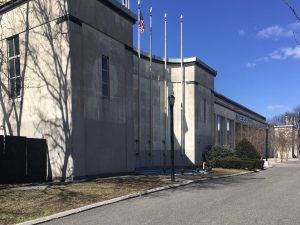
Queens Museum in Flushing Meadows (used during the Fair as the “New York City Building”). Photo credit: Teresa Brown
My first experience making use of a historical archive was spring of my sophomore year. I was taking a course called Making of the Modern American Landscape and we were assigned a final paper with little in terms of a prompt other than being instructed to use themes we learned about in class to research and write about some aspect of the history of the American built environment. I’ve always been intrigued by World’s Fairs, so I chose to write about the symbol of the 1939-1940 World’s Fair, a large, modernistic structure exhibited at the Fair that consisted of the spire-shaped Trylon and spherical Perisphere.
I started my research by making use of some of Columbia’s resources. CLIO is Columbia’s searchable online library database which allows students to look up a topic and find material throughout all of Columbia’s different libraries that might be of use. This may sound obvious, but I strongly urge everyone to make use of CLIO and Columbia’s libraries no matter what field of study you may be interested – this includes using them for core classes! For this project, my topic fell most closely under architectural history, so many of the results CLIO returned were located in Columbia’s Avery Architectural and Fine Arts Library. Here I found books on the history of the Fair as well as books of postcards and other original mementos from the Fair. After I had done some digging through Columbia’s resources on my topic, I met with my TA who suggested that I turn next to the New York Public Library.
The NYPL system is an expansive network that not only lends books but also houses a number of archival records. Different branches contain different collections, for example the arts collections at the NYPL for the Performing Arts. The main branch on 5th avenue houses several collections, largely consisting of the papers of individuals, families and organizations in the New York region. Two notable collections that they have are on the two World’s Fairs that were hosted in New York – exactly the kind of material that might help me in understanding the significance of the 1939 symbol.
To access this archive, I had to submit a form online detailing exactly which boxes I was looking for and why. I was then informed via email when my requested boxes were available, and I was able to go to the library to access them. The NYPL has a research room, and documents from the archive can only be accessed in this room. I was allowed to take pictures, but I had to submit a record of everything I took a picture of. Because archives contain original documents, the processes necessary to gain access to them are necessarily going to be more involved than, say, checking out a library book.
Often when undergraduate research is discussed, it is within the context of a senior thesis or a large-scale independent project. However, this is one example of how one can practice research techniques in courses prior to writing a thesis. Having experience with the skills needed for research will then help tremendously if and when those larger projects come along. Columbia and New York are full of incredible resources. Learning to use services like CLIO as well as being willing to think outside the Columbia bubble has the potential to enhance every class you take and opens up a world of possibilities.