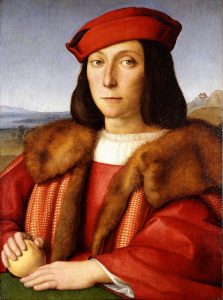
Young Man with an Apple, Raphael Sanzio da Urbino, 1505, Uffizi Gallery
By: Daksha Pillai, CC’27
With the barest exception of Basquiat, there is not an artist in the Art Humanities syllabus who incites more envy in me than Raphael.
It is not for his prowess as a painter – my malformed stick figures long put me out of the running in that game. What’s more compelling to me is his sensibility, his ease in moving through the world. He mingled easily with popes and tradesmen alike, fomented feuds and friendships in the art scene, and raked through so many mistresses that his early death was attributed to “overamorousness.” Though Giorgio Vasari certainly lays it on thick in Lives of the Most Excellent Painters, Sculptors, and Artists, there is something moving in his description of Raphael as someone so affable, so magnetic “that the very animals, not to speak of men, honored him.”
While the wheels of Raphael’s life were well-greased by power and money – his father served as court painter to the Duke of Urbino – the same was true for many of his contemporaries who lived far quieter lives than he did. In a time when the average person rarely left their village, Raphael exuded worldliness. So for those without a draftsman’s hand, there’s a much easier way to emulate Raphael than by producing a perfect Madonna: studying abroad.
Under the “Why Study Abroad?” page, the Center for Undergraduate Global Engagement lists nearly every reason under the sun, from developing thesis ideas to bettering one’s social network. For Raphael, it was all of the above – not only did he need to better establish himself to other artists and patrons, he needed new influence beyond that of his mentor Pietro Perugino.
With these aims in mind, his arrival in Florence was almost absurdly well-timed. In 1504, the city’s admiration for its own artists was reaching a fever pitch, with Michelangelo’s gargantuan David casting a physical shadow over every newcomer. Only 21 years old, Raphael had already made full use of his political connections in Urbino, and came armed with a letter of recommendation from the duke’s sister, Gianna Feltrea. As far as references go, it still holds up well as a template: the bearer of this will be found to be Raphael, painter of Urbino, who, being greatly gifted in his profession, has determined to spend some time in Florence to study. And because his father was most worthy and I was very attached to him, and the son is a sensible and well-mannered young man, on both accounts, I bear him great love…
Meeting new people, finding new ideas; it’s the bread and butter of study abroad. It was no different in the 16th century. Walking through the low-lit galleries of “Sublime Poetry,” the Met’s summer retrospective on Raphael, I wasn’t won over so much by the pristine patron portraits and papacy-bankrupting tapestries as I was his rough sketches – manic doodles of the David, first attempts at Leonardo da Vinci’s sfumato technique. The bodies of saints, vaguely potato-like when he was still painting under Perugino, grew muscular under Michelangelo’s influence. These improvements in his artistry would follow Raphael to Rome, where he spent the rest of his life on ornate commissions for the Vatican, including his arguably most well-known work, The School of Athens.
Equally compelling though are the anomalies, the techniques and subjects that Raphael never returned to again after Florence. He gave Young Man with Apple startling grey eyes, replaced the Madonna’s typical pastoral backdrop with swaying palm trees, and even portrayed a stern pregnant woman in La Donna Gravida, a highly unusual subject for the Renaissance period.
In my favorite work of his, The Entombment, a tangle of apostles and holy women lurch towards the open mouth of a cave, staggering under the weight of Christ’s corpse; the interlocking limbs, the arresting sense of motion, would have astounded the artist himself if he had never left Urbino. Also known as the Baglioni Altarpiece, it was commissioned by Atalanta Baglioni as a sort of penance for the death of her son, Griffonetto, whom she had refused to shelter after his participation in the “Red Wedding” massacre of his relatives. The focal point of the scene isn’t Christ but rather a young man hoisting the corpse, his reddish hair blowing in the wind, clearly the likeness of Griffonetto.
Part of what’s so moving about this painting to me is how Raphael has transformed Atalanta’s grief into something so unexpected. Rather than the standard Pietà, he depicts Griffonetto with the same strength and vivacity, as well as recklessness, that he must have had in life. Painted in his final year in Florence, The Entombment serves as evidence that Raphael’s time in the city made him not just a better painter, but a better person – someone who could look at the mother of a murderer and still give her son an honest, sanctified ending.
While a recommendation letter from royalty would still come in handy, Columbia students have an abundance of resources at hand if they wish to become neo-Raphaelites. While Raphael was only able to go as far as Florence and Rome, students have the ability to travel to Kyoto, Havana, and Paris, all through UGE programs funded by the Global Learning Scholarship.
Though I didn’t participate in a traditional study abroad program during my time at Columbia, I found other ways to have international experiences, from taking a summer course at the London School of Economics to working in urban slums in Mumbai. It is because of those experiences that I am able to look at Raphael’s 1504 self-portrait and feel a jolt of recognition; not in the fine brushstrokes forming his face, but rather in the laconic tilt of his eyes, that desire to be someplace where he could become more than what he was.