
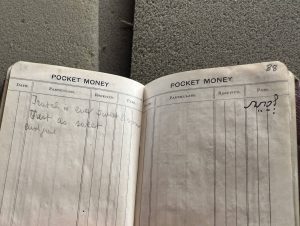
Isaiah Berlin Pocket Diary, Oxford Bodleian Library
By: Ari Gordon, CC’27
As an English major mainly focused on literature from between 1850 and 1950, the lives of the writers I study are usually vastly different from my own. Even for those whose stories are relatively uneventful and mirror my own circumstances, practically everything in a pre-smartphone-in-your-pocket era seems like a world away. Though a course like Literature Humanities demonstrates prose and poetry’s power to transcend time and capture the universal emotions and struggles of humanity, when researching the lives of great writers, I almost always feel personally disconnected from their circumstances. Sometimes, however, a flicker of my social or intellectual experience shines into the musty, dimly lit reading room with the utmost clarity. These moments offer something profound both for my research and for myself, as the researcher—a delicate exchange where personal experience illuminates a subject’s life while also recontextualizing one’s own experiences in light of the subject.
This occurred for me recently while looking through the Isaiah Berlin archives at the University of Oxford’s Bodleian Library, which I visited this summer as an Undergraduate Summer Research Fellow at Columbia’s IIJS (Institute for Israel and Jewish Studies). Isaiah Berlin was a Russian-British political theorist and Oxford professor famous for, among many other contributions, his distinction between positive and negative liberty. Many think of Isaiah Berlin as largely assimilated into Oxford-don sophistication and British high society, but whenever referred to as an English philosopher, he would insist he was a Jew first, writing: “I am a Russian Jew from Riga, and all my years in England cannot change this.” This contradiction fascinated me, and IIJS granted me the funding to pursue it.
But upon reaching the Bodleian Library and requesting Berlin’s diaries, I realized I had made a mistake. What was listed as “Diaries, 1923-1998” on the Bodleian’s website consisted of “Pocket diaries”—which I assumed meant small diaries, but actually refer to a kind of miniature appointment book. I was anticipating pages of Berlin’s innermost secrets, but instead found primary school timetables and homework assignments. I leafed through the volumes, which fit snugly in my palm, feeling frustrated and stuck: how was I to discover something new about his Judaism by poring over his daily to-do lists?
Still, I read every page of his appointment books, and on the end pages of one of his earliest schoolboy volumes, under the “Pocket Money” section, my own Jewish-schoolboy heart skipped a beat. Written in dark black ink was the Hebrew word לְכַתֵת. The word, lechatet, means to “beat” or “crush,” and is an uncommonly used phrasing with biblical origins, fittingly from Isaiah 2:4, which reads: “And they shall beat their swords into plowshares.” Could Isaiah Berlin have been expressing here his frustration with antisemitism in Britain with this cryptic word? Was he sharing his turmoil in his people’s tongue? From his namesake book of the Tanakh? I turned the next page, and…
Mistaken again. Lechatet was a lone verb written before multiple pages of free-styled vocabulary charts (בניינים/binyanim, the “buildings” of Hebrew grammar): notes I surmise were written for Berlin’s Hebrew class. I sat, stunned at what I found. Not because it broke the case of Berlin’s Judaism wide open, or because of some secret message, but because I had copied almost the same exact charts as a child. I knew Berlin spoke Hebrew, but seeing and touching the same drills that were instilled in me from a young age gave me instant insight into his faith and identity—because it had, at least partially, a common foundation as mine. Sitting in the Bodleian’s beautiful reading room, I was transported back to the little blue desks and brown notebooks of my Jewish day school. What began as a simple mistake in understanding the category of material led me not only to an intimate encounter with Berlin’s mind, but also to understand that an experience I had forgotten—writing grammar charts—was a formative act of identity-making.
Such moments are rare in research. But they are vital toward truly understanding one’s subject, collapsing the gulf of time that lies between a past life and one’s own. In Marcel Proust’s In Search of Lost Time, when the narrator dips a madeleine into a cup of tea, he sees his childhood spilling out in reverie. In Ratatouille, the harsh critic bites into the dish that Remy the rat-chef cooks for him and is transported to his grandmother’s home. The Core is rife with possibility for such transformative epiphanies. But humanities research is, too. It’s not only a process of knowledge acquisition but a cooperative antagonism of self-reflection. I implore everyone to approach their research with the receptivity and imagination necessary for such moments, and to purposefully seek out beloved writers and thinkers’ archives in order to excavate such experiences. It may be difficult, but it is what, for me, makes plain-old head-in-the-filing-cabinet archival research an experience that can, at points, rival the aesthetic and emotional heights of the Core.