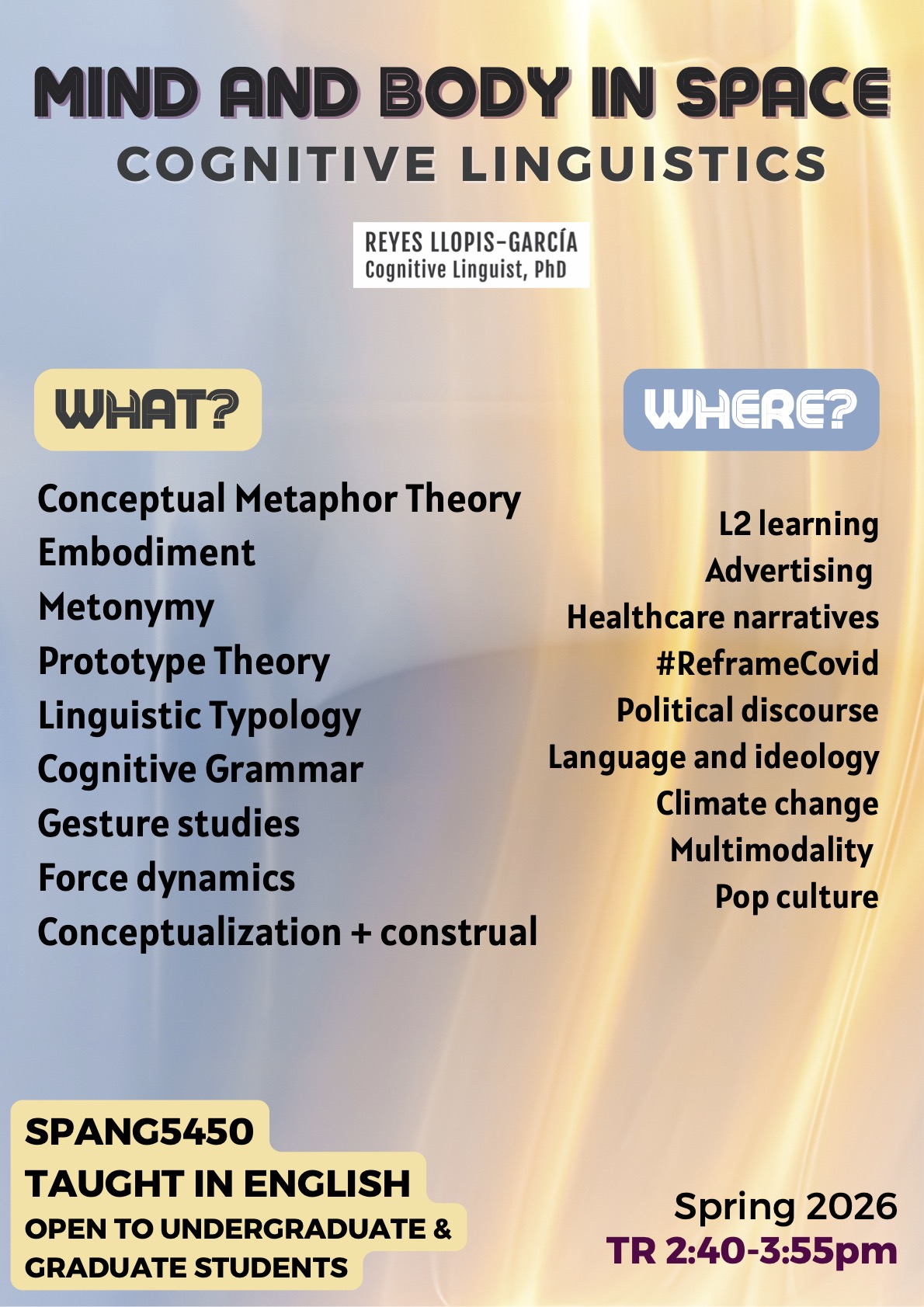
Reyes Llopis-García is a Senior Lecturer in Spanish in the Latin American and Iberian Cultures department at Columbia. She is passionate about the intersections between second-language learning, cognition, and linguistics– all of which are explored in her spring course Mind and Body in Space: A Cognitive Linguistics Account of Language (see the flyer at the end of this post!) Reyes spoke with us about her exciting research, her approach to teaching, and how it all comes together in her cognitive linguistics course.
For those who aren’t familiar already, can you explain what cognitive linguistics is, and how it’s distinct from the fields it is sometimes confused with, such as psycholinguistics and cognitive science?
Cognitive linguistics examines the relationship between language and the mind. It is not a single, homogeneous approach to the study of language and cognition, but rather a combination of theories and approaches to language that take into account anthropological, psychological, physiological, or cultural perspectives. CogLing also places a very strong focus on semantics. The discipline started in the search for alternatives to Generative linguistics and its syntax-centric approach in Universal Grammar. CogLing linguists argued that language could not be fully addressed and understood with math-like principles, parameters, and syntactic combinations that leave little to no room for semantic and contextual aspects in a speaker’s choice of words.
And I love that you asked about the difference between these fields. Psycholinguistics, cognitive science, and CogLing are disciplines with a lot of crossover because they all explore the relationship between language and the mind, but they differ in how they go about it (focus, scope, and method).
Psycholinguistics studies real-time use of language. By measuring reaction times in speech during a conversation, or the movement of our eyes when we interact with a text, or with fMRI and brain imaging, PsychLing looks at how we understand, learn, and produce language.
Cognitive science is a broader discipline, and I would say that we can look at CogLing as one of its branches. CogSci focuses on language as a part of our general cognition, and it looks at language from a variety of fields: linguistics, psychology, neuroscience, natural language processing, and even philosophy. Research here wants to know how language informs what we know about our general cognitive system.
BUT if we want to see how the mind relates to language, then we turn to cognitive linguistics. CogLing focuses on language as a reflection, or representation, of our conceptualization and experience of the world around us, which in turn gives rise to the linguistic systems we speak. CogLing works from two foundational principles: 1) language is integrated within general cognition, not in isolation (i.e. Universal Grammar) but in interaction with other cognitive abilities, such as memory, categorization, or attention; and 2) language is usage-based, symbolic, and motivated by human experience (i.e. it is not arbitrary). Thus, the study of semantic and pragmatic perspectives is necessary to fully grasp how language works and how we think about it. For CogLing, meaning arises from embodied experience and conceptual structures (like image schemas, categories, frames, and metaphor or metonymy, to name a few). So, when we say something like He’s a warm person or She gave me the cold shoulder, we are conceptualizing abstract ideas by way of conceptual metaphor, mapping the abstract, very personally-perceived domain of affection in terms of something we all understand, like temperature. AFFECTION IS TEMPERATURE, then, is a conceptual metaphor (or the language of our minds), while the two examples are linguistic metaphors that exemplify the first. It’s actually pretty fun to study language this way.
You teach a cognitive linguistics course here (which students can register for this spring!) What does this course cover, generally? What might linguistics students be particularly excited to learn about? Can you tell us a bit more about the title, “Mind and Body in Space”? It is very intriguing!
Yes! My course is called Mind and Body in Space: A Cognitive Linguistics Account of Language, and everyone is welcome to take it! The GR code (vs UN) of the class simply means that graduate students, often from Teachers College, may register. Any undergrads wishing to join should be able to.
If I may quote an edited version of my Syllabus:
🧠 What happens in the minds of people when language is at work? How do we process our surroundings, understand the world we live in, accommodate our own culture as a shaper of our perceptions… and communicate about it all by using the right words? 😵💫
“From a CL perspective, language is experiential – it arises from physical interaction with the world and it permeates the whole linguistic system and its grammatical structure. This physical interaction gives way to embodied aspects in language that become conventionalized in discourse communities through their systematic usage.” (Llopis-García 2024, p. 4, 13)
CL provides a theoretical and applied framework for understanding language as a builder of meaning that stems from interaction with the world. Language, from this point of view, embodies the global cognitive capabilities of all human beings, and is not understood as an independent component of the mind, or as an isolated, formal object of study.
In this course, we will explore key concepts and fields that define and study language in terms of meaning, such as conceptual metaphor and metonymy, mental spaces, prototypes, embodied cognition and gesture, multimodality, cognitive grammar, discourse analysis, or language learning.
There will be a varied range of genres and materials used for a discussion-based and hands-on experience of the content we will cover: basic and advanced readings from prominent references in the field, TED Talks or online lectures, newspaper articles, memes, movie excerpts and movies, or music. Individual, as well as collaborative work for in and out-of-class discussions will be constant throughout the semester 📝📚🗣️🔊☯️
You also teach Spanish as a second language. How does your linguistics training influence your language teaching? What about cognitive linguistics specifically? Does your experience teaching Spanish influence how you teach your linguistics courses?
It informs EVERYTHING in the way I teach both grammar and vocabulary. I have been teaching Spanish since the early 2000s (omg🤯) and I remember how I would prepare to teach grammar by way of charts, rules, and exceptions, as shown in textbooks and teaching materials. And then, I have vivid recollections of stress and anxiety when students raised their hands with questions and counterexamples to my neatly prepared slides. I would dread those moments. That’s because teaching language like it’s a fixed, static system of combinations (i.e. the preterit in Spanish is used with temporal markers such as yesterday, or after I think that you use indicative, but if you say I don’t think that, then you must use subjunctive 🤨🫠), brings a lot of headaches for instructors, and a lot of confusion to the students. It truly is the study of a foreign, alien object.
That is why, when I started working on my PhD back in 2003 and discovered CogLing, my whole approach to language pedagogy changed for the better, and I have never looked back. I can explain difficult grammatical concepts, such as prepositions (highly polysemous!), mood selection (indicative or subjunctive?), or the atrociously complex verbal system of Spanish in general, because I apply embodiment, motion, perspective, or the understanding of figurative language to my teaching. I said earlier that the study of language at the theoretical level from a CogLing lens is pretty fun. I will further add that teaching this way is a much more entertaining and helpful way to approach a second language with learners.
As for the case of the linguistics course, also yes to an influence from L2 teaching. As a matter of fact, most of the foundational readings we will work on at the start of the semester stem from Applied Cognitive Linguistics, which studies both disciplines together. Because all students speak two or more languages, I figure that approaching CogLing from the known experience of learning L2s brings about a more relatable route into the field.
What role, if any, has e-learning/language learning technology played in your language acquisition research and second language teaching? As both a linguist and a language teacher, what are your thoughts and insights into language learning technology?
E-learning has not really played a part in my research, except for a classroom-based empirical study I conducted in 2021, where everything had to be done remotely.
My opinions about language learning technology did change after the pandemic. Or rather, my approach to it changed as a language instructor. I used to incorporate several apps into my language classes, mostly for collaborative learning purposes, and it used to be an effective add-on pedagogical tool in our in-person courses. But after COVID-19 and our return to campus in 2021-2022, I found that screens in the classroom were more of a barrier (physical and metaphorical) than a learning opportunity. Since then, my language courses have all been analog. Students take notes in their notebooks, and I bring paper class materials to work with in class and beyond. They also have a digital learning platform where they complete activities from their textbook at home. These are more drills, fill-in-the-blanks, matching concepts, and grammar in reading comprehension, to name a few types of exercises. These are done online and help enormously with pattern recognition of linguistic forms, identification of grammatical topics in short sentences and in longer texts, and with general language practice that reviews the work we do in class.
Students have agreed that working analog-ly creates more opportunities for exchange, understanding, and collaboration. Being present in the class without the constant distractions of online devices has made a difference in how they interact with the L2, and we all (they and I) see it in their communicative competence. What is remarkable (and a little funny) is that this experience is new-ish for today’s technology-savvy learners, but it is the way it has always been done. We are simply going back to basics: language is a social product, so let’s use it socially! Drawing on studies in SLA (Second Language Acquisition), but also education and learning in general, paper vs digital has to be carefully considered and, depending on learning objectives, one might work better than the other.
On another note, the arrival in full force of generative artificial intelligence has made a huge difference in what can be done with language learning. There are many advantages to using AI bots for self-improvement in both writing and speaking, and also for understanding grammar and vocabulary, either as a standalone query or within longer texts. Additionally, the potential for in-class learning is also pretty great, and I have used it in my Intermediate Spanish courses to give students immediate feedback on their writing. This is something that can be done in seconds while it’s fresh, versus the hours and days it takes me to correct student work.
I believe that, like with all things, knowing how to use a tool is where the quality lies. When we do the writing exercise, I am the one who creates the prompt and shares it with the students so they can plug in their texts and get exactly the feedback I want them to see. What AI helps you with will ultimately lie with the prompt you craft and what you intend to get out of the interaction. So there is a lot of linguistic reflection that comes into designing activities for language learning with AI. Otherwise, AI unchecked may be more detrimental and unethical than helpful. If there is a learning objective you’re working towards, a scaffolded organization of where you want an activity to take the students in their learning, and an expected outcome that AI can facilitate, then I am in favor.
We saw online that you recently published a monograph on second language acquisition and cognitive linguistics. Congratulations! Obviously, this was a lot of work– what was the process like for you?
I did, thank you! 🤩 It is the most rewarding academic endeavor I have ever embarked on. Applied Cognitive Linguistics and L2 instruction is the name of my Element, which is a series of monographs with Cambridge University Press, designed to analyze a topic from a highly academic but also accessible and condensed perspective. It is the result of 20+ years of a scholarly career, a number of published works and empirical studies, many professional development workshops for language instructors taught, and a long experience in language instruction. I was able to devote myself fully to it during a much-loved sabbatical from my 6 courses per year workload at Columbia. I am very proud to say that its publication has generated a lot of interest and engagement in both the CogLing and the L2 teaching communities. I am excited for new projects and collaborations that have come up because of the monograph, such as a plenary talk at the 10th International Conference of the Scandinavian Association for Language and Cognition in the summer of 2026, or a current research project with universities in Spain and Switzerland on the expression of anger metaphors in English and Spanish (more on this during the Spring semester, because the empirical study with Columbia/Barnard students will be happening then!). So much to look forward to!