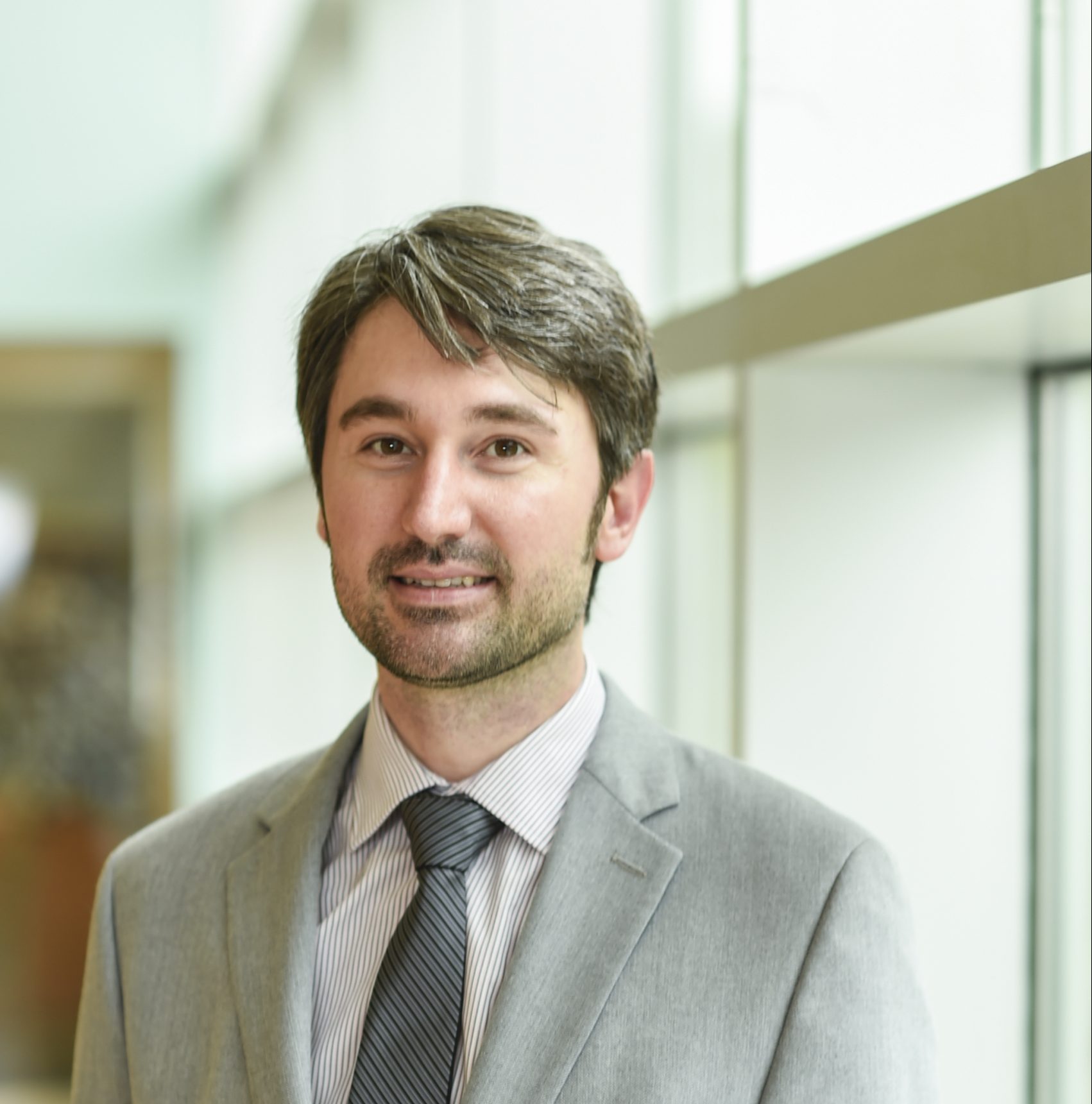
Author, professor, and linguist extraordinaire Ross Perlin recently tuned in from Berlin to update us on his latest research, his upcoming Global Core course in Paris, and a new book project in the works. Read on to learn more!
Can you tell us a little about yourself?
I’m a linguist, writer, and translator, so I wear different beanies on different days, and I’ve been teaching a range of linguistics courses at Columbia since 2018. I’m a born-and-raised New Yorker, now living in Queens (the place for languages!), but I can only dream of speaking a really r-less, h-dropping New Yorkese. I’ve also lived in California, England, and China. Otherwise, let’s see: I love smoked fish, raga, unnecessarily complicated fiction, and long city walks with lots of stops at classic local bakeries. But that’s probably not what you’re asking…
You’re currently a Nina Maria Gorrissen Fellow at the American Academy in Berlin, researching the many translations of the “Jesus Film” (available in 2,000+ languages!) Can you tell us about your current research and why it’s brought you to Germany?
The American Academy in Berlin is a unique place, where I’ve been very lucky to be in residence this fall, with extraordinary access to library and archival resources from across the country as well as myriad connections to German intellectual and cultural life and an amazing group of fellow fellows. It’s all been vital context and support for the current project, which indeed takes “The Jesus Film” as its point of departure but then opens up from this most translated of all films into a broader history of translation via missionary linguistics and scripture.
The project sounds very multidisciplinary– how do you see linguistic methodologies fitting into the research? How does your linguistics background help you undertake this research?
I’ve been plunging into translation studies, history, theology, Biblical Studies, and more, but linguistics is still very much my principal lens, and I think it’s a vital one too often missing from conversations in other disciplines. Although I draw on a range of linguistic subfields, including typology and documentation, I hope I can also speak to the history of linguistics as a field, recognizing that even in its secular academic forms, it continues to be bound up in complicated ways with the work of missionaries and Bible translators. There’s no judgment in this statement: it’s simply the reality of where the interest in and resources for research into the world’s languages has largely come from. I see it as vital to recognize and understand the deep connections between religion, language, and translation, past and present. In particular, I argue that you can’t understand Christianity’s arrival as the first truly global religion—a signature fact of our time—without understanding its relation to linguistic diversity and translation, which is unique among religions.
The relationship between secular and religious linguistics work is one of the driving questions for this book. I think it’s fair to say that these are two different worlds or two different cultures that are not always talking to each other and that have different strengths. Certainly, one thing that stands out in missionary linguist work is how long people are able to stay in the community. For the benefit of language communities, though, we need some understanding between all sides. That means better, deeper engagement with the materials that are gathered by missionaries and by other linguists who are working with missionary organizations— in many cases those are the only materials there are.
What kind of bearing might this project have on your language documentation work with the Endangered Language Alliance (ELA)?
For many languages, scriptural and other religious materials are all that exist, and missionary linguists are the only people with knowledge of the language. In many cases, members of the community have also worked on or are leading these faith-based projects, and ongoing, more or less successful evangelization is a key fact of life in many Indigenous areas around the world (including in cities!). Not to mention the degree to which all sorts of language documentation projects rely on tools like Fieldworks, Ethnologue, Keyman etc. For ELA, as much as for anyone engaged in language documentation, it’s crucial to know how to engage with this whole aspect of linguistic research in all its historic and present ramifications.
How do you approach “fieldwork” for the ELA? How does it differ from your more traditional fieldwork experiences, such as your PhD research in China?
My PhD work on Trung in China was “traditional” in the sense that I was far from home for a finite period, balancing academic and community goals and trying to work in the language’s homeland even as migration was becoming a fact of life for many. At ELA we’ve tried to forge a kind of urban “fieldwork” that is open-ended, alive to migration and diaspora as well as the facts of language contact and mixing, with a much wider range of community-driven outcomes on the table. Read Language City for the full story!
How do you approach finding and building relationships with language consultants, for both ELA and for more traditional linguistic fieldwork?
Relationship-building is one of the hardest things to learn or teach, and the relational side of research has not always gotten its due in the academic world. One relationship has to lead to another, as in life, which doesn’t mean you can’t have goals and intentions, but it does mean you have to engage seriously with the goals and intentions of others. Abstract talk of “communities” has to be grounded in relationships with individuals. Potentially your whole self goes into it, which I find works best when you’re in person (though virtual fieldwork is increasingly a thing in certain cases) and when you’re in it together for the long haul, in an open-ended way living in a shared context. Of course there are key advantages and disadvantages to both home-region and diaspora fieldwork, and there are family dimensions to relationality!
You recently published a book based on your ELA work, Language City, and you’re drafting a third book now in Berlin. Can you tell us about your writing process?
A book is not just a longer article, just as a marathon is not just a longer sprint. These things take years of sweat and toil that you have to coach and pace yourself through, first the conception and the research and then the execution, the rounds of edits, the launch and the reception. It’s a truism (but very true!) that you end up relying on a huge number of people in the process, and that you’ll be assailed by doubt at every turn. You have to be realistic, focused, and grounded, but also a little bit insane. You have to love the books of others so much, and what they’ve taught you, that you’re impelled to put something back in the pile. I wish I were the kind of writer who could churn out 500, or even 300 words every single day, but I’ve found that each project has its logic and its rhythms and has to grow with and through everything else you’re doing.
Does your writing process differ when you are writing to a general audience (versus for academics, for students, etc.)?
Call it register, to use a critical linguistic concept. The ability to move between different registers with different audiences is key for communicating with other humans. But that doesn’t mean dumbing things down: it means meeting people where they are, supplying what’s needed when it’s needed, and respecting their time and their intelligence—while being realistic about all the other things people could be doing instead of reading your work. Depending on the register I’m trying to reach with a particular text, I’ll marshal different kinds of material into very different kinds of sentences, and I’ll seek help from many different people. Also, clear thinking makes for clear writing.
Did your book grow from your course materials, or vice versa?
Language City, the book, grew in tandem with “Endangered Languages in the Global City,” the course, and the two continue to be closely interwoven. There’s also a short scene in the section on Seke that draws on the Field Methods course we ran at Columbia with my collaborator Rasmina Gurung! With this current project, it would be wonderful if one day there’s a chance to teach at Columbia on the history of translation and the role of religion in linguistic history.
Much of your linguistics work has been incredibly public-facing and service-oriented. How do you approach “translating” your academic work to people without a linguistics background? Are there particular challenges associated with this type of work?
I try to think of the public dimension from the outset and build it into the whole approach, so that I’m staying grounded in lived linguistic realities and dealing as little as possible in jargon or even very much motivated metalanguage that’s only intelligible to me or other specialists. Linguists themselves constitute a speech community, and there’s a danger of us only talking amongst ourselves. Historically, there has been too much linguistic research “on” communities, and too little work “with” and “for” them. The loss and endangerment of the world’s languages is an emergency not only for the discipline that ostensibly aims to study them, but for the communities that use them and for the world.
How do you explain the importance of your work to a general audience? What about for grants/fellowships?
It can be exhausting, but talking to a general audience may mean repeating yourself again and again and leaving some complexities to the side when there isn’t much time. Half the battle is then convincing people to listen a little longer so you can bring out those complexities, your evidence, the wider connections etc, but often you only have people’s attention briefly and you have to draw them in with counterintuitive thinking, bold narrative, and big-picture thinking. This usually means emphasizing that global linguistic diversity is much more substantial than most people realize, that it’s right here in cities like New York, and that it’s also very much endangered—but that there are also many things we can do to support smaller language communities. For grant and fellowship applications, the starting point is usually something similar but again it’s a matter of register and audience, and relationship-building at every stage!
This summer, you’ll be teaching “Endangered Languages in the Global City” in Paris! What is your game plan? What are you most excited for?
Things are still coming together, but the hope is to bring two of the world’s most linguistically diverse cities into dialogue, New York and Paris. Columbia’s Study Abroad program at Reid Hall feels like the perfect place to try to do this, and maybe even bring a few new faces into the Columbia Linguistics fold.
Many of us stumble into linguistics, discovering it somewhat fortuitously. What is your linguist origin story?
I’m a fortuitous stumbler too! I had the love of languages, which as an undergrad I channeled into Classics and East Asian Studies. Historical linguistics was one way in, but the key was time spent in China studying Mandarin and a talk by a famous Chinese linguist about language loss and linguistic diversity in China. I could only tell the story briefly in Language City, but 20+ years later here I am…