Every summer, Columbia linguistics students disperse from Morningside Heights and take their learning into the field. In this inaugural “Field Reports” post, we highlight students’ summer activities, travels, and reflections. Read on to hear about summer adventures in Ohio, Kenya, and Spain!
Interested in sharing your own summer experiences with CLAUSE? We would love to hear about them! Email us for more information.
Sarah Bryden (CC ’26) – Research Projects in Linguistics and Digital Humanities
This summer, I began work as a research assistant on two linguistics projects. As I was physically based in Seville to conduct some archival research for my senior thesis, my research involvement was virtual. Diving into linguistics research was one of the best parts of my summer, and I want to share my experiences for anyone curious about what “doing research” can actually look like (or, for anyone wondering if sending cold emails ever pays off– it does!).
First, I got involved with an ongoing project at Humboldt-Universität zu Berlin, which has the official title of “Cross-linguistic aspects of register variation.” This is a discourse analysis project with data from five languages: German, Yucatec Maya, Persian, Southern Kurdish, and Javanese. The central question is how certain grammatical features (like TAM marking, plural marking, object drop, etc.) can vary between registers intralingually, and how that variation compares cross-linguistically.
Since I have experience studying Yucatec Maya, my role has been glossing the project’s Maya data. This takes place on a software called FieldWorks Language Explorer (a.k.a. FLEx), which is a great tool for language documentation since it can automatically gloss data, build a lexicon, and create a sketch grammar. I’ve enjoyed learning to use this software, and it’s been fun to think about Maya in such an analytical way.
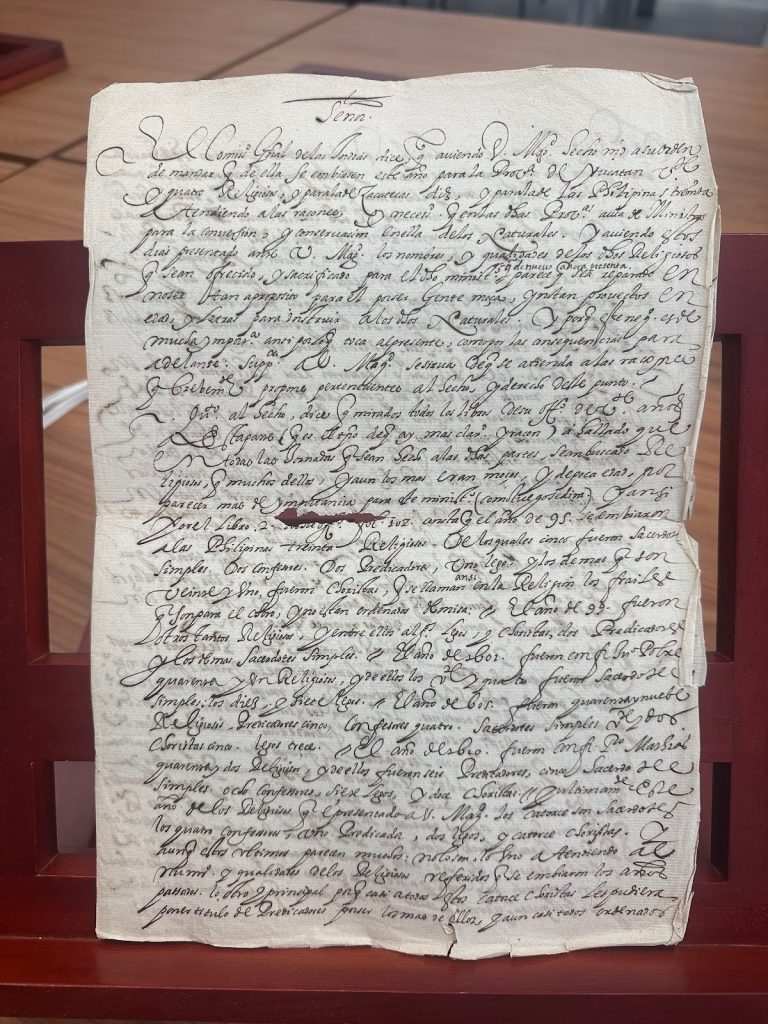
Next, I started assisting with a digital humanities project at Lancaster and Tecnológico de Monterrey called “New Spain Fleets.” This is an interdisciplinary project, and the main “data” is handwritten Spanish-language historical documents from the colonial period (1500s-1800s)– in effect, mostly ship logs! The project’s goal is to study maritime dynamics between Spain and its principal colony, New Spain (modern-day Mexico). There are three branches of investigation: leveraging Handwritten Text Recognition (HTR) for colonial paleography, applying NLP for automated annotation, and highlighting particular case studies.
Here, my role has been within the first two branches of investigation, supporting the auto-transcription and auto-annotation processes. I’ve also been able to attend the weekly team meetings for this project, which has been both instructive and inspiring. As a double major between history and linguistics, it’s been wonderful to use my linguistics training on this project in furtherance of historical research. One very exciting example: the team is currently working to expand HTR for Nahuatl-language documents, and it might be possible to train the model for Maya-language documents as well.
I’ll be continuing my involvement with these projects during the fall, so there is a lot more to learn and look forward to!
Joseph Leisz (CC’28) – Research Intern and Linguistics Ambassador in Ohio
This past summer I had the privilege of working at the Center of Science and Industry (COSI) in Columbus, Ohio through a partnership with the Ohio State University as an undergraduate research intern. As a member of this program, I took bi-weekly classes on continuing my career as a linguist, exploring what a job in academia or industry might look like, and how to make your own path and build connections in this atypical field.
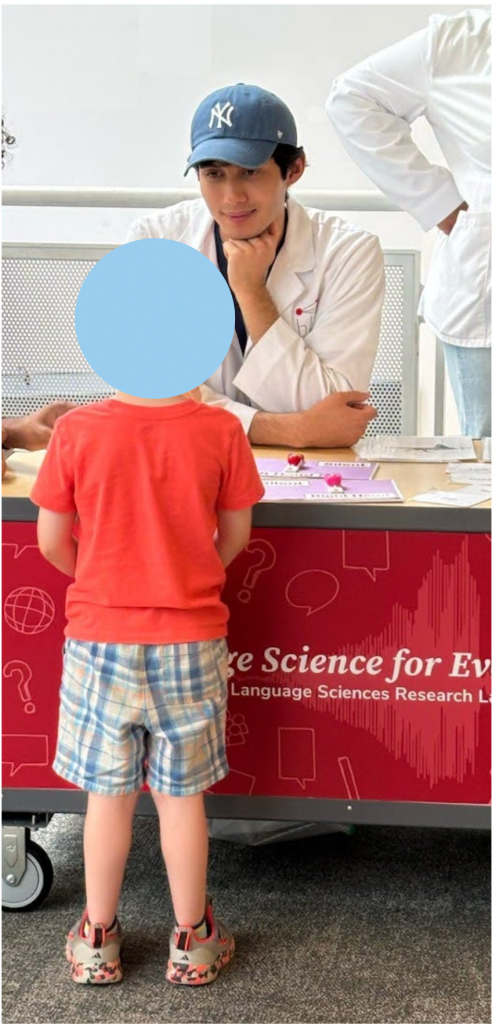
Alongside these classes, I also spent numerous hours each week working at COSI as part of the “Life” exhibit! I and other interns interacted with passing guests, educating them on different elements of linguistics. Through the lens of dinosaurs, foreign languages, and games, we explained things like morphology, phonology, and orthography in ways that were fun and accessible. My favorite demo was titled “Dinosaur Morphology”, a demo utilizing the morphological complexity of dinosaur names to explain compounding morphemes. In the demo, we would explain how dinosaur names explain attributes and behaviors of dinosaurs by putting together roots from different languages:
- Ex: “Triceratops” = “Tri” [Three, Greek] + “Cerat” [Horned, Greek] + “Ops” [Face, Greek] = “Three-horned-face”.
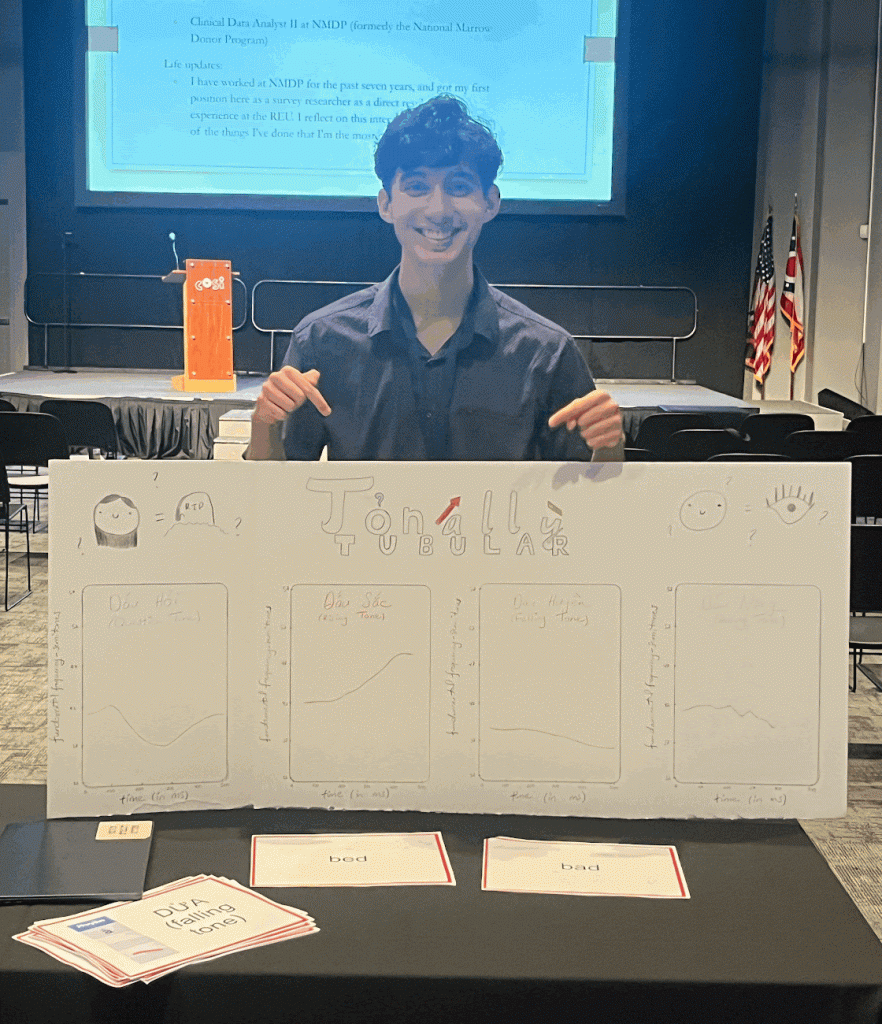
For many children and their parents, this was their first time learning about what “Language Science” or linguistics really is. Through this demo, children learned how words can be broken down into smaller parts that work together to create meaning. Kids even started to make connections in their own daily lives, noticing roots in other words (ex. tri- in “tricycle”). After enough practice performing past demonstrations, we interns also had the opportunity to make our own demonstrations! My demo, “Tonally Tubular” was focused on highlighting the productivity of tones in tonal languages.
Besides giving presentations, we interns also worked on several different research projects. In this program, each intern was assigned to a different project concerning linguistics, developmental psychology, or the intersection of these disciplines. Interns collected data for projects using COSI’s floors as a recruitment area. In my project, I surveyed visiting families on their understanding of kin term use and meaning, interviewing both children and parents on how well they knew their family relations and what they called them. The data my team collected was then compared to data from young speakers of Yeli Dnye, a language from Rossel Island, Papua New Guinea, with over 50 kinship terms (English has about 15), who were asked the same questions. Our project sought to answer the question of whether US children would perform as well as Rossel Island children if we simply used updated survey techniques.
As a whole, this program not only provided me my first foray into real research, helping me to develop the skills to be a useful member of a research team, but also gave me a newfound appreciation for the work of science educators. As I continue my linguistics journey at Columbia, I’ll remember the interest and curiosity that I fostered among museum-goers, and how exciting it can be to share my love for language with others.
Lily Safire (BC ’26) – Fulbright Language Immersion in Kenya
Hi! My name is Lily Safire and I’m a Linguistics major in my final year at Barnard College. This summer, I participated in the Fulbright summer Swahili program in Kenya, after two years of taking Swahili at Columbia with Professor Abdul Nanji. I think learning language in the classroom setting has many benefits, but I was also interested in a potentially more immersive environment, which the program offered.
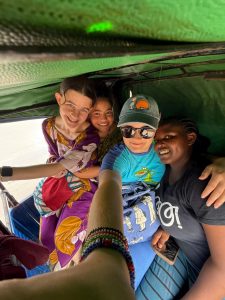
I had taken a semester off of Swahili because I was abroad spring of 2025 in Cuba, so I was a little bit apprehensive about taking on the intensive program, not knowing if my Swahili would be up to snuff. But I am more than glad I ended up deciding to go on the program. The eight weeks in Kenya were incredibly enriching, and I learned more than I ever could have hoped for. The program not only taught the Swahili language, but also went into depth teaching about Swahili culture and about the many other cultures and peoples that call Kenya home. In our first three weeks in Nairobi we focused a lot on Kenya as a whole, and our curriculum highlighted the various ethnic groups of Kenya, the Kenyan economy, and the school system. Then when we moved to Kilifi, a smaller town on the Swahili coast, our curriculum became more centered around the Swahili culture, learning lots not only about the language, but also its people, history, food, music, and so much more. And all of it was taught, of course, in Swahili!
Although we learned a lot of interesting things in the classroom, we also went on many excursions, some more for fun, others more educational, but all incredibly enriching. Whether it was driving through the game park on our trip from Nairobi to the coast and getting to speak about all the amazing animals we were seeing, or walking through the Gede Ruins, a famous Swahili historical site, the program always found a way to boost our Swahili language skills even outside of the classroom.
Attending this Group Study Abroad in Kenya was truly an amazing experience, and it has changed not only my Swahili speaking skills, but has also greatly improved my cultural competence and knowledge. If you take Swahili, I’d certainly recommend this program , but whatever language you may take here at Columbia, I strongly suggest looking into all the abroad programs and experiences offered (semester or summer!) as they may be truly life changing 🙂