Join the Columbia Linguistics Program for our Fall Dressler Colloquium!
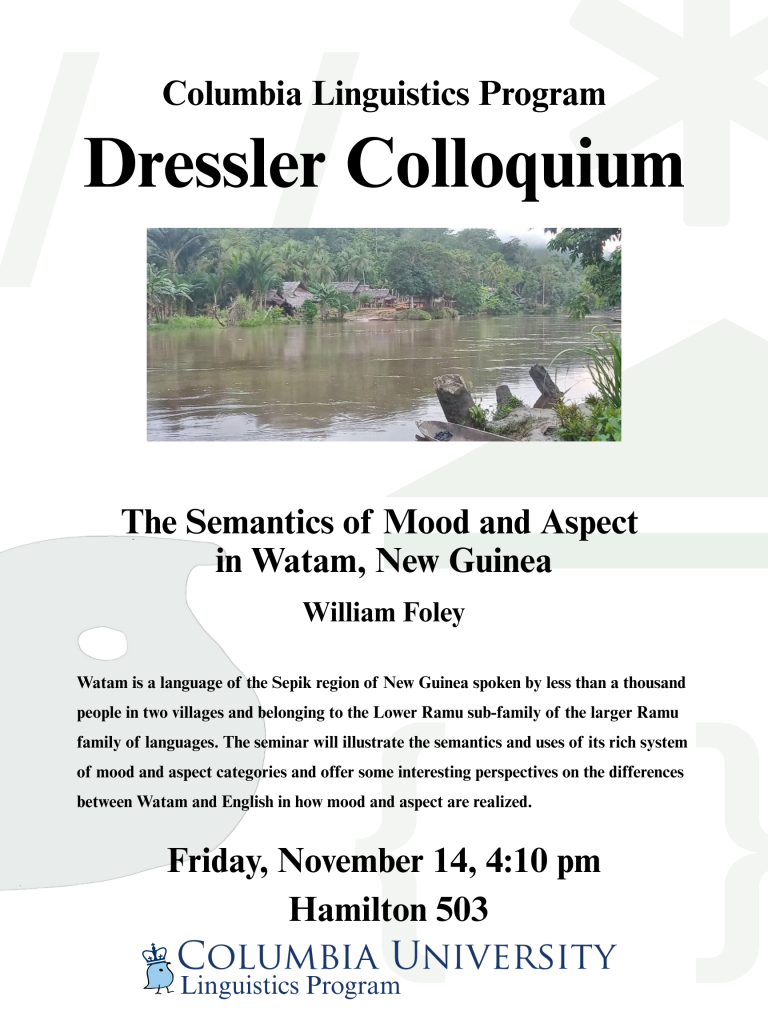
Friday, November 14, 4:10 pm, Hamilton 503
The Semantics of Mood and Aspect in Watam, New Guinea
William Foley
Watam is a language of the Sepik region of New Guinea spoken by less than a thousand people in two villages and belonging to the Lower Ramu sub-family of the larger Ramu family of languages. The verbal inflectional systems for tense-aspect-mood in all Ramu languages are dominated by a mood contrast between realis and irrealis events, i. e. between those which have occurred or definitely not occurred versus those which have not yet occurred and remain potentially unrealized, and Watam is typical in this regard. However, beyond this, Ramu languages typologically differ as to whether their verbal inflectional systems are tense dominant, indicating the time of the reported event deictically on a timeline with respect to now, the moment of speaking, or aspect dominant, indicating the nature of the temporal unfolding of the reported event, whether completed, ongoing or of current relevance. Watam belongs to the latter type. While it does possess a single tense marker for past tense, verbal inflectional options are heavily skewed both formally and in use toward aspect. The language possesses distinct inflections for six contrasting aspectual categories, including a crosslinguistically unusual distinction between perfect and perfective aspect. The seminar will illustrate the semantics and uses of this rich system of mood and aspect categories and offer some interesting perspectives on the differences between Watam and English in how mood and aspect are realized.