The first History in Action Project Awards (HAPA) were announced in September. Here, we catch up with the three inaugural winners to find out more about their projects, continuing with third-year doctoral candidate Katy Lasdow.
Katy Lasdow is a doctoral student focusing on waterfront buildings and infrastructure in early American port cities and around the Atlantic World. Prior to Columbia, Katy worked as a Research and Education Assistant for the White House Historical Association, was the Sally Kress Tompkins Fellow with the Historic American Buildings Survey, and conducted architectural research and fieldwork for the Colonial Williamsburg Foundation. Currently, Katy is using a HAPA grant to fund her work as a Research and Content Assistant with the Brooklyn Historical Society’s “Waterfront” exhibit.

(Source: brooklynhistory.org)
Q: How will you be using your HAPA grant?
I am working with the Brooklyn Historical Society (BHS) on their upcoming exhibit “Waterfront” opening at BHS: DUMBO inside the Empire Stores warehouse in Brooklyn Bridge Park. When renovations to the Empire Stores are completed, they will include the headquarters for the home decor company West Elm, retail, dining, and about 3,000 square feet of exhibition space for BHS.
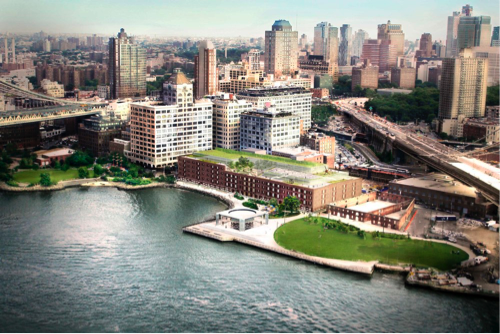
Proposed rendering of the Empire Stores, Midtown Equities (Source: meqs.com)
The exhibit traces the local history of Brooklyn’s waterfront, while also incorporating the site’s global significance to people, cultures, and markets around the world. Over the Stores’ 120-plus years of existence, they have held goods ranging from “venomous reptiles” and “wild horses,” to bags of seed and coffee. The Stores were also home to moments of labor unrest and solidarity among waterfront laborers. Today, the site offers an important opportunity to talk about contemporary issues of climate change and sustainable development in urban areas.
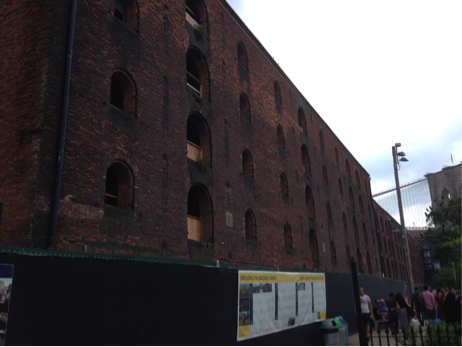
Empire Stores undergoing renovations, August 2014 (Source: Katy Lasdow)
With the support of the HAPA grant, I conduct research in BHS collections and other archives for materials related to the Empire Stores. Under the supervision of Julie Golia (Director of Public History, Columbia PhD) and Kate Fermoile (Director of Special Projects), I’ve traced the experiences of an Irish immigrant family who lived near the waterfront and worked at Empire Stores. (The father, Michael Harkins, was killed on the job when a bag of seed he was hoisting slipped and fell on his head!) I’m also involved in meetings with the Project Team—a group of historians, curators, designers, and other scholars—to develop exhibit content. My next research project involves tracing the growth of transportation along the waterfront. Ferries, tugboats, streetcars, trains, you name it.
Q: What organizations are supporting or sponsoring this project?
This project has been a great opportunity to see how the museum and design worlds support each other in New York. At BHS, we’re working with the Pure+Applied design studio to create the exhibit space. One of the most exciting aspects has been to brainstorm ways to incorporate the entire gallery (floors, walls, bathrooms, exhibit displays, visitor services spaces) into our larger story of the Empire Stores and Brooklyn’s waterfront. Each time we meet, the exhibit shifts into clearer focus. It’s fascinating to watch it unfold.
We have also been working closely with Brooklyn Bridge Park. (The Empire Stores are located immediately adjacent to Jane’s Carousel on the Empire/Fulton Ferry lawn.) Since this is an exhibit about the waterfront and the larger urban landscape, it’s important to craft a narrative that can extend outside the gallery. In the coming months we’ll be solidifying ideas for how we can incorporate BBP’s efforts toward sustainable urban design into the “Waterfront” project.
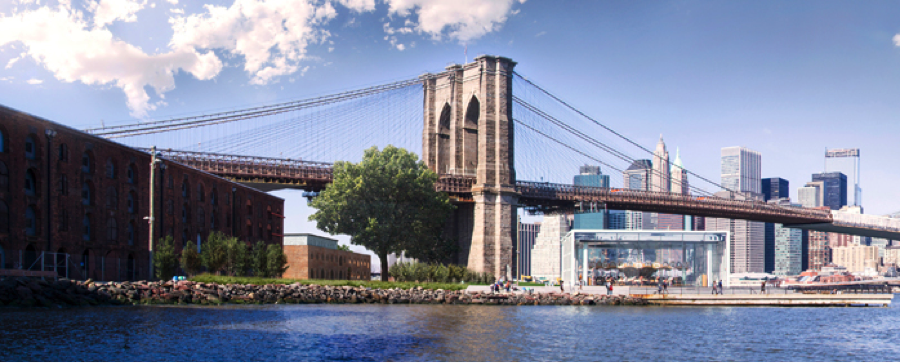
The Empire Stores, Jane’s Carousel, and the Brooklyn Bridge
(Source: stannswarehouse.org)
Q: What opportunities for “community outreach” (as it is described in the HAPA grant) do you envision?
In nearly all conversations I’ve had with the “Waterfront” team, community outreach has remained at the center. Not only is this project committed to creating an exhibit that people of all ages will enjoy, but it’s also concerned with crafting a story of Brooklyn’s growth and change that places the waterfront—its people, its transformations, its ecology, its contemporary relevance—at the heart of the experience. We want to encourage visitors to include the Empire Stores in their weekend outings to Brooklyn Bridge Park. We want to help New Yorkers and tourists understand how the waterfront has been (and continues to be) central to the tale of how the city functions both structurally and ecologically. And, we want to include the Empire Stores in a larger conversation about historic preservation and sustainable design. History is the product of human action, so we’re constantly thinking about the involvement of the community in our long-term vision for the exhibit.
Q: How does this work connect to your research at Columbia?
My dissertation focuses on the intersections between urban improvement projects, political authority, and the rise of capitalism in early American port cities and around the Atlantic World. I’m currently working on a project that examines the Charles Bulfinch-designed India Wharf and Broad Street developments in Boston from about 1800 to 1820. In the coming months I’m hoping to explore waterfront improvements occurring simultaneously in other cities (Savannah and Philadelphia, for instance). I’m interested in how larger social and economic goals are reflected physically in the buildings, structures, and urban spaces individuals have constructed to support and expand trade and commerce.
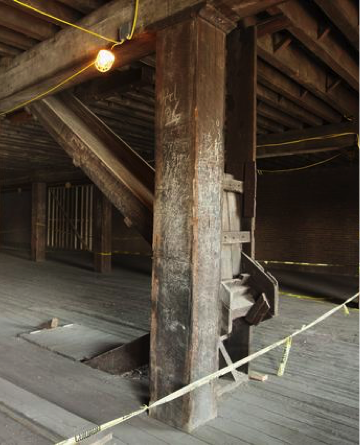
The Empire Stores are built at the tale end of my research interests—in the post-Civil War urban landscape (c. 1870). Their construction reflects a moment in which the global economy has solidified in earnest and connects cities and cultures around the world on a monumental scale. The Empire Stores also show us how urban warehouses come to follow a standardized pattern of design and use by the late 1800s. And, on a more visual level, there’s just something so striking about that industrial aesthetic. Exposed brick, massive beams and joists, pulleys, and cast iron hooks. They don’t build them like they used to.
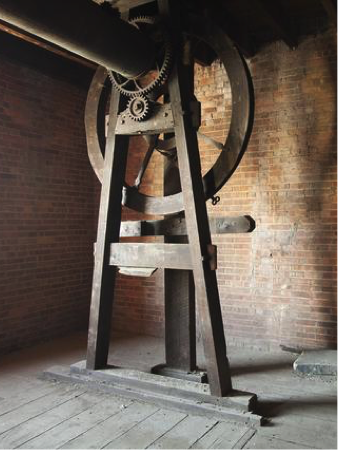
Coffee chute and pulley inside the Empire Stores (Source: Gothamist)
Q: What drew you to this particular project, as you proposed it?
In 2013, Julie Golia (Director of Public History) contacted me to help rewrite BHS’s building tour, “This is Brooklyn.” Over the course of that year, it became clear to me that BHS maintains the scholarly integrity of a library and archive, while constantly pushing the boundaries of how historical societies can make history meaningful to present-day audiences. Often this involves being willing to confront tough, controversial questions of race, inequality, and gender through mindful attention to historical context and contemporary sentiment. Other times, this involves thinking creatively about how to link the past and the present through speaker series, film screenings, or food tastings. In both cases, I was hooked. This past summer, Julie and I discussed ways that I might get involved with the “Waterfront” project. The HAPA grant for this project emerged from there.
Q: What drew you to the idea of “History in Action” more generally? What does “History in Action” mean for you?
At its core, I think “history in action” means an opportunity to move research from the written page to a more tangible, experiential medium. For me that has been museum exhibits, historic preservation, and face-to-face collaboration and conversation with museum professionals and individuals interested in the history of their city or neighborhood. But it doesn’t necessarily have to conform to this model. One of the great things about Columbia’s History in Action program is that it allows graduate students to explore many possible avenues for their chosen career path.
I’ve been very fortunate that “history in action,” what some might call “public history,” has been a part of my training as a historian since my years as an undergraduate at the College of William and Mary. I’ve always been fascinated by the diverse possibilities of the history profession—which I think has a lot to do with going to college on the edge of Colonial Williamsburg. After some time spent working in various sectors of the “public history world,” I decided I wanted to cultivate connections between the academy and the public more fully in my own work.
Q: What do you hope to accomplish in the course of your HAPA grant work? What are your (and your partner organizations’) larger goals for the project?
My biggest goal is to see the “Waterfront” exhibit to the finish. I’m excited to see how the project unfolds this spring and summer. I’m also hoping that the HAPA grant will allow me the opportunity to think more broadly about possible research avenues for my dissertation and potential career options down the road.
Q: Any final thoughts?
Thanks to the Department of History at Columbia University, particularly those faculty members and student leaders involved in getting History in Action off the ground; to my advisor, Betsy Blackmar, for her constant encouragement of my work outside the department; and to the Brooklyn Historical Society—Julie Golia, Kate Fermoile, and Deborah Schwartz—for supporting graduate student input in this project. This has been a fantastic experience and I’m grateful for the chance to participate!