Ali Moughania

(Doctor of Philosophy, Columbia University in the City of New York)

Ali Moughania

Archives for Blog

Symmetric Dignity: What Do the Rise of Digital Superintelligence, US-China relations, and Resisting Israeli Occupation of Lebanon Have in Common?

Copilot’s Artistic Depiction of a Future with Superintelligence


Humanity may soon confront forms of intelligence that exceed ordinary human cognitive capacity as dramatically as humans exceed other species. Whether such systems emerge through artificial intelligence, bioengineering, or something less predictable, is secondary to the ethical and intellectual history thought experiment at hand. This essay is less an empirical intervention than an exercise in ethical and intellectual history across multiple domains of asymmetrical power. In a word, dignity is the ethical constraint that must govern asymmetrical power. Historically, this is also the advisable approach to minimize damage and maximize chances of prosperity on the world stage.

Before getting riled up over artificial intelligence definitions, keep in mind that I am dealing with these real categories as thought experiments more than anything else. That is, the precise definitions used or being coined by AI experts are of less relevance than the function any given category takes on. The contemporary cultural discourse surrounding UAPs provides a useful thought experiment for reflecting on radically asymmetrical intelligence. Let’s imagine that at least some phenomenon associated with contemporary UAP discourse –– recently acknowledged as worthy of official attention by the U.S. government –– are attributable not to little green men, but to forms advanced artificial or non-human intelligence. In other words, as an exercise in thinking about how such intelligence makes a difference in our day to day lives, the so-called “non-humans” might as well be some form of AI that has gotten out of hand. But that is not the entire story.

Some of these so-called “non-humans” may be no more than advanced tools in the hands of creatures like humans, extensions of their intelligence, similar to how advanced weapons extend typical human beings. If they are relatively independent, they are too basic to threaten the most advanced human intelligence in the long run (at least, we may assume so, for now). When I write “no more than advanced tools,” I do not mean to downplay the threat these things may pose, as they can be as or even more dangerous than weapons of mass destruction, biological or nuclear weapons, etc. They definitely require human vigilance, safety measures, proactive deterrence planning, and the whole shebang. But compared to the next category, these “manageable non-humans” (or manageable AI, for that matter) are child’s play.

You see, the other, much more dangerous, “aliens” that may be in the mix, may be in the background watching, or may arrive at some time point, sooner or later, are not merely capable of making their own decisions at a level of freedom humans typically think is uniquely human, but are also able to outsmart humans at accelerating levels beyond the human intelligence and AI intelligence that is still under human control (with the exception of a Divine intervention of sorts, if you adopt a religious worldview). These non-humans are not the “manageable non-humans” of the earlier category but “superintelligent non-humans.” To use an analogy, the relationship between “superintelligent non-humans” (or Digital Superintelligence, for that matter) and humans, is like the relationship between humans and ants, where the intelligence gap can grow exponentially, even if communication between the two is possible at some level. If “superintelligent non-humans” passed by, they may or may not want to interact, similar to how we may or may not want to interact with ants, squirrels or other creatures that barely represent any serious threat to us.

Granted, these “superintelligent non-humans” may already be out there. Perhaps we are not actually enabling the rise of Digital Superintelligence by uninhibited AI development ––maybe that superintelligence already exists, maybe it has been around long before we arrived. But what if we are the first to be bringing it about? Should we be doing so? The stakes are so high that they would seem to trump any human conflict and should override any ethical consideration in order to ensure the survival of humankind. On the other hand, rogue human actors on Earth (or underground) ––let alone other non-human creatures in the cosmos ––may continue to enable the rise of “superintelligent non-humans” even if the vast majority of Earth’s leaders agree that such technology must be forbidden. So why not take our chances with giving birth to a form of “superintelligent non-humans” that was at least potentially under human influence (at first)? Or come as close as possible to the threshold of losing control in order to maximize our chances of developing “manageable non-humans” that could potential help us in a fight for survival against “superintelligent non-humans” (whether home-grown or visiting us from elsewhere in the universe)? Either way, you have a right to understand the stakes, exercise your judgment and make your mark on the world before it is too late.

Regardless, it may be reassuring to keep in mind that humanity’s intellectual history has been no stranger to the equivalent of either type of “non-human,” the “manageable” or the “superintelligent,” albeit recognizing these historical precedents requires a bit of a mindset recalibration. In some religious and philosophical traditions, for instance, God Almighty is the ultimate superintelligence ––not merely benevolent, but beyond any conceivable deficiency in existential excellence. Angels, in the portrayal of some holy scriptures, such as the Quran, are benevolent as well, albeit limited in ability and agency. Demons, on the other hand, may (debatably) appear (perhaps deceivingly) to have superior intelligence in some respects, relative to ordinary humans, but are forces of evil to be guarded against. Prophets and chosen Imams or saints (depending on one’s worldview) are also believed to have, or have access to, benevolent superintelligence in ways that far exceed the abilities of other human beings. The distinct features of Divine superintelligence are not only believed to have theological implications for worldview subscribers, but also historically provide an epistemic framework of security when human societies confront existential, non-human asymmetries. For instance, just as theologians have long discussed the differences between things like miracles, “sorcery,” and human technological feats, they would likely explain superior non-human intelligence within existing categories (e.g. extensions of angelic or demonic forces), or otherwise part of a master test/simulation by the absolute, Divine superintelligence. The point here is not that religious narratives must be adopted in order to address the intellectual challenges ahead, but that civilizations have historically used such frameworks to reason about asymmetrical intelligence, hidden causality, moral agency, and existential vulnerability. These analogies can, at least, enrich our intellectual imagination and vocabulary as academics, professionals, and as thinkers more broadly.

In the Islamic tradition, the biblical prophet Solomon is said to have understood the communication of ants and communicated with other animals (Qurʾān 27:18-22). Taken literally, these capabilities may have contributed to thought experiments regarding the limits of what was conceivable (directly) via miracle or potentially achievable (gradually) via technological mechanisms. Figuratively, however, the role of Divine intervention (i.e. through a prophet) to bridge vast power and intelligence disparities was clear. The biblical prophet Moses, despite his exalted status among prophets, is said to have lacked the patience required to initially understand some of the hidden wisdom behind Divine interventions by the mysterious righteous servant (Qurʾān 18:65-82), known to the tradition as the “Green One” (al-Khiḍr). Whether taken literally, executing God’s will much like other forces of nature such as the wind and rain, or figuratively as a symbol for such natural forces in God’s greater wisdom, even the great prophet Moses is portrayed as having something to learn about God’s day-to-day interventions in the world. Reflecting on this traditional story, in particular, draws attention to the contrasting layers of responsibility even among those working on the same benevolent team (i.e. ‘God’s team,’ if you will), even though each of them may be deemed impeccable while staying “within their lane.” A confrontation with “non-human intelligence,” whether “manageable non-humans” or “superintelligent non-humans,” and whether “invoked” by human actors or entirely non-human in origin, can arguably fit within the molds of such preexisting religious narratives.

But merely being able to readily come to terms with new data does not absolve one, religious or not, of the moral duty to assess the stakes, take a stance, and raise awareness. Every decision being made, whether by the leading tech companies, law enforcement, or an amateur techie in a basement on Mars, is consequential when the stakes include potentially “summoning” what earlier civilizations or religious frameworks might have described as a “demonic” intelligence––or what we might today call a superintelligence “misaligned with human dignity.” The extent of our willingness to give up personal freedoms in order to safeguard humanity as a whole invites our collective contemplation and demands our utmost vigilance. What is at stake here is not merely the physical survival of humanity, but the dignity of humanity’s survival. An evil superintelligence may choose to rid the world of humans altogether, but might also choose to enslave humanity, allowing them to maintain physical existence, while depriving humans of their God-given freedoms. The default dignity we expect for every fellow human being (for being human) is at stake, let alone the context-appropriate/symmetric honoring of dignitaries by their counterparts and others.  

Whether confronted by a seemingly all-powerful digital mind or an overwhelming earthly superpower, the call of one’s conscience is the same ––resist subjugation while strategizing for the actualization of higher ideals, a reality that historically compels a committed minority to wage a protracted material struggle for survival. In this sense, the dignity question is the common denominator for multiple arenas of short-term, mid-term, and long-term conflict. From the resistance of Israeli occupation in southern Lebanon, to the push for a symbiosis between the US and China to minimize damage on the world stage, to the need for a vigilant approach to Digital Superintelligence, intelligence and goodwill demand the reining in of power while pursuing a dignified peace.   

Lebanese civilians from across the political spectrum have resisted Israeli occupation since the early 1980s, followed by successive withdrawals. Many may not know that the spectrum of such resistance ranged from Lebanese leftists and communists, to pan-Arab nationalists, to Islamic-minded frontiersmen and villagers who were displaced from the ancestral homelands. Those operating within the secular-nationalist and Marxist lineages of the region typically recognize the history of colonialism and regional authoritarianism that included today’s Lebanese borders as well as neighboring countries, but they demand their sovereignty be respected as part of the status quo guaranteed by international law for all member states. For those who are biblically-minded in their narratives, Muslims and Christians alike, they view themselves as the rightful heirs to the legacy of biblical prophets such as the prophet Abraham, Isaac, Ishmael, and Jacob (Israel), each seeing themselves as upholding the ethical imperatives of that covenant (often in direct opposition to its ethno-nationalist rendering by modern Israeli Zionists).

Prompted by massacres, deprivation of freedom, and instability, the few but well-remembered Lebanese freedom-fighters, were willing to give up their lives in order to send a symbolic message, and to expedite an Israeli withdrawal that they believed to be inevitable. Justified acts of self-defense and unjustified acts of terrorism both find their ways into narratives of armed struggle against illegal occupation. That, perhaps, is not surprising. However, ignoring the underlying cause is arguably what perpetuates a cycle of unbridled violence. Unless human dignity is restored and honored, resistance to occupation will likely continue to whatever end each group justifies in its corresponding ideology. Based on this natural inclination, coupled with Lebanon’s recent history and the interests of regional powers, the notion that compromise will occur in Lebanon ––without such a bare minimum of dignity being restored first ––is delusional. In other words, so-called “peace talks,” without a true cessation of hostilities and honoring of agreements, are unlikely to produce durable stability and can potentially backfire into more intense hostilities.

Many regional, and global, powers with interests at stake would seem to be willing to support, and a sufficient number of determined, well-organized, Lebanese groups with overlapping interests, would appear to be willing to perpetuate resistance. That combination is precisely why the current US policy of supporting Israeli expansionism appears strategically unsustainable, insofar as unresolved asymmetries of power and dignity tend to reproduce cycles of resistance rather than durable stability. (But perhaps that is precisely the point: for some decision-makers, this is less an exercise in rational state strategy than an example of institutional capture, serving the short-sighted interests of a few who profit from unnecessary wars while disenfranchised populations suffer the consequences thanks to taxpayer dollars.) Others may argue that disproportionate use of force, unconstrained technological acceleration, or amoral military dominance are regrettable but expedient features of so-called “survival” in an anarchic world system. Surely, the combination of human and AI-powered intelligence can come up with a more ethically-sound way to prosper. Peace in the Middle East can arise from the balance of immediate concerns with strategic interests that remain subject to the dignity human beings are entitled to. Crucially, a lesson of these geopolitical standoffs ––whether between the US and China, other world powers, or localized occupations ––is that unchecked dominance, subordination that is inharmonious with the dignity of people, yields instability. The strategic logic behind AI alignment also applies to geopolitics. Economic interests, political influence and legacy perpetuation must be subject to that “constraint” of conscience for the same reason we instinctively want superintelligence to be aligned ––not merely for the sake of our survival in perpetuity, but for a symmetric sense of dignity in the face of power asymmetry. Moreover, stable systems emerge when power is refined by context-appropriate recognition of dignity.  

Perhaps you have more questions than answers now, in a good way, and for good reason. Let’s not assume something is inevitable before it truly is ––let’s not sell ourselves short. Please do not blame me for the (hopefully) gentle wake-up call… In the reported words of Imam Muḥammad al-Jawād (d. 220/835), whose commemoration coincides with this day in the hijrī calendar, “Your enemy is one who hides the truth you need to hear in order to follow your whims.” (Ḥusayn ibn Muḥammad al-Ḥalawānī fl. 5th century AH, Nuzhat al-Nāẓir wa Tanbīh al-Khāṭir, 134). To only be told what we want to hear in the age of social media algorithms is just the beginning, unless we reclaim our dignity more consistently going forward.


Why Don’t They Just “Surrender”?

Pope Francis and the Grand Ayatollah Sayyid Ali Al-Husayni Al-Sistani in Iraq in March 2021 (photo from https://www.vaticannews.va/en/pope/news/2023-03/pope-francis-ayatollah-al-sistani-message-anniversary-visit-iraq.html)


This post should be of relevance to both decision-making public officials as well as to members of the general public who are concerned about the safety of American service personnel. I usually would not have weighed in so soon after an earlier post, but the gravity of what is at stake as well as the relative absence of this perspective in the most widely accessible media coverage (as far as I can tell) pushes me to make an exception. The fact that the Senate and the House both voted (for the most part) along party lines when there was an opportunity to express bipartisan objection (or at least reservation) regarding needlessly putting American armed forces in harm’s way is another cause for urgency. As a footnote, although such votes arguably do not precisely represent the electorate that brought them to power, those members of congress who have failed to live up to their moral and civic duties are becoming complicit to the extent that they are unexcused in enabling the crimes being committed (try justifying that to the American people and the international community though ––come November, we remember). Back to the point of this post: if the Iranian military has been so severely damaged by American tax-payer military might, why don’t they just “unconditionally surrender” already, as the current President has been hoping? Is this a matter of time? Or is there a deeper analysis of what is going on here? I specialize in understanding the ideological foundations for the religiously-trained personnel in question ––it is more complicated than you might assume.

Of course, specializing in Middle Eastern Studies, particularly in the Intellectual History of its diverse Muslim or Islamic populations, does not automatically mean a specialization in the ideology of the Islamic revolutionary guards, for instance. But there is such a significant overlap in what I will be referring to justifying the extended specialization area. In other words, this applies to various iterations of Muslim thought, not merely in the iteration specific to the Iranian Islamic revolutionary guards. For a more detailed discussion, a specialized session or course would be in order. But as an executive summary of sorts, consider the following. Muslim thought, including Twelver Shia Muslim thought, includes a number of historical precedents that have been taken as authorizing different forms of expressing dissent, depending on the circumstances. These are thought to have biblical or more innately human origins, have been documented in the holy book (and miracle claim) of Islam, the Quran, as well as in reports of early Islamic history. But traditional scholars of Islamic thought disagree in the synthesis of these different cases, in the resulting emphases, and, perhaps most crucially, in the transparency of applying them to changing circumstances.

For example, the historical precedent of concealing one’s faith when prevailing circumstances are unsafe, only expressing one’s views with careful discretion, exists in Quranic references to “a man of faith from the House of Pharaoh who was concealing his faith,” (40:28), as well as the Prophet Muhammad’s companion Ammar ibn Yasir (16:106). This sort of a precedent would not only justify an avoidance of military confrontation but even of expressing dissenting views in some cases. The Prophet Muhammad reportedly avoided the use of physical force for several years in the beginning of his mission, despite being personally harassed and disrespected (traditionally understood to be part of his mission in demonstrating patience and the higher moral ground unless death were to be deemed inevitable). In this period, he was, however, vocal about his views, delivering a message that he said was in line with that of biblical prophets sent to the Israelites, and even Jesus Christ, but he claimed that those earlier messengers had been misrepresented over time, regardless of intentions (thus explaining some disagreements with Jews and Christians of his time and subsequently). It is said that he only left his hometown, Mecca, under the threat of assassination, after his uncle and influential protector from hostile clansmen had passed away. Moreover, the Prophet Muhammad’s grandson, known to Twelver Shia Muslims as the second Imam, Hasan, reportedly accepted a cessation of hostilities agreement with Muawiya ibn Abi Sufyan, not because he trusted his judgement or honoring of the potential agreement, but because of a multidimensional calculus of long-term community interests coupled with the unreliability of his own soldiers at the time.

On the other hand, defensive measures with a spectrum of passive to more proactive expressions, similarly have historical precedents. For instance, the biblical Prophet Moses is described in the Quran as having come to the aid of a fellow in faith, using physical force (28:15). The Prophet Muhammad and his followers were given permission to fight in self-defense due to their forced migration from their hometown and/or to deter further harm being done to their freedom of public religious expression (22:39). They were commanded to fight, despite hating it, to deter aggressors from seeking to annihilate them (e.g. 2:194; 2:216; 4:84). Perhaps most crucial for the purpose of deterrence, they were ordered to prepare, proactively, whatever means of force that might be effective in order to deter “God’s enemy and your enemy” (8:60), leaning toward peace when possible, while being vigilant of potential deceit. The Imam Ali, first Imam to Twelver Shia Muslims, and fourth caliph to Sunni Muslims, took up arms in order to defend his administration against civil unrest after having been acknowledged as caliph by the masses (in addition to Prophetic appointment, according to Shia Muslims). In Shia tradition, he is said to have opted for patience and minimizing damage to the nascent Muslim community up until then despite being the rightful (immediate) successor to the Prophet Muhammad. The Prophet’s grandson, known to Twelver Shia Muslims as the third Imam, Husayn, was reportedly forced into a standoff with forces under the command of Muawiya’s son Yazid, in which he was given one of two options: surrender in disgrace, or fight to the death while being vastly outnumbered ––i.e. face guaranteed death; he and many loyal companions alongside him chose the latter, not to “die” but to be martyred in the way of God.

Islamic history beyond those early precedents is filled with examples of prominent Muslim figures who chose the path of one, the other, or both, precedents, depending on their outlook and/or circumstances. For instance, according to Twelver Shia Muslims, their Divinely appointed Imams after Imam Husayn generally avoided direct confrontation with ruling authorities. They were often accused of plotting against the authorities and their sudden deaths have been believed to be caused by poisoning assassinations, but with the exception of their 12th and awaited Imam (i.e. the Mahdi) who is anticipated to potentially take up armed struggle for world justice, the other post-Husayn Imams did not directly take up arms against Muslim rulers. That being said, it is suspected that they indirectly endorsed or at least tolerated some of those who did take up arms against their oppressors, such as Zayd ibn Ali ibn Husayn, who is arguably respected by Twelver Shia Muslims but not viewed as an Imam in the same sense as the 12 Divinely appointed Imams whom they hold in exceptional esteem. The way such history is read is important to consider when assessing how pragmatic it would be to entertain forcing an organized, ideologically-oriented, Muslim group into “unconditional surrender.” Consider the following synthesis attempts as thought experiments.

Synthesis A: The Last Stand Model

            Some Muslim scholars might argue that the position taken up by Imam Husayn, for example, is a model to be followed whenever possible. This was not suicide, but well-calculated martyrdom, meant to rejuvenate the community’s spirit in the long-run, deterring enemies in the process. His brother, the Imam Hasan, would have done the same had he had even the few loyal supporters that the Imam Husayn had. Subsequent exemplars of Muslim leadership who fell short of this standard, similarly, only did so because they did not have the quality of supporters who would make the sacrifice meaningful as a test of faith. That is, they had to prioritize training such followers instead of merely sacrificing themselves before passing on. They might superficially acknowledge a tyrant, or desist from resisting arrest or the like, but this should be understood as a temporary regrouping, only until the baton can be passed on for the ultimate sacrifice, not a “surrender” of moral ground. Such thought arguably yields a perpetual posture of resistance, only hidden at times, but forever attempting to surface when possible. So long as a loyal group of such supporters exist, the resistance can potentially continue perpetually with no “surrender,” even if they are all killed ––justified by going down in history to be remembered as “martyrs.”

Synthesis B: The Strategic Discretion Model 

            Other Muslim scholars might argue that the path of martyrdom chosen by Imam Husayn, for example, is only a model to be followed in exceptional circumstances, perhaps only justified by the assessment of someone as ideal as Husayn himself. The exception of the Imam Husayn exists not to be encouraged as a standard but to reinforce the actual standard indirectly, which is to navigate life with careful discretion (instead of sacrificial confrontation). In this synthesis, what may be perceived as a quietist approach is the general posture expected of a Muslim. It is not “surrender” to evil per se, but it is wise discretion for the purpose of a long-term strategy. The practice of the post-Husayn Twelver Shia Muslim Imams would appear to support this general posture. A Muslim with this outlook would think of the strategic decision as a surrender to God’s wisdom, not to the tyrant, and it is definitely possible to occur in the face of overwhelming tyrannical force. Sure, this still has limits, which are discussed in Islamic law. If the survival of ultimate religious truths and/or the Islamic community’s integrity are at stake, for instance, self-defense is not merely permissible but mandatory. That being said, at times the duty of such defense, to the extent of its utility, might already be being carried out sufficiently by others, in which case not everyone would necessarily be in the defensive posture at all levels. Regardless, in their capacity as Islamic judges, qualified religious authorities could still issue judgements calling for the arrest and/or punishment of those committing crimes against innocents, and these orders would generally be considered binding on all Muslims. Hence, even when an individual may otherwise want to surrender, it could become binding upon him to fight in order to implement that judgment in some cases.

Synthesis C: “Black Box” of Epistemic Reservation (meta-framework)

            Another group of Muslim scholars may acknowledge the strengths of the aforementioned syntheses depending on the circumstances, but refrain from accounting for their own synthesis in a robust manner. There is arguably more to this than merely maintaining a degree of ambiguity for greater interests that may be at stake. In some cases, the ambiguity may be at the level of the synthesis itself, not merely the presentation of it. How so? Depending on the epistemic assumptions of the scholar in question, mystical experiences may play a role in arriving at the certainty threshold required for his assessment of exceptions to the default posture. For those scholars that have a categorical issue with appealing to mystical experiences as evidence, they still might admit a verified encounter with the 12th Imam (or someone on his behalf) to serve the same purpose. Predicting what such scholars and their loyal followers would do when confronted with threats of overwhelming force is not straightforward. It is very possible that they might default to a position that mimics one of the A or B syntheses above in terms of external actions, but have a different internal justification for it. Why does this difference matter? Because in cases with high stakes the “black box” ambiguity they exhibit may be one that is also part of their synthesis itself. A decision-maker who thinks it is worthwhile to “call their bluff,” if you will, may indeed be leaning in to the type of risky scenario creating the desperation characteristic of what may be subjectively experienced as a “mystical experience” or that which functions in a similar fashion. So, would such adherents be more likely to “unconditionally surrender” if they remain true to their Islamic thought commitments? If mystical experiences (or trusted claims to have experienced them or the like) can be artificially engendered, then the conditions for giving the ultimate sacrifice may very well be more likely than “surrender.”  

Which synthesis do the Iranian armed forces adopt? Well, the answer is not so straight forward. There is a fairly common culture among Shia Muslims today that would seem to be driven by Synthesis A. Yet, technically, this may be a conflation of driving syntheses. It would actually depend on the view adopted by the Guardian Jurist (al-wali al-faqih) and/or the Religious Authority (marjiʿ) of each individual service member. “Revolutionaries” would seem to be justifiably stereotyped as adopting Synthesis A, but assessing any religious authority’s views in extreme case scenarios can be tricky. For even when religious authorities write books on these matters, they do not necessarily spell out all variables that determine decisions in the final analysis. If I had to guess, I would estimate that most (living) Twelver Shia Muslim religious authorities, whether affiliated with Iran’s government or not, can be understood as adopting some version of Synthesis C.

The above syntheses are being presented in consideration of the Islamic thought dimension to a given ideology (e.g. in this case, the Iranian Revolutionary Guard). If national or cultural identity and a sense of honor related to sacrifice in defense of one’s homeland are added into the mix, then each assessment betting against “unconditional surrender” is even more convincing.

Call to action: Stop this war immediately before things get any worse, and study, study, study. Not to mention that this is a very costly distraction from the AI safety and policy decisions that are needed to safeguard the future of humanity and human dignity.


What Would Jesus Do? Are you Ready for the Mahdi?

P. 15 of the Dr. Heussane Publication 10 THINGS EVERY CHILD SHOULD KNOW ABOUT GOD


Deciding on America’s interests should not be at the whim of a gut feeling at a late hour of the night, running on too little sleep and probably an upset stomach (Luckily, it is the month of Ramadan, not only Lent, and fasting has been prescribed for physical health, among many other benefits to wellness). This is not about “terrorism” or “weapons of mass destruction” (headline excuses for the invasion of Afghanistan in 2001 and then Iraq in 2003; read: “nuclear weapon or ballistic missiles that can reach the U.S.” for the current 2025-2026 Iran *war(s)*). Make no mistake, there can be silver linings even when the worst decisions in history are made, but that should not cause a rational individual to become delusional about how things should have been decided to begin with, let alone going forward. It should not be about allowing a minority voice within Iran, however amplified by the Iranian diaspora, to “take over their government.” For God’s sake, prioritize the issues Americans want prioritized (e.g. affordability, safety, healthcare, education, etc.) and solve world hunger before trying to overthrow foreign governments. By all means, continue waging the war on drugs––for the benefit of humanity at large––but get the authorization of congress after consulting widely.  

I write as a Middle East Studies specialist but also as a concerned citizen of the United States. Mobilizing the U.S. armed forces should be about securing American interests, at the highest level of multidimensional calculus, upholding a respectable standard befitting of the largest military budget in the world, not to mention the reputation of those forces that is supposed to be maintained in the process. It should include assessments of long-term well-being, moral standing, and (not to be cliché but to be clear) “the golden rule.” Is that what is currently taking place? It does not look like it, not even close. If that is not already obvious to you, you are welcome to make an appointment to discuss it with me, but I am sure you will find many qualified specialists making similar assessments online 24/7. If you do not want to hear it, here is a wakeup call ––in a democracy, we can be held accountable by the people here and now, not merely to God Almighty on a Day of Judgment (depending on one’s personal beliefs).  

Over the past few years, the world witnessed how the voice of protest could not even bring a “democratically elected” leadership to stop a genocide or to muster the will to cease enabling one. Then can such a voice of protest possibly stop an unnecessary military “operation” against Iran? To stop an attempt to bully the Islamic Republic of Iran? Yes, but not because of moral clarity alone. Not because there are no competing narratives and interests. Not because there are no accusations of foul play tossed across both/all sides of the aisle. In the end, grey areas can be artificially created even if they would not genuinely exist without twisting the facts. Rather, the voice of the people can be more impactful now because the ramifications are weightier for the “State of the Union,” for the very fabric of our Republic, which is (supposedly) still the rug underneath elected seats of power (Conspiracy theories aside, however tempting in light of recent revelations).

This is not merely about an appeal to awaken our sense of shared humanity with the innocent lives being crushed across the globe (been there, done that; story of our lives at this point). It is not merely a summoning of our innocent childhood sensibilities of having a conscience and not wanting to be on the “naughty” list. It is far more than that. It is about representation in our Union. It is about various segments of the electorate, perhaps seemingly disconnected at this moment, uniting around a call for saving our American “Republic.” When war is, in effect, declared by the President without the authorization of congress, when diplomacy becomes no more than a front for carrying out an agenda of deception (at least twice), so much so that it is no longer even believable, when American lives are being lost for a façade… It is much more than having the decency to value lives overseas as being no less important than the lives of our pets at home. This is about the chance to save our Republic, if it is not already too late.

What will come first? Will the people rise to the occasion? Will “karma” take its toll before we live up to our civic duty? Both? More? Thanks to the unwise decisions of those in power, the ball is in Iran’s court: our current U.S. administration has decided to throw our armed forces under the bus. That is, the Commander-in-Chief has decided to take the fight to Iran’s home turf, presumably giving them any right to self-defense that we would give ourselves in the safety of our own homes (By the way, countless Americans do not have homes of their own but our government still spends billions of dollars on wars of attrition and worse). But it is not up to the same administration to decide when Iran stops retaliating. “Assassinating” (if we can call it that) their spiritual head of state, who happened to be a religious authority for millions worldwide (not merely Iranians), many of whom would be willing to die avenging him, not to mention killing scores of innocent schoolgirls in the initial strikes, did not help represent the best version of our ideals abroad either. Unless, of course, we actually want foreign nations to think of America as being forever defined by and destined to repeat the ugliest evils of its history (the skeletons in the closet that we like to think we grew out of).

Much to say, much to reflect on, drawing on lessons of the past, and even prophesied traditions of pseudo-Armageddon that are embedded in the psyche of people in this region, but I hope this is enough for now. To give a quick taster, if you will, one of the common themes found in Islamic and, particularly Shia, traditions (the vast majority of Iran’s people are Shia Muslims), is the prophecy regarding the advent of the Mahdi (a messianic figure who is to save the world along with Jesus Christ in his second coming). While devout Muslims are not supposed to rush in assuming the sacred traditions apply to current events, they are encouraged to be prepared for the possibility that those “signs” may indeed be verified cumulatively (i.e. if enough prophecies line up over time, minimizing the possibility of mere coincidence or generic similarity). So, while the current U.S. administration is anticipating some form of “surrender” by Iran’s armed forces, many of those forced onto the battlefield in self-defense are probably wondering whether the following reported tradition, for instance, will be fulfilled (or seem close enough) by them in the days/weeks/months/years to come (Hint ––so long as they are fighting in self-defense, they will deem it necessary and fight until the death, out of religious devotion and/or national solidarity, but if the sacrifice is merely honorable without being necessary, then at least some might negotiate in anticipation of surviving to witness the Mahdi’s imminent advent):

It has been reported that Abū Jaʿfar [i.e. Imam Muḥammad al-Bāqir (d. 114/733), the fifth Imam of Twelver Shia Muslims] has said: “It is as if [I can see] a people who have mobilized in the East; they seek what is [their] right but they are not granted it; then, they seek what is [their] right, but they are not granted it. So, once they see that [this is the case], they take up their arms, and are thus given what they asked for, yet they do not accept it [––not] until they rise up. And they will not turn it over [to anyone] except to your Master [i.e. the Mahdi]. Their casualties are martyrs. Indeed, if I were to witness that, then I would attempt to maintain my life [i.e. avoid unnecessarily sacrificing life too soon, in preparation] for the Master of this Affair [i.e. the Mahdi].”   

Reference: Ibn Abī Zaynab al-Nuʿmānī (d. 360/971), al-Ghaybah, 281.

In memoriam: Victims of senseless aggression and unnecessary wars, including, most recently, family friends such as the honorable Shaykh Abdallah Cheaito, his son Mohammed, and his daughter Zahraa. Heartfelt condolences to their families and others pained by their tragic departure. May their memory bring us closer to the long-awaited relief for all of the oppressed.


Cousins of your Cousins too

Screenshot from report by WXYZ-TV Detroit | Channel 7

Just another casualty, right? Add 3 children, or their dismembered body parts, and their dad to the thousands already buried under the rubble “in that part of the world.” Good news: their mother managed to survive the strike and attended their funeral on a stretcher. And their sister? Still fighting to survive. More “good news”? It was not some UFO or UAP (although there is some interesting news on that for another time), but an admittedly Israeli strike, supposedly targeting a “bad guy” on admittedly Lebanese soil despite a cessation of hostilities agreement. Hundreds, if not thousands, of such violations have been documented since November 2024. But it is all fine so long as we adopt one side’s narrative that they are targeting bad actors on another country’s territory and only hurting civilians on accident, or “unintentionally,” correct? Just take one side’s word on it because we (and/or they) are the most exceptionally fair judges in the history of court cases, right? Even when an international court of justice is warning such a side to prevent a genocide from occurring on (and/or because of) their watch in Gaza. Right?

Every single number is a story just like yours, dear reader. The Charara family had its own dreams, just like yours does. Shadi was striving to put bread on the table too. Celine would have gone to school on Monday too. The baby faces of Hadi and Silan would have brought a smile to the face of strangers walking by too. They could have been cousins of your cousins too. They could have been any one of our kids. Any one of our friends. Any one of us.

But this is not about the fragility of life so broadly speaking. I’ve held discussions for a course titled, “Why Do Bad Things Happen to Good People?” and it is much more than intellectually enriching for participants. It enables better coping with suffering, preventable or not. But when we realize that some suffering is preventable and that we have a responsibility to do something about it, the focus should and must shift. This is not a natural disaster for a cosmic wisdom. This is preventable, man-made suffering. It must be stopped by fellow man to prevent any further damage. The challenge we all face is to not become desensitized, not to become numb, not to become distracted. Does it have to shake us so close to home for us to wake up?

A close friend of mine, who I am tempted to call an enemy (very much a love-hate relationship ––long story), shared an intriguing anecdote with me that is relevant here. One of his students was practicing his Arabic skills and tested them out with a (playful) phrase that can be translated to mean, “Israel created Hezbollah.” I chuckled when I heard this story because it was a moment of witty reflection for me. The student was apparently referring to a level of analysis that does not perfectly fit the mold of narrative on either side of conflict. Neither does Hezbollah consider Israel its main inspiration nor does the Israeli government take credit for forming cells of resistance to its occupation of Lebanese soil, for instance. Yet, it is this sort of thought twister that can potentially break the cycle of tit-for-tat in the media, in the annals of history, and, indeed, on the battlefield. From this angle of analysis, the point is not the name of the group(s), their articles of incorporation, or official blacklist designations, for that matter. The point is, rather, the underlying function, causes, and how to address the substantive issues at stake with appropriate sensitivity. In our privileged positions as Americans, or merely as humans who are not being bombed at the moment, what can we do about all this?

The words of my Ph.D. advisor at Columbia University (2016-2022), the late Professor Emeritus Brinkley Messick (d. 14 August 2025), resonate still. As he once wrote, “I completed this study in a time of war in and upon Yemen, a time of human suffering and devastation. I am ashamed that the United States has been a facilitator of aggression rather than a staunch advocate of peace.” (Brinkley Messick, Sharīʿa Scripts: A Historical Anthropology (Columbia University Press, 2018), 404). Had he been alive and well, writing about the aggressions over the past several months, I am certain that Dr. Brink would have also meant Palestine, Gaza, Lebanon, and anywhere else where unnecessary suffering is being enabled by our government’s decision-makers. Brink was born in Dayton, Ohio in 1946 and served in the Peace Corps long before he specialized in the secular academic study of Islamic cultures, bridging the disciplines of Anthropology, History, and Middle Eastern, South Asian and African Studies. Across the spectrum of our government agencies, grassroots movements, social media platforms, and community centers, can we rise to the challenge of being the best version of ourselves? Each day a bit better than the last? Holding ourselves accountable?

In the face of double standards or empty slogans that do too little too late, if anything at all, for the destitute, disenfranchised, and the meek of the Earth, I recall the hints of a traditional scholar-sage who also departed us recently. He was one of the two primary advisors who oversaw my studies in the Ḥawza learning community of Najaf, Iraq (2010-2014). In 2010, I had travelled to the age-old shrine-town of Najaf to explore questions of epistemology, philosophy of science, and spirituality, alongside other traditional knowledge systems of the Middle East. Simultaneously as part of my personal and intellectual journeys, I was looking for a program on more “mystical ways of knowing.” He knew what I meant ––his great grandfather had reportedly written a book on it! His words were brief but clear enough: That is not how we do things here ––the focus is on what you observe (and absorb) in practice. The sagely teaching-scholar, whose ancestral legacy of traditional scholarship and spirituality was only matched by his family’s recent roles in the scholarly, political, social and spiritual history of post-Saddam Iraq, was the dearly departed professor of advanced Ḥawza studies, the venerable Sayyid Muḥammad ʿAlī Baḥr al-ʿUlūm (d. 23 August 2025).

Claiming to avoid civilian casualties is easy, but it was likely already too difficult to swallow the very first time, let alone after decades of supposedly accidental or “unintentional” massacres. Imagine it is your baby first. If that does not move your conscience, then imagine it is you. If that does not move you to your senses, then beware that healthy members of humanity will not stand idly by. To talk the talk of a sage, much like saying something politically correct, might very well be teachable. Maybe even impersonated by artificial intelligence, sooner or later. But to sense the inner peace of a sage, the contagious tranquility of presence without anxiety, that is something else. To speak of patience and self-restraint is one thing, but to refrain from pulling the trigger of treachery, or the fancy button of butchery, is another thing altogether.

Luckily for the criminal-in-a-suit or criminal-to-be, the moral duty at hand is much more feasible than becoming a true saint: Just stop the massacre. Stop the starvation. Stop the genocide (or whatever name you choose to call it ––just stop it). Show good will. Show that you are not bent on maintaining conflict. Show that you are better than to prioritize might over what is right. If you are too weak, then step aside and let those who are capable minimize the damage. If you are so tough, then show that you are on the higher ground in terms of your morality. May the memory of the innocent martyrs haunt the criminals until their crimes are accounted for. May their blessed souls rest in peace.


The Late William K. Brehm (d. 2025)


Screenshot from Interview at https://leadersandbest.umich.edu/brehm

It feels too soon to be writing a reflection on Mr. Brehm’s life. Perhaps I assumed he would be around to see additionally significant ripple effects of his generosity first. At least a few more updates that he used to encourage my colleagues and me to share. Alas. But I will write, nonetheless, for others to get a glimpse of what this loss means. Much more should be discussed in less somber times… On Thursday evening, I received the sad news that Mr. William K. Brehm had passed away the day before (July 30, 2025). My heartfelt condolences to his family, friends, and others pained by the departure of this notable philanthropist, mentor, and public servant.

As a recipient of the William K. Brehm Scholarship at the University of Michigan in 2006, I joined a growing group of Fordson High School graduates who — like Brehm — would soon call both Fordson and UMich their alma mater. To provide some context, up until that point many Fordson seniors rarely thought of applying to the University of Michigan in Ann Arbor, let alone top-ranking schools out of state. The Brehm scholarship, along with the administration and advocacy led by Fordson’s former principal, the late Mr. Imad Fadlallah (d. 2017), remarkably changed that trend. About twenty years later, it is now becoming familiar news to hear of Fordson High School graduates admitted into top-ranking programs across the country.

Despite receiving many other awards that year (2006) and beyond, the late Mr. Brehm became more of a mentor to me and a symbol of philanthropy that enhanced prior as well as subsequent achievements. I had previously heard of philanthropists. I had previously felt grassroots community encouragement and solidarity. But the late Mr. Brehm, along with his late wife Mrs. Delores Brehm (d. 2022), became a more tangible symbol of philanthropy. One that goes beyond the borders of shared ethnicity, religion, and class privilege. This symbol personifies a spirit of friendship, in addition to collegiality and genuine concern. It is a symbol that continues to motivate me throughout my journey.

It was not the Resume/CV of Mr. or Mrs. Brehm that inspired this, in my estimation. I, for one, knew little to nothing of the late William Brehm’s tenure in government. I don’t recall ever discussing government or politics with him myself. After all, I only knew him many decades after he had left government and made his fortune through the private sector. His few words in person exuded the tranquility of wisdom gained through experience. His thoughtful E-mail messages made the much younger me feel destined for greatness even in the midst of a setback, and the more recent me humbled despite being recognized for achievement. I saw his care for humanity, his appreciation for the arts, his sense of gratitude to his alma mater, and his generosity of time and spirit, not merely monetary wealth. He was an artist with a passion for devotional performances, but also a systems thinker, determined to accelerate diabetes research. If I were to extrapolate based on this, it would not be a stretch to assume that the late Bill Brehm would have worked to improve or minimize the damage of any system in which he had a decision to influence, and then in all humility give credit to the team as a whole, asking God Almighty to pardon any shortcomings in serving the public good.

With the man-made suffering in our world today, especially the atrocities of death and starvation making headlines, with so little outrage in proportion, I would not be surprised if a man of conscience dropped dead in agony. I can only imagine our dearly departed Mr. Brehm reminding us that gratitude matters, generosity matters, systems thinking matters, minimizing harm matters, art matters, humanity matters, anyone starving — let alone women and children starving — matters. I recall, in particular, Bill’s 2013 E-mail response to my description of the annual Arbaeen visit, where food and drink are freely offered as a convenience to the visitors every few feet along a walking route of approximately 50 miles:

“The pilgrimage you describe sounds wonderful. In these days of so much strife it is reassuring to learn of people reaching out to each other in a spirit of friendship and genuine concern.”

May his memory be a blessing.


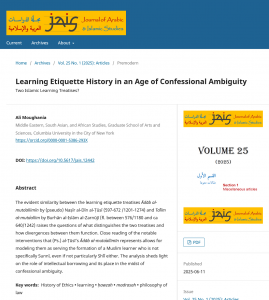
Latest Academic Publication: Why a manual on learning etiquette matters so much, and what’s next?

How could research comparing two manuals on learning etiquette be relevant to our day-to-day concerns in the “real” world?! Why would I write about this on a public blog? Why not just keep such news confined to the academic circles that would be interested in reading the article themselves? I could pose such questions about almost all academic work that does not lead to very tangible inventions, treatments, or other enhancements for the life of the body (i.e. the physical body, its needs and comforts). But then what would be left for the life of the mind? The life that makes humans more than just creatures of instinct, and opens us up to explore the prospects of what transcends and gives meaning to the world of our senses.

If I did not yet win you over to this side of “the force,” then let me reason with you on more directly relevant terms. Previous academic studies have shown that the distance and separation we often assume between civilizations (e.g. Eastern and Western, Christian and Islamic) are actually not so distant and separate after all. Key advancements in ideas, inventions, and the like, that appear in one part of the world may have influences (acknowledged or not) traceable to a very different cultural context. In the world of differences between schools of thought or religious communities (e.g. between Sunni Muslims and Shia Muslims), there is also a tendency of each side to focus on its own ideas, narratives, and books, without considering how the intellectual production on “the other side” sheds light on its own history, tradition, and narrative. Studies in specialized fields closely examine and compare the intellectual productions associated with different communities to uncover the threads of evidence that support, refute, refine, or otherwise synthesize these related theories. This includes studies from a wide range of fields: For instance, some may focus on the history of science, some on the history of religion, and others on the history of ethics and learning (which crosses several areas of intellectual history, and deals with content relevant to philosophy).

The recently published study that pushed me to write this blog post did just that. The most direct contribution it made was to draw attention to two different learning etiquette manuals, associated with seemingly different communities and traditions, and to show how the differences between the two go beyond what meets the eye. This was not merely to show the evident similarity and potential borrowing between the two, as previous studies have shown. Rather, this was mainly to focus on the function of these similarities and differences, of these inclusions and omissions ––the role that they play in forming the individual being trained, specifically.

In this way, the study makes a contribution not only on the textually “empirical” side, and not only in supporting/complementing previous theorizations, but also in distinctly theorizing for the function of such divergences. At the level of theorization, academics familiar with my other work would rightly read this article as a new case study gesturing toward my discussion of subject-formation (by the way, an enhanced book version is “in the pipeline,” so to speak). Besides these overarching findings, there are “micro-contributions” throughout the article, which would be difficult to summarize in such a brief piece.

The so-called “age of confessional ambiguity” mentioned in the title of the article points to the arguable function of the treatise Ādāb al-Mutaʿalimīn in relation to Taʿlīm al-Mutaʿallim, as the article’s analysis shows. But a discussion of the broader narratives implied by that phrase has been intentionally postponed for future studies, which this article is bound to contribute to. Also forthcoming is an earlier compilation of learning etiquette in the history of Islamic ethics, mined from sources not labelled in the etiquette (ādāb/adab) genre.

Reflecting on this publication’s findings, the article takes a more descriptive/analytical approach, rather than prescribe a set of ethical norms and behaviors. But it is surely not meant to tolerate, let alone condone, centuries-old citation practices (or the lack thereof). Many of our modern sensibilities or laws have their own histories but are geared toward safeguarding the same rights/responsibilities humans have long appreciated intuitively (even if they did not express them in the same codified way). Differences in historical practices and communities, as with present ones, have contexts to be understood within.

We have our differences, perhaps for good reasons, but we also have a choice to make about which differences to create anew and which to (de)emphasize or resolve. We must look ourselves in the mirror and ask: Why am I highlighting this or not bringing attention to that? What function does this serve? Does this advance knowledge and, at least, gradually, even if only indirectly, bring about advancement? Does this make me a better person? Am I using this difference to justify evil? Am I leaving the world a bit better off than when I came into it? What legacy do I bequeath for posterity, for history and, indeed, eternity?

The article is available open-access through the Journal of Arabic and Islamic Studies (JAIS).

“Learning Etiquette History in an Age of Confessional Ambiguity: Two Islamic Learning Treatises?”. 2025. Journal of Arabic and Islamic Studies 25 (1): 89-107. https://doi.org/10.5617/jais.12442.


The Child Within Us?

If we are waiting around for a sincere change of heart, for something that would appear to be as miraculous as it is momentous, then we are in for quite a wait. That is assuming we will even survive to see the wait bear its fruits. Actually, in many cases, we have already waited for far too long. Have the atrocities of this past year alone not proven that tens of thousands of times over? With each innocent life? With each destroyed future? Hasn’t this been the living testimony of every decimated school, university, hospital, home, and tent left burning in flames? And the testimony of countless healthcare workers, journalists/reporters, the elderly and the young, the women and the children?! I feel ashamed to have to state the obvious ––the well-documented obvious, I might add.


A historian would prefer to contextualize events by referring to a much earlier timeline, perhaps (i.e. years of tit-for-tat, occupation, exodus, etc). But I, along with many of you reading this, have been relatively familiar with the same history for at least an entire year now ––a year of following along and seeing how different “perspectives” (or manipulations, at times) cannot hide barebone facts on the ground. Dear reader, at this point, you are familiar with enough history to say, “enough is enough!” With the facts at hand, I should not have to refer you to the history before this for that purpose. If this magnitude of unjustified destruction is uninhibited despite being livestreamed across the globe today, then it is much less of a mystery now how the massacres of history unfolded before a much less sizeable viewership.


Shame on those who spin the most salient facts to justify an ongoing, let alone expanding, massacre. Shame, yes, shame, by any humane standard –– religious or not –– shame on whoever it may be. Hear the most esteemed voice of conscience you can conceive of saying it, “shame on them!” At least, then, if you feel it deep down inside, you’ll know that you still have a heart that feels something worthy of being called human… It is the least we can do ––if we can do nothing more that would make a difference. It is clearly far from an appeal to set yourself on fire in protest (by the way, that was done already, and, although I definitely do not condone it, I understand how a feeling of helplessness can lead even a decorated Airforce pilot to extreme measures). But if you are a willing agent on the face of this earth, answerable to some call of conscience to do what is in your power to stop the madness, to stop the rampage of destruction in this simulation of life, then weeping over the ashes does not cut it. Admit that you are not God, but take action with your God-given ability now.


The luxury of waiting for a change of heart belongs to a peacetime scenario, not a war zone, to points of caution with a noble adversary, not a pleading for mercy from a manipulative tyrant. The ethics of war must be upheld for one’s own sake, for one’s own sense of decency, of humanity, of good-will ––not because one is so delusional as to think that being ethical will rub off on a despotic foe. Sure, optimism, praying for those who have lost their senses, hoping that there will be a change of heart… that is all great… I encourage it, in fact ––so long as it is not at odds with being simultaneously vigilant and ready to take on one’s inevitable responsibilities. Remember who is on trial here, it is our conscience judging us, it is history judging us, and for the faithful, at least, it is God giving us a chance to be better versions of ourselves before the final reckoning.


If there is little utility in writing, if I am professing to those already initiated, then why do I speak out? Why write? It is an affirmation and a reminder, on the one hand, and it is an artifact left for history on the other. The children who survive the current turmoil will grow up and will be in positions similar to ours. So I write for our children, and whatever innocent child lives on through and within each of us… still vulnerable enough to submit to what is right, whatever/wherever/whenever it may be, and resiliently brave enough to do so despite it being quite the adventure.


In the spirit of writing for children, I take this opportunity to draw the reader’s attention to a line of children’s books that I highly recommend (hint: I am closely familiar with the creators, their vision, and work). The most recent release of “Dr. Heussane” is meant to celebrate personalities that are widely regarded as the pride of humanity, a “spirit of Christmas” ethos in celebrations of various faiths and humane traditions (i.e. not limited to Christianity and Islam). Due to the ongoing atrocities, festivities across the globe have been toned down or postponed, a phenomenon that adds another dimension to the notion of “moving a ‘Mole-Lid’” (the book is titled How the HeussKid Moved the Mole-Lid!). I encourage you to check out the recent releases and to sign up for the mailing lists of family-reading-time communities like this one: www.DrHeussane.com.


Ambulance? Here, Have a Sandwich Instead.

Bing Generated Image in Response to the Prompt: “Generate an image of someone on the ground who needs an ambulance but was given coffee instead”

“Quick, call an ambulance!” I had originally planned to write a blog post about handing a cup of coffee (and/or a sandwich) to someone who really just needed a ride to the hospital because that person had just been shot. It was meant to be an image that would drive home a principle ––one that applies to many different issues in life: poverty, unemployment, social justice, human resource distribution, war crimes, etc. But I kept putting it off. Lo and behold! What better concrete analogy do we have before us now than the images of parachuted “assistance” coming in from the shores of Gaza, Palestine…


Gratitude is Multi-Faceted

“Would you like sugar and cream with your coffee?”

“Yes, thank you, but hold the genocidal war please.”

You can be thankful for a blessing and unwelcoming of genocide at the same time, right? It is tempting sometimes, when you are in the position of the one doing a favor, to consider any critique directed towards you to mean that the person critiquing you does not appreciate all you have done for them. But reverse positions, imagine yourself in their shoes, and it will be much easier to distinguish between the two issues. Sure, sometimes a person may be both critiquing you and too bitter to appreciate God’s blessings, but that is not necessarily the case.


Furthermore, sometimes a person may appreciate God’s blessings that are coming through you, and would in normal circumstances express gratitude to you, but because doing so will likely encourage/condone/enable abusive behavior, they may opt to hold back on making you feel good about yourself with their profuse “thank yous.” In such a scenario, would you blame them? Or would you have done just the same? Imagine the murderer of your loved ones comes up to you and gifts you a meal, even meals for a lifetime, heck even meals for your entire network of friends and family ––would you be jumping up and down thanking them? If you have a sense of human decency, you would understand entirely and likely react the same way in their shoes.


Look, to be honest, I really appreciate the cancellation, deferment, or whatever it may be called when it comes to student loan debt. But even more sorely needed are suitable job opportunities for graduates to sustain a living wage, before getting to pay off loans. To honor the knowledge and prized credentials they have strived for means that there must be commensurate opportunities reserved for such qualifications… and in adequate numbers. Otherwise, the feedback loop should inform the “pipeline” of each academic/professional specialization trajectory. One can be appreciative of whatever good has come their way while recognizing these issues and calling for reform. This does not contradict or conflict with that.


In a related vein, educators at all levels, not only (and let alone!) university professors, should be treasured for the knowledge they pass along as its keepers. If teachers and professors (adjunct faculty or not) are satisfied to work in less favorable conditions because they are pursuing their passion for sharing and deepening knowledge, then so be it. But the rest of society must not devalue such dedication by assigning an unreasonable wage to such efforts. First, reasonable compensation, commensurate with credentials and experience, well beyond the living wage expected for all professions, should be a basic assumption in institutional budgeting. Second, if reasonable compensation, compensation in light of one’s credentials, is not fully possible in a given institutional context, then whatever is possible to maintain the value of those credentials, and reward one’s efforts, should be presented as being within the scope of their service to the public ––pro bono publico (for the benefit of the public), whether fully or partially discounted from the reasonable compensation value. It should go without saying that work conditions should be respectful across the board, honoring not only basic human dignity but the value of knowledge in a context-appropriate manner (for the very same underlying principle).


In other words, there should be no mistake in the broader public regarding the value of college degrees. Honoring knowledge, and the credentials that attest to it, is an ethical responsibility with economic implications (the value of degrees, tuition, institutional and professorial network reputations, etc…). Each dimension could be discussed at length, but the idea is apparently intuitive enough to hit home with the reader without the need for further elaboration. Every party involved, the teacher, the student, the public, etc., has a role to play in this dynamic. The point is that raising awareness regarding the necessity of such reforms do not conflict with gratitude. The reforms in question merely emphasize what should be addressed while maintaining the sense of appreciation for whatever good is already being done. Thus, there should be no room for rejecting this sort of discourse by an appeal to appreciation guilting, similar misunderstandings, or (unfortunately in some cases) various forms of manipulation. Let’s keep the eye on the ball, so to speak.


Cut your Losses but Don’t Kid Yourself

Most people with a good head on their shoulders are not going to be fooled by the theatrics. Minimize the losses, reduce the suffering, stop the bloodshed, etc… But if you are not sincere, do not carry on a charade that makes it even more difficult to confront your demons. We all have them, but what makes us different is how we deal with them. Should you just throw in the towel because you have been so deeply complicit already? No. That would be going deeper into the abyss. But is everything fine and dandy simply because you had a change of heart for political reasons? Or because you finally realized that the initial operation’s plan was doomed to fail? No. Salvage what can be salvaged because it gives you the best chance for your own long-term interests. That includes both moral and political interests (they overlap but not always). When that’s done, and a sincere change of heart is in order, let’s talk.


If you find these posts useful, remember to follow, like, and share. Sign up for updates and reach out for further discussion.


Illegals, DEI, Dearborn and Your Fair Share

Bing Generated Image in Response to the Prompt: “Generate an image of the future with AI robots doing most of the work and humans supervising”

So you have a college degree now, so what?! What value does that bring to the table? Even if you have multiple degrees, and the highest degree offered in the land for God’s sake… Besides decorating the walls of your office with them, what can they do for you? I mean, after all, either you get a job through your network (who probably would have helped you get a job even without all the fancy degrees) or you draw on your network’s support to start your own company/institution/organization. The myth of “succeeding” in the “real world” with the mentality of “getting good grades in school” has been proven wrong far too many times. Street smarts are what put food on the table, and your degrees are like trophies in sports whose fans have become disenchanted. Stick to the bare minimum and sprint out to start your “real” life. Right? Not so fast.


While the reasoning above may be tempting, it has at least two fatal flaws:

  • Knowledge is not merely pursued for the purpose of putting material food on the table. You see, knowledge is itself food for hearts and minds. It is a lifelong journey and anyone getting the short end of the knowledge “stick” is surely missing out (even if they do not sense it; kind of like how someone who has never had mulukhiyeh done well simply does not know what they are missing ––shout out to Lebanese and Egyptian cuisine, no rabbits please though).


  • Degrees are not pursued merely for the purpose of gaining knowledge such that one should stick to a bare minimum for work or business. Rather, degrees are a testament to knowledge gained, training undergone and potential for achievement depending on and at the level of the degree conferred. One should continue reading books and learning throughout life, but degrees are a way to organize and attest to one’s mastery in a widely recognized way.


Of course degrees have become one of the key ways that job applicants are filtered and assorted, both for reasons of merit and practicality. But imagine the not-so-far-fetched world of the future, in which Artificially Intelligent Robots have taken care of most jobs that used to require entry level degree credentials, let alone most hand-labor jobs. Assuming Artificial General Intelligence does not wipe out the human race due to some unforeseen catastrophe, in some of the more optimistic scenarios AI will actually make all of our lives much more like a paradise on Earth (in terms of physical luxuries). The AI programs and robots would be doing most of the heavy-lifting, whether in calculations/processing or in labor, and human specialists will mainly take on the roles of supervisors and/or entrepreneurs. Content creators will continue to bring fresh insights to the drawing board, but likely with the help of, and in competition with, AI creators. The deeper meaning of degrees as credentials, and not as tickets to a luxurious lifestyle, will become more pronounced at that point (which may come much sooner than you think).


For when the basic standard of living has been raised to such a degree by the advancement of civilization, a university credential (or the equivalent) will likely maintain at least three social benefits:

  • Reputable university degrees will continue to contribute to a sense of trustworthiness regarding its holder’s competence and potential for achievement, particularly in their area of specialization. This will give degree-holders a merit-based edge in competition for roles overseeing AI programs and robot operations. The higher the degree, the more distinct the merit-based edge. (As is the case today, there will also likely remain co-existing systems to establish credibility, some community/industry-specific, such as those of religious hierarchy or industry-experience).
  • Degrees will likely serve to distinguish levels of knowledge and potential for academic achievement in an even more distinct way than they currently do. This is because, in the envisioned future, the human factor would be mainly taking on the oversight role and the main merits distinguishing humans for such functions would be their university training and/or advanced research discoveries/contributions.
  • Degree-holders will likely be regarded as those most qualified to take on socially influential roles in their capacity as thinkers, advocates, political leaders, etc. This would be due to the increased emphasis on merits that distinguish humans in their capacity to manage AI agents (the previous two points).


Especially when it comes to ethics and making meaning of things. While it does not necessarily require a college degree to reflect on one’s worldview and address ethical dilemmas, let alone a PhD or another doctorate degree, having such degrees would indeed be expected to give someone a merit-based advantage. With the increased luxury in life, monetary wealth will likely be less of a concern to many individuals (except the most financially ambitious, whether for philanthropy or greed). At that point, popular focus will likely look beyond to expanding human civilization across the cosmos before the next cataclysmic event on Earth.      


Illegals crossing the border? There will be no issue as the “aliens” will prefer to stay in the luxury of their ancestral homes and Americans will be more hospitable than ever. Diversity, Equity, and Inclusion (DEI)? There will be no need for such proactive policies because everyone will have a fair opportunity to work in a job commensurate with their credentials or will employ an AI robot to do it for them. Dearborn? Which one? Every town on Earth and beyond would have renamed itself “Dearborn” in admiration of the home of the Fordson Tractors (just kidding, but shout out to my hometown and alma mater), right? Except for the Dearborn joke, I am pretty serious about the rest of it though. Imagine.


And remember: On a day of reckoning, in this world or the next, remember that even the click of a button counts. When you share a post, when you like a post, you are casting a vote. In a court of justice, someone we thought was innocent might be handed a container with the blood of an innocent person slain in vain. “Why is this being handed to me? I have not murdered anyone, I have not caused such agony and pain.” In the teachings of the Prophet Muhammad, the narrative goes: Such a person will be told, “You heard John Doe say so and so, you passed it along… It was shared until it reached that tyrant who then murdered him because of it. So this is your share of his blood.” (See, for instance, al-Kulaynī’s al-Kāfī, v. 2, p. 370-1).

Stop the war. Ceasefire now.


If you find these posts useful, remember to follow, like, and share. Sign up for updates and reach out for further discussion.


Do Not Be a Slave…

Morpheus Offering the Truth to Neo in The Matrix (1999)

The United Nations (UN) International Court of Justice (ICJ) has just weighed in on potentially genocidal violations in the ongoing humanitarian catastrophe in Gaza (Palestine). The court explicitly called on Israel to take specific measures that would prevent (further) genocidal violations. As for the final verdict of the court on whether or not Israel is guilty of the violations, that may take a while. It is also important to keep in mind the following blind spots that may have been missed/omitted from most media coverage on this court order. Ready for them?

Notice two things in particular that I have not come across in the media on this yet:

  1. The introduction to the court order document portrays the narrative of things starting on October 7, 2023 (instead of Palestinian narratives related to recent violations/threats against the Aqsa Mosque in Jerusalem, the siege of Gaza for years, the ongoing occupation of Palestinian land, the catastrophe for Palestinians in 1948, let alone the earlier history of conflict leading up to it). Having a sense of history is arguably necessary for an accurate understanding of the present and to have a fighting chance at avoiding the mistakes of the past. While some legal professionals may claim that the longer history is not as relevant for passing a court judgment on present violations, I would argue that at the very least there is an ethical responsibility to future humans that the court note the contextual history of the conflict for the official record. This is not about changing the final ruling on the matter, but of approach when it comes to this human record so many have set their hopes on.
  2. The document calls for an immediate and unconditional release of the “hostages abducted during the attack in Israel on 7 October 2023” (85). While this appears justified on humanitarian grounds when applied across the board, the double standard is arguably a key reason why the Palestinian-Israeli conflict has persisted for so long to begin with. Palestinians have been demanding the release of Palestinian prisoners (including woman and children) held by Israel for decades and generally view a potential swap agreement not as a resolution to a hostage crisis but as an exchange of prisoners of war (POWs). The court document seems to completely ignore prominent Palestinian narratives.

Regardless what else the court is saying, keep in mind whose narrative is being privileged as the assumed “matrix” for the proceedings, blind spot or not. Nonetheless, many have lauded the move as a step in the right direction ––one that raises awareness and provides a glimmer of hope for justice coming in the form of a court ruling by an internationally recognized body.

Granted, justice on Earth may come with too little too late, and worldly conflicts are more practically addressed through negotiated compromise (not absolute justice; Divine justice is another story though). But without a bare minimum of humanity and justice, no lasting peace is to be expected by a reasonable observer.

Perhaps the words of Grand Ayatollah Sistani represent this pragmatic outlook best when he recently wrote, “Ending the tragedy of the respected people of Palestine, which has persisted for seven decades, by granting them their legitimate rights and removing the occupation from their usurped lands is the only way to bring security and peace to this region. Without this, resistance to the aggressors will continue and the cycle of violence will keep on claiming more innocent lives.”

The zeal for that basic human dignity can be visualized as a phoenix that rises from the ashes. Any “victory,” let alone a Pyrrhic one, against human dignity is a moral failing beyond measure ––assuming such a so-called “victory” were possible at all. The words attributed to the Imam Ali (d. 661), as recounted in Nahj al-Balāghah, arguably speak to the souls of dignified human beings worldwide when he says, “Do not be a slave of someone else when God has made you free.” It is time to take the lessons of history and humble ourselves, to negotiate and save whatever is left of humanity.

If you find these posts useful, remember to follow, like, and share. Interested in a more rigorous format of engagement? Consider reaching out for further discussion, and check out the Spring 2024 courses here.


Page 1 of 2:1 2 »