- Resources for Creating Community while Teaching Remotely (during the COVID-19 pandemic)
- A Final Project as a Resource to Enhance Critical Thinking in Spanish
- Understanding and Implementing Metacognition in the Classroom
Resources for Creating Community while Teaching Remotely (during the COVID-19 pandemic)
Teaching a language online can be tough. This last year, I have worked on making my Spanish class inclusive, accessible, and welcoming while being far away from my students. Despite the distance, I have developed two teaching practices that have helped my students in making the most of learning the language while fostering an online community. One teaching practice is related to what I call “demystifying quizzes” and the other is called “weekly hangouts.”
Demystifying Quizzes
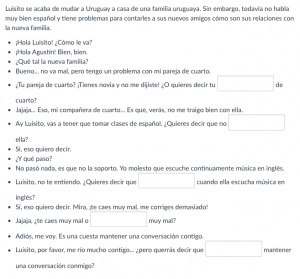
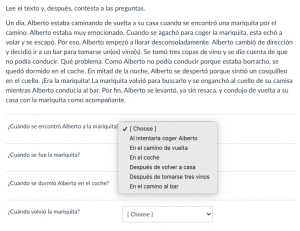
I have designed quizzes, set at the end of each unit, as a way of tracking and assessing student performance. Being online, I wanted to make the quizzes challenging so that they could not easily copy and paste the answers; instead, I wanted students to understand the logic behind the questions asked. For this reason, I asked students to take the quiz in pairs, so that they could go over all the questions with a partner and discuss their thoughts before sitting on final answers. They would get complete points for the quiz (3 points) regardless of the result, and they could improve their grade by actively participating in the collective grading of the quiz and by completing a self-evaluation survey (up to 5 points). Doing the quizzes in pairs helped students gain confidence and feel more prepared for the discussion afterwards, while creating bonds with their peers. They understood that the point of the quizzes at the end of each unit was not getting all the answers right, but understanding why their answers were (or not) adequate. You can see below a sample of exercises found on my quizzes.
Weekly Hangouts
Once a week, instead of holding regular class, students used to work in predetermined groups to practice their speaking skills in Spanish. The learning goal of these conversations was for students to practice Spanish while engaging and interacting with their peers. These weekly hangouts were a great tool to strengthen oral and communicative competences in Spanish and to get ready to jump right into Intermediate I—allowing time and space for students to digest the information they were required to study and to produce a meaningful conversation putting what was learnt into practice. It was indeed a fantastic way to get to know one another in an online setting! You can see below a sample oral assignment.
Para esta práctica oral, vais a intentar adivinar cuál era el objeto o la comida favorita de la infancia de tu compañerx. La práctica tiene dos partes:
1) Preparación individual (15-20 minutos):
- piensa en cómo describir tu objeto o tu comida favorita de la infancia; hazlo de manera que tu compañerx pueda entenderte
- piensa en qué preguntas le puedes hacer a tu compañerx para adivinar de qué está hablando
2) Conversación en directo (el tiempo que tardéis en adivinar, unos 2 minutos por persona):
- NO os digáis el objeto o la comida de antemano; el objetivo de la práctica es intentar adivinarlo a través de la conversación, usando el imperfecto porque es una descripción de un objeto del pasado.
- Usad frases (sentences) sencillas, adecuadas a vuestro nivel.
- Voy a puntuar vuestra capacidad de interacción y de negociación de significados.
Rubric (15% of the final grade):
| Criteria |
Points (10) |
| Uso del vocabulario aprendido en clase
The student incorporates the vocabulary learnt in class, showing acquisition and understanding. |
2 |
| Uso de la gramática aprendida en clase
The student incorporates the grammar learnt in class and relevant to the assignment. |
2 |
| Capacidad de interacción y fluidez
The student easily communicates with their peers and has a capacity to react on time in the conversation. |
2 |
| Pronunciación y entonación
The student speaks clearly and with distinctive sounds. |
2 |
| Capacidad de negociar significados
The student is able to understand the assignment and to engage in the conversation with their peers, asking questions and offering corrections when needed. |
2 |
A Final Project as a Resource to Enhance Critical Thinking in Spanish
During the Spring semester of 2020, when we suddenly had to switch to online teaching, I decided to make a couple of adjustments to the course that I was then teaching (Literature Humanities) at Columbia University. One of the most significant changes was that I decided to eliminate the final exam and turn it into a DIY final project. Such change allowed me to measure what students had learnt in a deeper level, since I wanted them to take a step back and show what they were able to do with the knowledge they had acquired throughout the year.
I have exploited this performative aspect—this focus on doing—when teaching Elementary Spanish II during 2020-2021. In a much more structured and carefully planned way, I have designed a final project with a main goal: students will use the target language as a way of doing research in a topic of their interest. Through a set of scaffolded assignments, students will produce an object of their choice (podcast, website, infographics, poster, etc.), crafting a narrative of their own and a formed view on the subject matter. This approach allows students to enhance their critical thinking skills in Spanish while collecting information, analyzing data, and putting together their stories. In addition, students are easily attracted to a project like this due to their own self-motivation: they choose topic, they choose media, and they choose how to communicate their findings to the class. See below the rationale that I shared with students.
Learning goals:
- research (reading, thinking, writing…) in Spanish about a topic of your choice
- produce an object to showcase your findings
- share your findings with the class
Requirements:
- do research in Spanish to the best of your ability
- apply what we are covering in class: uses of the past(s), use of the imperative, DO & IO pronouns… Prove your level!
Scaffolded Assignments (20% of the final grade):
- First Draft (5 points) = a 100-word outline including your refined topic, parts of your project, preliminary bibliography, and format chosen for your object
- Second Draft (5 points) = a 250-word text including an overview of your project and your personal involvement on it (why are you researching X?), plus a preview of what your object will look like
- Final Product (5 points) = your carefully crafted object and a revised version of your second draft, incorporating my feedback
- Class Presentation (last week of class) (5 points) = for 5 minutes, you are encouraged to establish a (short) discussion with your peers, finding ways to engage them into your topic as you introduce your object. You are also expected to actively participate in your peers’ presentations!
Rubric:
| Criteria | Points |
| Adecuación gramatical y ortográfica
The student doesn’t have spelling or basic grammar mistakes. |
1 |
| Aplicación de lo aprendido en clase
The student incorporates what is being taught in class. |
1 |
| Investigación original y en español
The student pursues an original project and looks for sources in Spanish when possible. |
1 |
| Efectiva resolución de la tarea (contenido)
The student responds to what has been asked in terms of content. |
1 |
| Efectiva resolución de la tarea (forma)
The student responds to what has been asked in the correct format. |
1 |
Understanding and Implementing Metacognition in the Classroom
This online 2-part workshop was the first graduate student-led program ever hosted by the CIRTL network (Center for the Integration of Research, Teaching and Learning). Along with my colleague Braden Czapla, and drawing on a Learning Community on Metacognition that we had co-organized for Columbia’s Center for Teaching and Learning, we co-facilitated two 90-minute synchronous, highly interactive online sessions in which we introduced participants from a wide range of disciplines to the theory behind metacognition and offered a couple of pointers to make the most of it in our classrooms. An attendee mentioned in the Student Evaluation that having concrete strategies and seeing how they can be applied was very useful: “the most helpful things I got out of this workshop were the specific techniques […].”
Description
Metacognition, or thinking about one’s own thinking, is a critical active learning concept in the classroom. Once mastered, self-reflection allows students to take ownership over their own learning by critically self-examining both the bounds of their knowledge and how they may best expand upon them. This two-part workshop addresses the many roles metacognition assumes in a learning environment. The first session unearths the meaning of metacognition. It focuses on the research surrounding metacognitive learning, such as the benefits of self-reflection and giving students agency over learning, and what happens when students are lacking in self-awareness of their own knowledge. The second session delves into the use of metacognitive practices as teaching tools. Participants workshop and develop a lesson plan which utilizes metacognitive techniques to maximize student learning. By the end of both sessions, participants will leave confident in their knowledge and ability to enhance their teaching practices with metacognitive strategies.
Learning Outcomes
- Describe several known high-impact, evidence-based effective instructional practices and materials and recognize their alignment with particular types of learning goals.
- Describe several assessment techniques and recognize their alignment with particular types of learning goals.
- Describe how to access the literature and existing knowledge about teaching and learning issues, in a discipline or more broadly.
More information is available at the CIRTL website. You can also find here access to the resources developed for the workshop (login required). Students’ evaluations are available upon request.