Author Archive for Matt Clemons – Page 47

U.N. Secretary-General Visits SIPA Students in Malawi

One of the hallmarks of a SIPA education is 30 full weeks of professional development while studying in our program.  Although employers value academic learning, the immediate challenges they face require people of action.  Our professional development opportunities teach you how to mix what you are learning in the classroom into the “real world” of complex policy development.

Practical training takes place through a 15 week internship and a 15 week workshop.  Both projects are completed with real world policy agencies and give you the opportunity to showcase your abilities and experience in a job interview.  Internships and workshops can also be completed anywhere in the world because we do not offer summer classes.  The summer is an ideal time to travel anywhere in the world to complete one the required professional experiences.

One set of policy goals our students have been involved with are the Millennium Development Goals (MDGs).  The Secretary General of the United Nations recently visited one of the projects SIPA students have been working on under the guidance of Professor Jeff Sachs.  An excerpt of the article is below, the full article can be found on the Columbia News site.   And for details on other workshops our students have been involved in, please see our workshop page.

On May 30, United Nations Secretary-General Ban Ki-moon visited Mwandama, a rural village located in southern Malawi once marked by rampant and extreme poverty. Since 2006, however, the village of approximately 35,000 people has been moving closer to achieving sustainable development, thank to its involvement in the Millennium Villages, led by Columbia’s Earth Institute, along with the United Nations Development Programme and the nonprofit Millennium Promise. The initiative strives to help poor communities end hunger, achieve education, have access to health care and meet other vital needs using best practices in science, research and technology.

CaptureMDG

Working closely with local and national governments, businesses and other partners, Columbia researchers and students from across the University are applying their expertise in public health, energy, water, agriculture, engineering and other areas to help communities meet the Millennium Development Goals (MDGs)—eight objectives for meeting basic human needs and achieving sustainable growth. Approximately 500,000 people now live in 80 Millennium Villages, all of which are located in “hunger hotspots,” areas of low agricultural productivity and extreme hunger. The hotspots comprise several different agro-ecological zones distributed across 10 sub-Saharan African countries, including Ethiopia, Ghana, Kenya, Malawi, Mali, Nigeria, Rwanda, Senegal, Tanzania and Uganda.

New Student Photo Series 2010 – Entry #5

Submissions continue to roll in for our new student photo series.  If you are an incoming student we encourage you to review this entry for details on how to submit your own photos to display on the blog.

The first set of photos was submitted by Jiaming Ju, an incoming MPA student focusing on Economic and Political Development.

__________________________

The first photo was taken in Ghana, I was working as a photographer and correspondent in Accra at the time. My colleagues and I spent a relaxing day on the beach one day and I saw those two local boys playing football, they were truly enjoying it.

Jiamingju6

The second photo was taken in Seoul, South Korea.  I took this shot near Hongdae University by accident when there happened to be a B-boy ( break dancing boys) dancing competition going on. It was truly impressive.

Jiamingju3

The third photo was taken in Dandong, Liaoning,China. I have been a head teacher for Roots&Shoots(an educational project engaging youth in environmental issues) in school here. This is a photo of my students from Class2, Grade 2, No.17 middle school.

Jiamingju1_____________________

The second set of photos comes from Laura Agosta, an incoming MPA student from Argentina.

_____________________

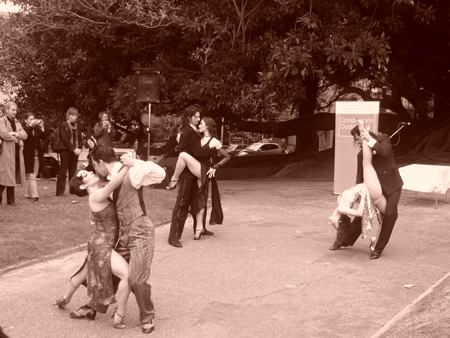
The first picture is a typical postcard from Buenos Aires. I took it in a very nice park and they are three couples dancing tango in a very professional way. I certainly don’t dance it this way!!!

Laura Agosta 1

The second and the third picture are the ones that I’ve taken in San Telmo, one of the nicest “porteño” towns in the city. Every Sunday people gather in Defensa Street and they buy different handcrafts and clothing from sellers that show their stuff there.  The first picture below is a very strange garbage can that I’ve found in the street. Apparently, I was not the only one who was interested in taking a picture of it! The third one is a guy playing a strange instrument. What I love about this picture is that he is very focused on his music, while everyone around him don’t seem to notice his presence.

Laura Agosta 2

Laura Agosta 3

The World Cup and Columbia

CaptureSGAs most of the world is aware, perhaps the most well known sporting event in the world begins today.  What you might not know is that Columbia University has a very close connection to the World Cup.  Sunil Gulati, the President of the United States Soccer Federation, just so happens to be an economics professor on our campus.

The time zone of NYC will make for interesting viewing times for games.  Greece plays South Korea for example at 7:30 AM on Saturday and my wife, being a South Korean native, will make sure we are up with coffee when kick off occurs.  Good luck to your country, as for me, if a game between a South Korea and the  U.S.  occurs it would likely result in my wife and I watching the game in different locations =)

New Student Photo Series 2010 – Entry #4

Submissions continue to roll in for our new student photo series.  If you are an incoming student we encourage you to review this entry for details on how to submit your own photos to display on the blog.

The first set of photos were submitted by Waqas Aslam Rana, an incoming MIA student from Pakistan.

_____________________

The first, titled ‘miar glacier’ was taken in 2005 in the Northern Areas of Pakistan. ‘Miar’ is a big glacier near the Nagar valley in the famous Karakorum mountains in northern Pakistan. Taken during our group’s ascent at a 5000 meter peak, the mouth of the glacier can be seen in the picture.
miar glacier
The second, titled ‘derawar fort’ was taken in 2004 during a desert camel safari in the Cholistan desert of Pakistan. The Derawar fort in the picture was built centuries ago by the then rulers to control this ancient desert kingdom called ‘Bahawalpur’.
derawar fort
The last picture, titled ‘rugby’ was taken in 2006 during a university trip to the Hunza valley in northern Pakistan. A friend and I are captured here practicing our rugby throws against the beautiful background of the valley. Incidentally, both of us in the picture are coming to SIPA in the fall!
rugby
___________________________
The next set of photos come from Molly Powers, an incoming MPA-DP student.
___________________________

I took this photo in 2005 onboard the Spirit of Massachusetts as we were approaching the island of Montserrat in the Caribbean.  I was working aboard the traditional schooner at the time with Ocean Classroom Foundation. Montserrat was an amazing place to visit, as the island’s volcano had erupted the year before, burying the airport and most of the main city of Plimoth. The only way to reach the island was by boat.

approaching monserratl

Nanukuloa, Ra.  Fiji Islands. 2006.

This is where I worked as a Peace Corps Volunteer for 2 years on the island of Viti Levu in Fiji. These children are out “fishing” (more likely they’re just playing around and swimming) on a bilibili or bamboo raft.

Picture 036

Lavalsal, Malakula Island. Vanuatu. 2007.

On this small island, every family in the Seventh Day Adventist community has their own dugout canoe used for fishing in the deep, shark-infested waters. As a visiting Peace Corps Volunteer, I was given a tour of the island by a local man and his son.

Picture 190

New Student Photo Series 2010 – Entry #3

Submissions continue to roll in for our new student photo series.  If you are an incoming student we encourage you to review this entry for details on how to submit your own photos to display on the blog.

The first photos today come from Tamara Tschentscher, an incoming MPA student that will study Energy and Environment.

___________________________

The first picture was taken in South Africa in 2005 during a couple of months of conservation volunteer work. I have always been excited about nature, landscapes and wildlife, but that Summer I entirely fell in love with the African Savannah. This leopard cub – with its major habitat in the tree tops – was only one of many creatures that were so fascinating.

DSC02136 (2)

Believe it or not, but the round concrete object you see in the next  picture is an “improved, fuel-saving and smoke reducing stove” in  Ethiopia, which may save up to 50% biomass and reduces the risk of  respiratory diseases among women and children.

IMG_4819

Like in many developing countries around the world (especially in African countries), more than 90% of energy consumption comes from biomass. In Ethiopia, the forest cover has been depleted down to 3%, fuel wood is getting increasingly more expensive and erosion more severe. The final picture shows merchants transporting coals and
fuel wood across Lake Tana, which often takes four hours or more (one way), to sell it in Bahir Dar.

IMG_5191

___________________________

The next two photos come from Katherin McFarland, an incoming MIA student.

___________________________

The photo of the 3 boys was taken in Blue Creek Village, Belize.  I lived in Blue Creek Village during my Peace Corps service, and these were three of my favorite boys in the village. They were always willing to laugh and share a smile. The village was a Mayan village made up of about 300 people in the Toledo district in Belize. Pictured From left: Gari Ack, Atley Mas, and Clemento Mas.

DSC01310

The photo titled Jankunu_Dancer was taken in Dangriga, Belize. It is a close up of the Jankunu dancer during a cultural day performance. The history behind the Jankunu, (Jonkunnu, John Canoe) stems from West Africa as early as the 1700’s. In Belize, the Jankunu dance is typically done by the Garifuna and Kriol cultures. Men dress up in elaborate masks and decorations to represent colonial slave masters. The garifuna drums are played and the Jankunu dancers’ feet quickly move to and against the beat creating a limber and satirical dance for their spectators.

Jankunu_Dancer

"The most global public policy school, where an international community of students and faculty address world challenges."

—Merit E. Janow, Dean, SIPA, Professor of Practice, International and Economic Law and International Affairs

Boiler Image