Current Researches
- Dynamic Spine Brace Project
Around six million people in the U.S. suffer from scoliosis, a sideways curvature of the spine. These include approximately 2 to 3% of adolescents who are diagnosed each year with idiopathic scoliosis, which is usually identified during puberty and progresses until skeletal maturity.
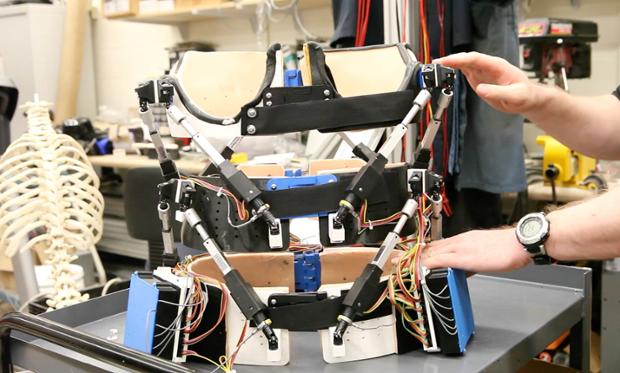 One in 500 children today require treatment using spine braces and 1 in 5,000 need spinal surgery. The typical spine brace is made of rigid plastic that fits around the child’s trunk and hips and applies counter-pressure on the spine’s abnormal curve, on the theory that pressure and support on the curve from outside will stimulate more normal growth of the spine.
The rigid braces have several shortcomings: they “freeze” the child’s upper body and limit movement to such an extent that users often avoid wearing the brace. And as the child grows, the required external forces to correct the abnormal posture change along the length of the curve and over the course of treatment. Having the flexibility to move when wearing a spinal brace while still applying corrective forces would be a very useful feature for both patients and physicians.
In 2015, our ROAR Laboratory at Columbia designed wearable spine braces that consist of rings that fit on the human torso. These rings are dynamically actuated by servomotors placed on adjacent rings to control the force or position applied on the human body. Onboard sensors record the force and motion data and transmit the information to a host computer for monitoring and adjusting the treatment.
- Passive Spine Brace
I and our project team work on a second spine brace that is fully passive, made of compliant components able to adjust stiffness in specific directions. The current dynamic brace has 12 active motors and needs an active power source while the passive brace cannot provide active controls. In addition to that weight and bulkiness of current dynamic spine brace will be reduced. With passive design, brace can be worn the longest time of period. For that we replaced spring limbs instead of all active limbs.
- Hybrid Semi-Active Spine Braces
The goal of the new design is combine the merits of the two. These will be less power hungry and can be worn over a longer duration of time. In new design, we replaced passive limbs instead of some of the active limbs.
Also, you can review our work here: Poster 2016
Former Researches
- Optimization and Design of Hood Linkage Mechanism in Automotive
An automotive hood is to be designed so that it stays at various open positions. This is becoming more important because more cars are now owned by women who have to take care of simple maintenance. Automobile hoods may be heavy to some and a mechanism is needed to assist in opening and keeping the hood in an open position without the need for a prop.
This design requires a spring wherein, it stores potential energy that is given up by the closing of the hood and releases it back when the hood is open. What is required and needed in the design is to locate the attachment points of the spring on the mechanism that is optimum in opening the hood and in keeping the hood in a stable open position. This will require the interaction between mechanism synthesis in conjunction with optimization methods.
Advisor: Professor Meng-Sang Chew (PhD. Columbia University)
2. Energy Efficient-Based Design and Economic Analysis on the Central Air Conditioning Systems
In this study, selection of suitable HVAC system and its components for the mall by thinking energy efficiency was done after heating and cooling loads of a sample mall building in Kayseri-Turkey had been calculated. Investment and operating costs were also considered in selection of suitable HVAC system and its components. Energy savings and refund periods were calculated for he using of high efficient rotating heat exchangers with hygroscopic material coating to take advantages such as sensible and latent heats of exhaust air in four units of the mall having large fresh air necessity such as entertainments, hallways, fast-food and cinemas. Additionally, refund periods were determined by analyzing economically the use of cogeraration or trigeneration systems were calculated fort annual heating, cooling and electric loads of a sample mall building in Kayseri-Turkey.
Our research team joined with this study “Design and Implementation of Energy Efficient Central Air Conditioning Systems” Project Competition in Turkey and won the fourth best research among the twenty participants from the top Turkey Universities. In addition, it was presented and published as “Energy Efficiency-Based Design and Economic Analysis on the Central Air Conditioning Systems for an Example of Shopping Center in Kayseri” in the 1st National Symposium on Air-Conditioning CoolingTraining.
Advisor: Professor Suat Canbazoglu (PhD. Technical University of Istanbul)