


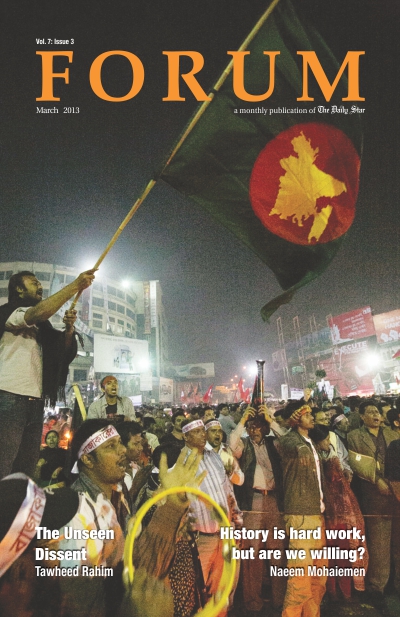
There is a particular way of lensing mass movements, when we are observing from within immediate tactics. In a fast moving situation, with opponents and allies squared off, the first thing to shrink is the space for internal critique. Professor Azfar Hussain uses the term “critical solidarity” for his approach to the issue of 1971 and memory. A critique that seeks to help the history activists, but also demands changes from within the movement. Hussain reminds us, “The middle-class tragic sentimentality and liquid emotional nationalism actually suppressed the radical character of the language movement. So we have to return to history and say loudly: language movement was for establishing linguistic rights, but also a battle for the rights of farmers, laborers, and the working class.”
1989, the year I arrived at Oberlin College in USA, was the first time I met a Pakistani face to face. Before that, Pakistanis were an abstraction, a mixture of Yahya, Tikka, Bhutto and other architects of 1971 — rolled up into the archetype of the Qamrul Hasan poster. Now, to have a debate, you need a debating opponent who disagrees with you, or at the least, engages. But most of the Pakistani students at Oberlin were oblivious to the history of 1971. The attitude could be summed up as, “Once there was a war, so we heard.” The only student who had studied the 1971 history was Chris Coelho, a Pakistani Christian who was Anthony Mascarenhas’ nephew. He had read his uncle’s “Genocide” dispatch, and the book, Rape of Bangla Desh.
History is hard work, but are we willing?
by NAEEM MOHAIEMEN.
[Forum Magazine, March 2013]
Read full essay here.