Archive for Student Life – Page 22

A Seeple’s take on managing a student budget

Being a student generally means you’re poor. Or you feel poor. There, I’ve said it! Now, that’s not necessarily the case for everyone, or all the time, or an inescapable situation. SIPA makes shrinking budgets particularly painful, because most students come from working for a few years before SIPA (it is a graduate/professional school, after all), and losing that stream of full-time income can be downright depressing. However, fear not, future or current SEEPLES, there is a method to the (financial) madness! Read on!

If you’re lucky enough to have generous support from your family, significant other, awesome government, etc., and ALL of your living and tuition expenses are covered, great! You may read the rest of this post as pure amusement or if you really care about saving a few pennies. But really, you can just skip the rest of the post and go have a relaxing afternoon!

For the rest of us plebes: it really comes down to three things: take advantage of cost-managing resources (campus and off-campus), try finding additional sources of income, and manage your expectations.

  1. Cost-managing resources: while general wisdom dictates that being a student is financially sucky, I tend to disagree. Students have a variety of perks available to them, which allow them to get access to everything from academic resources to leisure/entertainment choices for a fraction of the cost “normal people” have to pay for them. A few of my personal favorites include:
    • Cuts on buying and renting books (if you think you need to pay at all! I haven’t bought a book since my freshman year of college. They’re all usually at the library, or the profs have copies you can borrow).
    • Cuts on electronic and IT equipment and software (stores from Apple to B&H offer student discounts)
    • Fitness/physical education discounts at gyms throughout the city, including Columbia’s own Dodge Fitness Center, where you get special rates
    • Entertainment/art discounts (see Columbia’s Art Initiative for free concerts and plays, discounted performances, and special events; also, if you’re a Met Opera fan, like me, check out their Met Students Program – you pay $ 25 for seats that are normally in the hundreds!) Cost management also includes assiduous financial aid research – apply to everything you are eligible for!
    • You should also talk to the Admissions and Financial Aid Office, OSA, advisors, etc., and identify external and within-Columbia/SIPA fellowships, scholarships and funds you can apply for. I had my second year and half of my first year entirely covered, tuition-wise, all thanks to fellowships and scholarships! I also got reimbursed for participating in conferences and other academic opportunities, such as research fellowships.
  2. Find additional sources of income: from campus opportunities (assistantships: TA-ships, PA-ships, Reader-ships; paid research opportunities; fellowships and scholarships) to off-campus streams of income (paid internships, part-time jobs, consultancies, etc.), you will find that with careful planning and excellent time-management skills, SIPA allows for enough room to take advantage of these options. But it’s up to you to find them. They will rarely fall into your lap. I have successfully supplemented my income with most of the above-mentioned (some of the oddest, and least-SIPA related have involved modeling and selling stock photography. Some of the most-SIPA related have included paid research and assistantships).
  3. Manage your expectations: you will see this stressed everywhere, and even though I’m not personally a great believer in it (do you adjust your dreams to your life, or your life to your dreams?), it is worth mentioning. My mother always reminds me that I’m a “student” now (again! gah!), and that I’m supposed to live within my means. Luckily, I have a SO who disagrees, and an ambitious, resourceful personality that helps me in finding opportunities to support my needs and interests. But generally, yes, it is a very wise and mature approach to downsize your travel, living arrangement, eating preferences, entertainment, etc. to match your available resources while at SIPA. It might hurt in the beginning, but you’ll get used to it, and remember: it’s temporary!

So there you have it, peeps, the essence of managing a student budget! Fret not, you will not be on it for long! 🙂

[Edited Photo by Donald Bowers Photography | Adriana Popa, MIA 2016, holding stacks of money and listening to music, because why not?!]

10 reasons you shouldn’t attend SIPA

Are you on the fence about joining SIPA in the fall? This list should make it easier for you to decide.

1. THE CAMPUS IS A REAL EYESORE

aprilfools-campus
Seriously. Don’t even bother taking a campus tour. The grass is lush and beautiful for half of the year, then it’s blanketed in the fluffiest white snow you only thought you could find in your Winter Wonderland dreams.

2. THE CLASSES ARE SMALL

aprilfools-classroom

It’s graduate school. How are you ever going to learn anything if you’re in a classroom with just a dozen other students? Better yet, how can you take a nap in the back of the room without getting noticed? Sadly, you can’t do that at SIPA. THIS is what your average classroom looks like.

3. THE CLASSES ARE ALSO B – O – R – I – N – G

aprilfools-dayattheUN

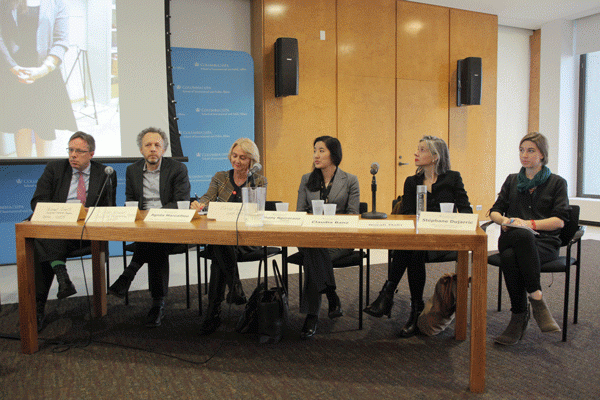
In addition to being stuck in a classroom with less students, you’re also not going to enjoy any of the classes you take next year. For example, the United Nations Studies specialization offers “A Day at the United Nations: A View from the Inside.” Students spend at least two days accompanying UN staffers to work at headquarters. Then our Seeples and their UN hosts (pictured above) share what the experience was like in a panel presentation at SIPA. Last year, speakers included Claudia Banz (third from right), a senior political affairs officer at United Nations, Department of Peacekeeping Operations and Jo Scheuer (second from left), the Director of Climate Change and Disaster Risk Reduction with the UNDP. What a snooze fest.

4. THERE’S NEVER ANYTHING TO DO IN THIS PLACE

aprilfools-flyers

This is what the average hallway looks like at SIPA. It’s plastered in flyers for social receptions, student organization meetings, and random events on and off campus. Among the 42 SIPA student groups, they host 12-15 events each week. With so many choices, it’s no wonder students can’t make time to attend the events and are left with nothing to do except explore the Big Apple.

5. AND THEY KEEP YOU TRAPPED ON THE GROUNDS

aprilfools-Molly-Powers---Uganda-11

At SIPA, “on the grounds” can mean anything from taking a class in a Columbia University classroom to being forced onto a plane halfway around the world just to help bring an end to extreme poverty. That’s what Molly Powers, MPA-DP 2012, had to do as part of her Summer Field Placement when she interned with the Millennium Villages Project. It’s obvious by the photo she didn’t volunteer for the gig.

6. THE PROFESSORS ARE MEH

aprilfools-faculty

SIPA has more than 70 full-time faculty members and 200 adjunct faculty, professional practitioners and visiting scholars on staff. With so many experts to learn from, you’re hard pressed to find anyone who’s notable among the bunch. (Remember the saying about quality vs quantity?) David Dinkins is the former mayor of the City of New York; Claudia Dreifus writes “Conversation with…” in the New York Times’Tuesday science section; Paola Valenti consulted with World Bank’s Human Development Network and Social Protection Group; and Jason Bordoff joined SIPA after serving as the Special Assistant to the President and Senior Director for Energy and Climate Change on the Staff of the National Security Council for four years. Sorry, but that’s not an all-star lineup.

7. YOU’LL NEVER MAKE ANY FRIENDS


aprilfools-friends-jumpingLast month, these three spent their Spring Break in Peru as part of their second-year capstone project. There’s nothing more awkward than spending time with other Seeples in a foreign country and then asking them to pose with you and pretend like you’re all actually having a good time…while jumping near the ledge of a cliff. You’re bound to fear for your safety, thinking that at any moment one of these two will push you over the edge—literally. With thoughts like those racing through your mind, can you ever really become friends? (Note: At the request of a student, a previous entry featuring students at the Dead Sea has been removed.)

8. YOU WON’T FIND A *STELLAR* JOB AFTER GRADUATE SCHOOL

aprilfools-sipabanner

Last year, our graduating Seeples worked in the private, public and nonprofit sectors. But they were working for some less-than desirable organizations. Brookings Institution, Clinton Foundation, Federal Reserve Bank of New York, Kofi Annan Foundation, Ministry of Foreign Affairs, PricewaterhouseCoopers and the United Nations Development Program were just a few of the terrible places our graduates ended up. Clearly, all of your hard work and the SIPA brand don’t get you anywhere these days.

9. THERE’S NOTHING WORSE THAN A SEA OF COLUMBIA BLUE

aprilfools-graduation

There are shades of blue everywhere you turn on campus. From Admitted Students’ Day and orientation week to sporting events and graduation. Blue, blue, blue, blue, blue. What kind of school has this much pride for a cool color palette?

10. SORRY, BUT IT’S JUST NOT WORTH IT LISTING ANOTHER REASON…

I warned you there were reasons you shouldn’t attend SIPA this fall. But don’t take my word for it. Confirm your enrollment today so you can see things for yourself.

Elaine Kubik’s summer in Southern Africa

One of the best parts of the MPA-DP program is the opportunity to spend three months in a developing country. The Summer Field Placement is a requirement within the program, and proves to be an integral component of the graduate learning experience. While most of my cohort comes from a variety of different countries, or has had development field experience already, the Summer Field Placement becomes an opportunity to advance professionally with a recognized organization.

I spent my summer in Maseru, Lesotho, a small enclave within South Africa. There I worked with an amazing organization called Jhpiego, working on their HIV outreach programs. Although it was challenging at first to see how my marketing and communications experience would relate to development work, I found my summer placement to be a worthwhile learning experience.

Check out my video below (it’s only 3:46 minutes) to learn more about my summer placement and my life at SIPA!

Conquering homesickness like a Seeple

For this post, I’ve chosen to tackle a rarely discussed subject, especially in grad school. While, as an international, I spend time in groups of international students, I spend the bulk of my time with Americans. I find that the topic of homesickness creeps up in discussions in both groups, under different forms. My Hungarian friend might yearn for guláš, my Texan friend might miss his childhood friends or his high school buddies, and I may reflect on the pace of life in Romania, and how differently things move in New York.

I remember we talked a lot more about being homesick in college, when we had just left home for the first time for an extended period of time (most of us), had arrived in a new/strange country (some of us) and we were younger and less quipped to deal with stress and separation anxiety (all of us). By grad school, when we are supposedly “adults”, have traveled, worked, gone through a variety of social relationships and reached a new level of maturity, it’s almost embarrassing sometimes to admit that we are “homesick”. I said the word to one of my friends in my second semester at SIPA, and they replied with “aww, miss your momma’s cookies?” I laughed it off, but I did indeed miss my mother’s homemade desserts, and so much more.

As for all of life’s deepest existential/soul-related afflictions, there are no easy solutions. But there are ways to cope. I, like most SIPA students, take refuge in my work, in the day-to-day marathon of keeping on top of coursework, jobs/internships and professional opportunities. Making friends in your new environment is also, of course, important, and I am fortunate to have wonderful friends of all backgrounds here in the US, and in New York in particular. Having friends of your own nationality/from your own culture can be even more helpful, if that’s your thing (it’s not mine, but it is most people’s). Reconnecting with your roots can mitigate homesickness – I sometimes go to the Romanian restaurant in Queens, or to the St. Nicholas Russian Orthodox Cathedral on the Upper West Side (not for religious, but for cultural reasons). And, naturally, staying connected to the people you love, the people back home, can do a lot for your suffering heart: I talk to my parents on Skype or WhatsApp weekly, and we text/email daily (I am an only child, and we have a very tight relationship). I also keep in touch with several high school friends. I watch old Romanian movies, listen to traditional Romanian music (I don’t care for the contemporary one) and of course, whenever I can, go back to Romania and go on trips around the country. I also have traditional Romanian knick-knacks scattered around my NYC apartment, and they remind me of home, in a warm and touching way. I have made it my mission, though, to take advantage of New York while I am here, and so, most of the times, I focus on the present and the geographically immediate, immersing myself in discovering this wonderful city.

It’s worth noting that homesickness has been recognized as a factor that affects students, and that there are resources on campus that can help: http://www.wsj.com/articles/new-help-for-homesick-students-on-campus-1445363539?alg=y and https://health.columbia.edu/counseling-and-psychological-services.

SIPA Love Stories: A speed dating match

Valentine’s Day is right around the corner, and this time last year I shared a week’s worth of love stories featuring some of our Seeple.  Read More →

"The most global public policy school, where an international community of students and faculty address world challenges."

—Merit E. Janow, Dean, SIPA, Professor of Practice, International and Economic Law and International Affairs

Boiler Image