Archive for Columbia University – Page 15

Students launch social enterprise accelerator

Although the concept of social enterprise—harnessing the power of market forces to solve social problems—is not new, the ecosystem to support such ventures in New York City is not very robust. Recognizing this gap, four SIPA MPA-DP students are running a five-day social enterprise accelerator this May. In partnership with the Unreasonable Institute (which co-founder Nicolas Toro MPA-DP ‘17 called “the gold standard” of accelerators), the students have launched Unreasonable Lab NYC to help budding social enterprises get ready to pursue venture capital.

“This is for people with social enterprise ideas that have gone from pilot to concept, and now they want to take that concept to scale, and they’re looking for the appropriate funding,” said co-founder Joe Heritage MPA-DP ’17.

“One of the biggest problems that social enterprises face is that they feel like they’re ready to receive investment, but they don’t know how to do it,” added Veni Jayanti MPA-DP ’17, another co-founder.

The program’s fourth founder is Josh Jacobson MPA-DP ’17.

The five-day accelerator, which will take place at SIPA May 19 to 22, will feature the Unreasonable Institute’s investment preparedness curriculum, Unreasonable’s network of social enterprise mentors, and expertise from Columbia’s Start-Up Lab, the Tamer Center for Social Enterprise, SIPA faculty, and the four co-facilitators themselves.

“One of the best things about the lab,” said Toro, is “there’s a lot of exposure to other entrepreneurs that have gone through the process, that know how to deal with issues like how to create a funding plan, how to pitch, what type of investment you need.”

The program will culminate with a high-level capital investment session, where participants will have a chance to practice their pitch with actual capital advisers and investors.

The four students involved in the project all have strong backgrounds in social enterprise. Before attending SIPA, Heritage spent seven years managing a social enterprise in Kenya—a farm that employed refugees and used its profits to fund education scholarships for girls to attend school. Jayanti worked at Unlimited Indonesia, a social enterprise accelerator with branches all over the world. Toro was a serial entrepreneur with a penchant for social justice, having started a cosmetics retailer in addition to serving in the Peace Corps and working in economic development issues in Colombia. Jacobson founded his own social enterprise and serves as a mentor for Startupbootcamp, another social enterprise accelerator.

“We just are all very excited about the idea of creating sustainable solutions to poverty through best practices in business,” said Heritage. “That’s why I came to SIPA, and that’s what I want to gain, so I can leave and do that more effectively.”

Toro was drawn to pursue this project in addition to taking classes at SIPA and the Columbia Business School in social enterprise because “I wanted to make something bigger. I wanted to create a pilot, an experiment to see how these social enterprises can be supported to really grow and scale up, and become the new Warby Parkers, the new Toms, and really make amazing solutions, both in New York and across the world.”

“It’s going to be a great learning experience,” Toro said. “You’re going to meet great people, and it’s going to be a lot of fun.”

“And a lot of dancing,” Jayanti added. “There’s going to be a lot of dancing!”

— Lindsay Fuller MPA ’16

Ruth DeFries and Jeffrey Sachs Named University Professors

Great news! SIPA’s Director of the Earth Institute, Jeffrey D. Sachs, and his colleague Ruth DeFriesh have been named University Professors, the highest rank our faculty can receive. You can read the complete announcement from Columbia University President Lee C. Bollinger below.

Dear fellow members of the Columbia community:

I am pleased to announce my appointments of Ruth DeFries and Jeffrey Sachs as our newest University Professors, the highest rank Columbia bestows on its faculty.  It is fitting that Professors DeFries and Sachs receive this honor in tandem, as they are two of the world’s foremost scholars investigating how to ensure a sustainable future for our planet.  As is always true, but especially so here, by recognizing their many contributions through this honor, we also strengthen their, and our, capacity to serve the entire Columbia community and the world.

Professor DeFries is Denning Family Professor of Sustainable Development and Co-director of the Undergraduate Program in Sustainable Development at Columbia’s Earth Institute.  Her scholarship is committed to nothing less than understanding the changes experienced by the planet over the course of human existence.  Professor DeFries’s institutional leadership led to the creation of several innovative Earth Institute programs, and her public advocacy is responsible for advances around the world concerning climate change, food and water insecurity, and nature conservation.  She was elected to the National Academy of Sciences in 2006 and the American Association for the Advancement of Science in 2008.  In 2007, Professor DeFries received a Fulbright Award for Research in India and a MacArthur Fellowship.

Professor Sachs, Quetelet Professor of Sustainable Development and Professor of Health Policy and Management, is a peerless economist who has dedicated his life to building a sustainable future and reducing global poverty.  He came to Columbia in 2002 to serve as Director of the Earth Institute.  Under his leadership, the Institute became the world’s premier institution for research, teaching, and public outreach regarding earth sciences and sustainable development.  As the longtime Special Advisor to the United Nations Secretary-General, Professor Sachs oversaw the adoption and implementation of the Millennium Development Goals as well as the Sustainable Development Goals agreed to last year.  He is Director of the UN Sustainable Development Solutions Network, which convenes at Columbia and at our Global Center in Europe, under the auspices of Secretary-General Ban Ki-moon.

I know we all join in congratulating Professor Ruth DeFries and Professor Jeffrey Sachs on their many achievements and on becoming Columbia’s newest University Professors.

Sincerely,

Lee C. Bollinger

My experience as a Lemann Fellow

Besides the incredible network of SIPA Students and Alumni, being at Columbia gave me the chance to access other great exclusive groups. One of them is the network of Lemann Fellows.

The Lemann Fellowship was established by the Brazilian entrepreneur Jorge Paulo Lemann, in order to support students that are committed to the overall advancement of Brazil, through their educational and professional experience. The fellowship is is curated by the Lemann Foundation, and includes lifetime access to an incredible network of people (including Jorge Paulo Lemann himself!). If you want to become a Lemann Fellow like me, you need to write a separate essay explaining your connection with Brazil – but always check the website for more information, since the rules of application might change from year to year.

The Lemann Fund also strengthens Columbia University’s research, teaching, and discussion of Latin America. The Institute of Latin American Studies (ILAS) is one of the nation’s foremost centers in the field and it is the house to the Lemann Center for Brazilian Studies, that serves as a key focal point for students and faculty with an interest in Brazil. ILAS regularly hosts events related to Latin America (you can check out their full agenda of events here).


Here I am checking in for the event!

Here I am checking in for the event!


In order to achieve its goals, the Lemann Foundation holds regular events inside and outside Brazil. These events are a great opportunity to get Fellows together and foment discussions about Brazil’s hot topics. Every year one major University hosts one of such events, called the Lemann Dialogue. It took place in Stanford, in 2014, and it is scheduled for Harvard, in 2016. But last semester what was hosted by SIPA. The 5th Annual Leman Dialogue (Innovating in the Brazilian Public Sector) was by far one of the best events I saw at Columbia. You could see a complete myriad of Brazilian authorities in the lobby, such as   Ministers, such as Tereza Campello; former head of Brazilian Development Bank, Andre Lara Rezende; Brazilianist, Professor Albert Fishlow; Presidential candidate, Marina Silva, besides Jorge Paulo Lemann . The event’s panels discussed topics such as: | The Current Political and Economic Landscape; Policies and Social Inclusion; Reforming Representative Democracy in the XXI Century; Technology and Citizen Engagement; Urban Development and City Management; Coordinating the Flow: Addressing the Challenges of Urbanization; Innovating in Policy Making for Education (click here for a complete list of topics).

If you want to get a better view of what the event was all about, watch the following short video:

The Fifth Annual Leman Dialogue was a once-in-a-lifetime experience for me. I hope I can make it to the sixth edition!

PICTURES: http://globalcenters.columbia.edu/riodejaneiro/content/lemann-dialogue-2015

https://www.dropbox.com/sh/xefe9wh27jehs50/AAAfvlp8R9kI05styRsG05H9a?dl=0

Live Coverage: 19th Annual David N. Dinkins Leadership & Public Policy Forum

The 19th Annual David N. Dinkins Leadership & Public Policy Forum is taking place today at Columbia University’s Alfred Lerner Hall. The yearly gathering continues to serve as an important vehicle for discussing major urban policy issues. Today’s event features The Honorable Loretta E. Lynch83rd Attorney General of the United States, who will be presenting a keynote address on 21st Century Policing and Criminal Justice Reform. Throughout the morning we’ll be posting tweets from the event. So check back regularly to see what’s going on, or watch it live through the livestream video below.


That’s it! We hope you enjoyed following along with us today during the forum.

10 reasons you shouldn’t attend SIPA

Are you on the fence about joining SIPA in the fall? This list should make it easier for you to decide.

1. THE CAMPUS IS A REAL EYESORE

aprilfools-campus
Seriously. Don’t even bother taking a campus tour. The grass is lush and beautiful for half of the year, then it’s blanketed in the fluffiest white snow you only thought you could find in your Winter Wonderland dreams.

2. THE CLASSES ARE SMALL

aprilfools-classroom

It’s graduate school. How are you ever going to learn anything if you’re in a classroom with just a dozen other students? Better yet, how can you take a nap in the back of the room without getting noticed? Sadly, you can’t do that at SIPA. THIS is what your average classroom looks like.

3. THE CLASSES ARE ALSO B – O – R – I – N – G

aprilfools-dayattheUN

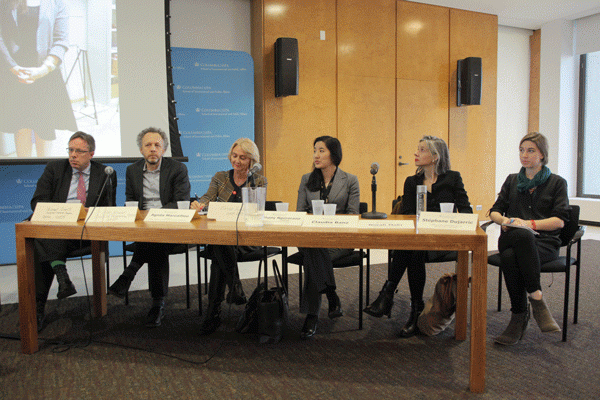
In addition to being stuck in a classroom with less students, you’re also not going to enjoy any of the classes you take next year. For example, the United Nations Studies specialization offers “A Day at the United Nations: A View from the Inside.” Students spend at least two days accompanying UN staffers to work at headquarters. Then our Seeples and their UN hosts (pictured above) share what the experience was like in a panel presentation at SIPA. Last year, speakers included Claudia Banz (third from right), a senior political affairs officer at United Nations, Department of Peacekeeping Operations and Jo Scheuer (second from left), the Director of Climate Change and Disaster Risk Reduction with the UNDP. What a snooze fest.

4. THERE’S NEVER ANYTHING TO DO IN THIS PLACE

aprilfools-flyers

This is what the average hallway looks like at SIPA. It’s plastered in flyers for social receptions, student organization meetings, and random events on and off campus. Among the 42 SIPA student groups, they host 12-15 events each week. With so many choices, it’s no wonder students can’t make time to attend the events and are left with nothing to do except explore the Big Apple.

5. AND THEY KEEP YOU TRAPPED ON THE GROUNDS

aprilfools-Molly-Powers---Uganda-11

At SIPA, “on the grounds” can mean anything from taking a class in a Columbia University classroom to being forced onto a plane halfway around the world just to help bring an end to extreme poverty. That’s what Molly Powers, MPA-DP 2012, had to do as part of her Summer Field Placement when she interned with the Millennium Villages Project. It’s obvious by the photo she didn’t volunteer for the gig.

6. THE PROFESSORS ARE MEH

aprilfools-faculty

SIPA has more than 70 full-time faculty members and 200 adjunct faculty, professional practitioners and visiting scholars on staff. With so many experts to learn from, you’re hard pressed to find anyone who’s notable among the bunch. (Remember the saying about quality vs quantity?) David Dinkins is the former mayor of the City of New York; Claudia Dreifus writes “Conversation with…” in the New York Times’Tuesday science section; Paola Valenti consulted with World Bank’s Human Development Network and Social Protection Group; and Jason Bordoff joined SIPA after serving as the Special Assistant to the President and Senior Director for Energy and Climate Change on the Staff of the National Security Council for four years. Sorry, but that’s not an all-star lineup.

7. YOU’LL NEVER MAKE ANY FRIENDS


aprilfools-friends-jumpingLast month, these three spent their Spring Break in Peru as part of their second-year capstone project. There’s nothing more awkward than spending time with other Seeples in a foreign country and then asking them to pose with you and pretend like you’re all actually having a good time…while jumping near the ledge of a cliff. You’re bound to fear for your safety, thinking that at any moment one of these two will push you over the edge—literally. With thoughts like those racing through your mind, can you ever really become friends? (Note: At the request of a student, a previous entry featuring students at the Dead Sea has been removed.)

8. YOU WON’T FIND A *STELLAR* JOB AFTER GRADUATE SCHOOL

aprilfools-sipabanner

Last year, our graduating Seeples worked in the private, public and nonprofit sectors. But they were working for some less-than desirable organizations. Brookings Institution, Clinton Foundation, Federal Reserve Bank of New York, Kofi Annan Foundation, Ministry of Foreign Affairs, PricewaterhouseCoopers and the United Nations Development Program were just a few of the terrible places our graduates ended up. Clearly, all of your hard work and the SIPA brand don’t get you anywhere these days.

9. THERE’S NOTHING WORSE THAN A SEA OF COLUMBIA BLUE

aprilfools-graduation

There are shades of blue everywhere you turn on campus. From Admitted Students’ Day and orientation week to sporting events and graduation. Blue, blue, blue, blue, blue. What kind of school has this much pride for a cool color palette?

10. SORRY, BUT IT’S JUST NOT WORTH IT LISTING ANOTHER REASON…

I warned you there were reasons you shouldn’t attend SIPA this fall. But don’t take my word for it. Confirm your enrollment today so you can see things for yourself.

"The most global public policy school, where an international community of students and faculty address world challenges."

—Merit E. Janow, Dean, SIPA, Professor of Practice, International and Economic Law and International Affairs

Boiler Image