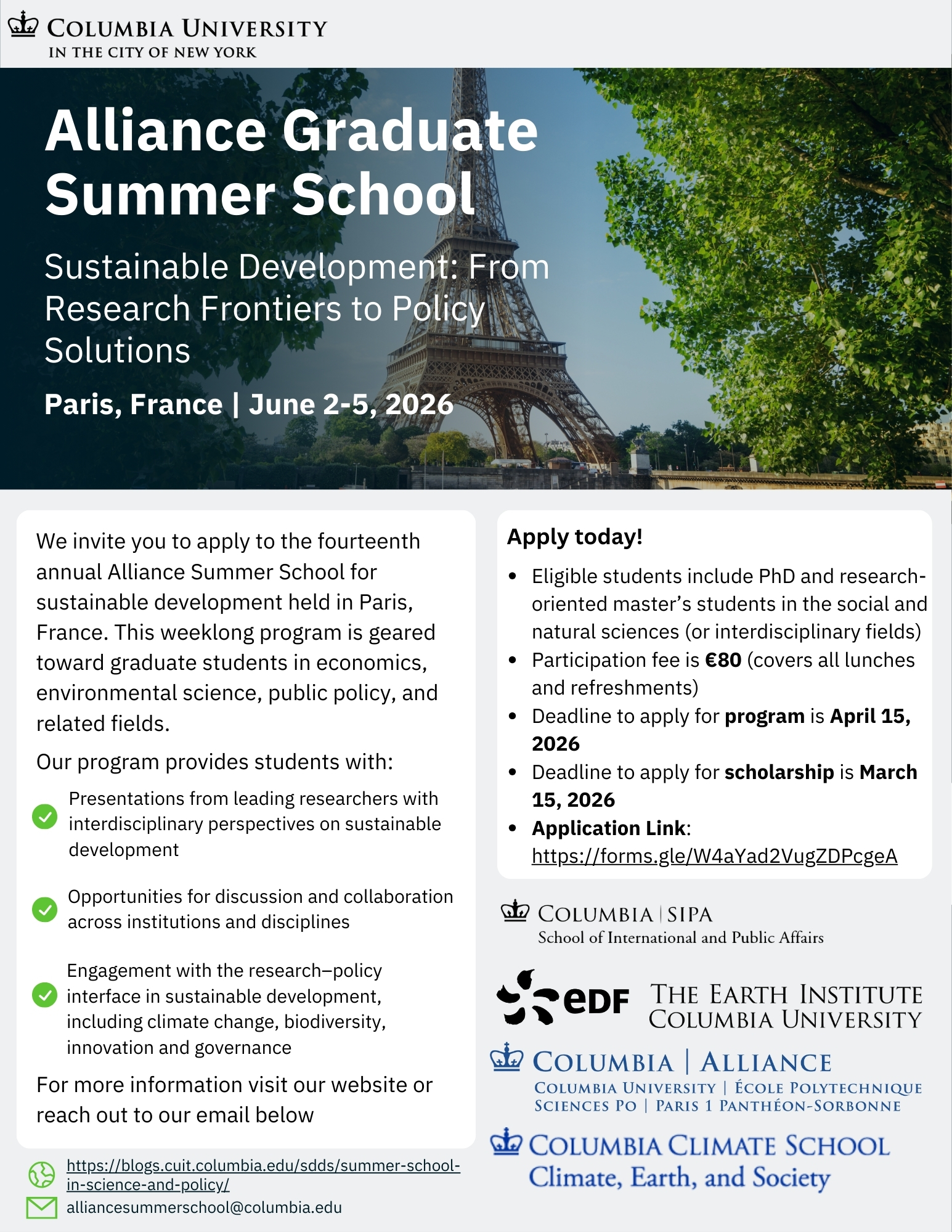
The Alliance Graduate Summer School is an event organized by the Sustainable Development Doctoral Society of Columbia University. It began in 2012 as a student-led initiative to promote interdisciplinary exchange among graduate students working at the nexus of science and policy within Alliance institutions. The summer school connects world-class professors, industry experts, and graduate students through a mixture of guest speakers and workshops to foster the exchange of ideas, encourage intellectual discourse, and highlight cutting-edge research. This year’s theme is “Sustainable Development: From Research Frontiers to Policy Solutions” and will occur from June 2nd to June 5thin Paris, France.
Organizing Committee:
- Elena Maberry ([email protected])
- Thaïs Nuvoli ([email protected])
- Matthew Salah ([email protected])
- Emilio Leguizamo Londono ([email protected])
- Yangyang (Kira) Wang ([email protected])
Scholarship Recipients
| Laura Elizabeth Moreno-Gama | Sharon Broid Goldberg | Yuli Xue | Balasurya (Bala) Sivakumar |
| PhD student in Political Science at the University of California, Santa Barbara | PhD Candidate, The New Environmental School, Tel Aviv University | PhD Student in Agricultural and Applied Economics at the University of Wisconsin–Madison | PhD candidate in Economics at Oslo Business School, Oslo Metropolitan University (OsloMet), Norway |
 |
 |
 |
 |
| Laura Elizabeth Moreno-Gama is a Ph.D. student in Political Science at the University of California, Santa Barbara (UCSB), a 2035 Initiative Ph.D. Fellow and a Broom Center for Demography Graduate Student Associate. She holds both a B.Sc. and an M.Sc. in Economics from Universidad del Rosario in Bogotá, Colombia. Her research focuses on the political economy of conflict and the green energy transition in Latin America, using experimental and quasi-experimental methods. She studies how conflict legacies, governance institutions, and fiscal policies shape support for climate and development policies in fragile settings. Before joining UCSB, Laura worked at New York University (NYU) Abu Dhabi, and gained professional experience in the nuclear energy sector in the United Arab Emirates. Through her research, she aims to generate evidence that can help countries pursue climate action while strengthening governance, peace-building, and sustainable development. | Sharon is a PhD Candidate at The New Environmental School, Tel Aviv University. Her research focuses on economic incentive structures for water utility efficiency. By modeling market dynamics and analyzing physical and economic data, she investigates the mechanisms that disincentivize utilities from reducing non-revenue water (NRW)—a critical issue in developing countries where NRW averages 40% to 50%.
She is also a Climate Research Fellow at the Arison ESG Center, where she studies corporate sustainability incentives. Previously, at the Israel Innovation Institute, she managed technology implementation programs tailored for extreme environments, including the Great Green Wall in Sub-Saharan Africa and the Atacama Desert in South America. There, she learned about the gaps between existing technological solutions and structural incentives. Her fieldwork taught her that global water challenges extend far beyond sheer supply; they are deeply rooted in management, quality, and equitable availability. She believes that to secure universal access to clean water and sanitation, we must optimize our existing resources by deeply understanding the economic incentives driving institutional decision-making. |
Yuli Xue is a PhD student specializing in Environmental Economics in the Department of Agricultural and Applied Economics at the University of Wisconsin–Madison. Yuli’s research interests are in environmental and public economics, urban economics, and empirical industrial organization. Her current research examines how incentive policies affect electric vehicle adoption in the ride-hailing industry, the environmental impacts of data centers, and the long-run environmental and economic consequences of public recreational works programs. From majoring in Environmental Economics and Policy at UC Berkeley to earning an MSc in Environmental Economics and Climate Change at LSE, and now pursuing her PhD, Yuli has remained committed to applying rigorous scientific methods to better understand and address challenges in environmental economics. By leveraging empirical evidence to inform policy design and evaluation, she hopes to contribute to sustainable development and foster international dialogue on how economic growth can be achieved without compromising environmental well-being. |
Balasurya Sivakumar (Bala) is a PhD candidate in Economics at Oslo Business School, Oslo Metropolitan University (OsloMet), Norway. His research focuses on applied microeconomics, with a particular interest in how environmental and institutional factors shape human capital accumulation and welfare in developing countries. His current work examines the effects of coal-fired power plants on educational outcomes in India and the role of climate shocks and public policy in rural livelihoods. Prior to his PhD, he worked as a Research Assistant on projects within the Environment for Development (EfD) network. His work uses survey, administrative, and geospatial data to study policy-relevant questions in developing countries. Broadly, his research aims to understand how economic development can be made more sustainable and inclusive. |