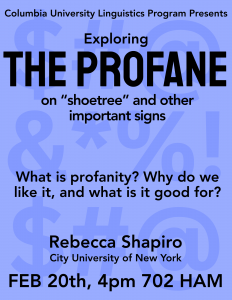
Join the Columbia Linguistics Program the first of three Spring Dressler Colloquia!
Friday, February 20, 4ː00 pm, Hamilton 702
EXPLORING THE PROFANE:
ON “SHOETREE” AND OTHER IMPORTANT SIGNS
Rebecca Shapiro
City University of New York
During this interactive talk, we’re going to learn what is profanity, why we like it, and what it’s good for. Simply considering the word “profane” tells us a lot about what used to be considered alarming language, but we’ve moved on from thinking that language directed against religion is dangerous. This broadening of the definition of what we call profane is largely because religion no longer has such a hold on our public and private lives and therefore we have fewer guideposts for what makes something unacceptable in that way. Likewise, something essential about profanity is that it is relative (we will discuss how literally it is relative to the Shapiros); that is, unlike speech that violates the First Amendment, we don’t always know it when we see it because what some of us consider profanity depends on who is using it, when it’s being used, where it is used, and for what purpose. We need to be able to recognize the meaning of certain language before we tag it as profane or not, so we consider that what is unacceptable in one context isn’t in another context. (Sometimes, sounds or words just “feel” profane, and we’ll discuss why that it as well.) Moreover, there are limits to what we will consider profane and somehow we understand where those limits are of what something means. To demonstrate the limits of our understanding of profanity, we will engage in lots of swearing (itself also a religious term) and then we will, as good linguists, test our theories by ranking these essential words.