Address: 37-50 74th St, Ste 3750, Jackson Heights, NY 11372
Subway: 74th St-Broadway (7), Jackson Heights-Roosevelt Ave (E,F,M,R)
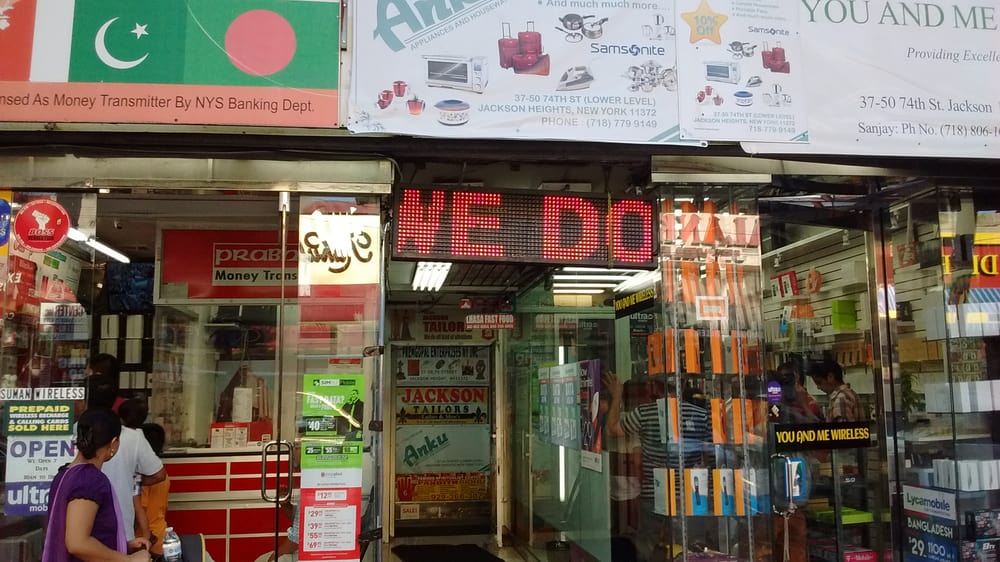
The phrase “hole-in-the-wall” doesn’t do this little restaurant justice. Hidden behind several storefronts on (street), Lhasa Fast Food would have been nearly impossible to find if my friend had not scouted out the area before. To get to the restaurant, we had to enter a small shopping complex, pass through a set of clear doors, turn right into a narrow hallway flanked by small retailers, then turn left before we reached the cozy couple hundred square feet that is Lhasa Fast Food.
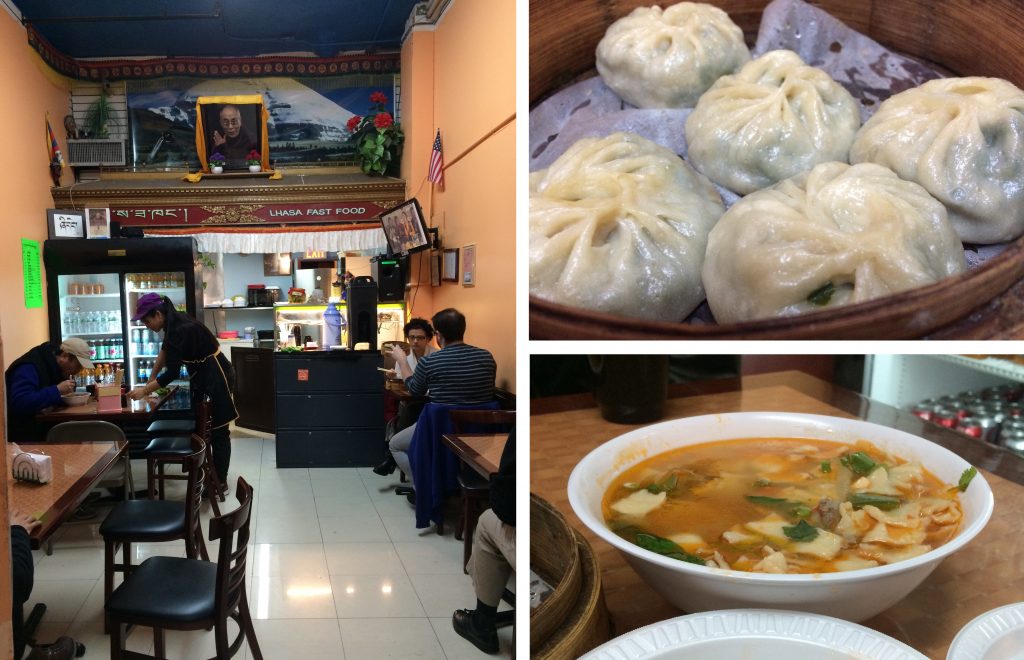
 The first thing that grabbed my attention inside was a picture of the Dalai Lama placed on a false roof above the kitchen. In the picture, the Dalai Lama looked like he was just about to wave and say hello. His expression was so enthusiastic that I couldn’t help but smile before looking down to search for a place to sit. There were no empty tables, so we joined a lady who seemed to be finishing her meal. I knew I wanted to try the beef momos, but wasn’t sure what else to get. When the lone waitress came by to take our order, I asked her in Chinese what their most popular dishes were. Through pointing and some broken Chinese, she told me that the momos and thenthuk were what people usually ordered. Beef and chives momos and thenthuk it was.
While waiting for the food to come, I couldn’t help but want to see what the chefs were doing in the kitchen. My curiosity got the better of me and I ended up asking the waitress if I could go behind the counter and watch the cooks. I stood in the middle of the kitchen and stared, fascinated, at the two cooks bustling around the kitchen. I learned that Ta Shi was from Amdo–the Gansu province–and Sang Jien Ben from Sichuan. Ta Shi showed me how to fold the momos, which were rounded like Chinese soup dumplings, and explained that the rounded-style of folding is the “Amdo style.”
The momos that are folded in a more linear fashion (like potstickers and gyoza) are more of the Central Tibet or “Lhasa”-style. To demonstrate the difference, Ta Shi made a Lhasa-style dumpling. I learned that momos are made from an un-yeasted dough and filled with either 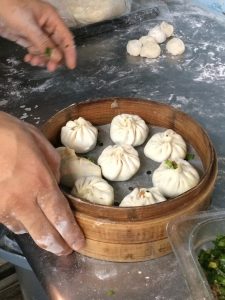 some sort of meat, chives, or a mixture of the two. Eight momos are places in a bamboo steamer basket and steamed for eight minutes.
Meanwhile, Sang Jien Bien rolled out a ball of dough into a thin pancake and sliced it up into long strips about an inch in width. To make the dough pieces for the thenthuk, he would take a strip over to the boiling pot of broth and quickly and deftly rip pieces of dough off and into the soup. I asked him why he does this step by hand instead of cutting the dough into squares. His answer roughly translates to: “doing so makes each piece more special” The thenthuk pieces reminded me of a pasta-type dish from my parents’ hometown in China, Xi’an, called ma shi. or ma shi-er. To make it at home, my dad would cut up a flat disk of dough into small quadrilaterals that we would then press and roll with our thumbs. The indented pieces were then cooked in boiling water.
Jien Bien also pointed out these round, yellow mung bean sheets in the corner that he rolled and sliced up into strips and seasoned with minced garlic, soy sauce, chili oil, vinegar, and a scallions. He called the dish laping.
I asked the two more about themselves and learned that they moved to the U.S. 11 years ago. They started working at LFF several years ago and said that business is quite good. Even though the space in the restaurant–if you can even call it that–is limited, there was a constant stream of customers and orders, both in-house and over the phone.
When our food was ready, I left the kitchen and sat back down. The momos, fresh off the steamer, had a semi-translucent skin that allowed some of the green of the chives inside to show through.

Carefully biting into one, I quickly realized that they had given us the wrong type of momo: the filling was just chives instead of beef and chives. They still tasted delicious though and the filling was surprisingly flavorful and juicy, considering it was just chives. The thenthuk came as a steaming bowl of sliced beef, the little “noodles”, green and red bell peppers, vermicelli, spring onions, and white radish in a light broth that had a touch of chili oil. I added some soy sauce to the thenthuk because the broth was quite light in flavor. It was very reminiscent of the hot noodle soups that my parents would throw together back home using whatever was left in the fridge. 
As we were finishing up our meal, Jien Bien shouted to me from the kitchen to try some of the butter tea, or su you cha in Chinese. The waitress pour us each a cup rom a very large thermos jug near the counter. The tea was very smooth and slightly sweet, much like the more mainstream milk tea. I know from experience that the actual butter tea Tibetan drink is much more viscous and buttery. However, I have to say that I definitely enjoyed this watered-down version much more than the authentic kind.
Our bellies warm with momos and thenthuk, we bid farewell to the friendly waitress and cooks. Next stop: Phayul.