Archive for June 2010 – Page 3

Spring 2011 and Fall 2011 Application Notes

For those interested in applying to SIPA for coursework beginning in 2011, please note that our goal is to have the new application live on August 15th.  The deadline for spring 2011 consideration will be October 1st and the deadline for fall 2011 consideration will be January 5th.

Each summer we make some technical changes to the application as well as review the content of the application.  The Admissions Committee begins a series of meetings each June.  In these meetings we discuss everything from the review process to the questions or topics applicants will be asked to respond to on the application.  I am confident based on how the review process went  last year that the bulk of what we ask applicants to submit will be the same.  I am also confident that we will not be asking applicants to respond to the same essay questions/topics.

Although the application will not be live until August 15th,  I will provide updates throughout the summer on this blog.  For example, as soon as the committee determines what applicants will be asked to write on, I will make sure to post the information on the blog.

I would recommend that interested applicants review what we asked for last year.  You can review everything we asked for by clicking here.  There should be no major changes in our asking applicants to submit the application, fee, three recommendations, two résumés, transcripts, a personal statement composed of one or several questions/topics, and appropriate test scores.

It is entirely possible to start working on your application now by ordering transcripts, starting on your résumés, making contact with recommenders, and studying for appropriate tests (GRE, GMAT, TOEFL).  I will provide further guidance on the personal statement at a later time, but sufficed to say, it should incorporate what you wish to do in the future and how you see SIPA playing a role in your development.

Summer Reflections 2010 – Post #2

John Hughes just graduated from SIPA and during his second year of study worked in our office.  He is spending the next two months in the office to assist with projects and help fill in for a staff member on maternity leave.  John is set up for a job in Washington, D.C. and will be moving there in August.  I asked him to reflect a bit on his experience as a SIPA student and contribute to the blog over the summer.  This is his second entry.

___________________________

I often speak to incoming students here at the Admissions Office who tell me that they “were admitted into the EPD concentration” or “accepted into IFEP” etc.  Though it is good that these students know what they wish to concentrate in at SIPA, I thought I should write a blog post about what to consider when you are actually selecting courses.

First, if you came to SIPA for a specific concentration, by all means take all the courses that interest you in that concentration.  However, it is not necessary to limit yourself to only courses within your chosen concentration, and you can always switch your concentration if you decide there is a different one that better fits your interests (that said, you should have a good idea of the path you want to pursue before you come, and your admissions essays should reflect this).  One of the great advantages of SIPA over many of our rival schools is the breadth of courses available to students, both within SIPA and at the other graduate schools at Columbia.

Every semester there are scores of courses offered at SIPA, plus many more open to SIPA students at all the other graduate schools.  You will receive a list of what these courses are (including those at other schools) before registration, and I would recommend looking through this list thoroughly before choosing your courses.  Many incoming students have the misperception that they must do as many courses within their chosen concentration as possible in order to set themselves up best after graduation, though this is not necessarily the case.  The reality is that your concentration does not show up on your transcript, and potential employers will never ask you what your concentration was.  Thus, whether you take 6 ISP classes or 8 ISP classes you will still have an MIA or MPA degree at the end of two years, the same degree as your friend who did 6 IFEP classes.

I do not wish to imply that you should just take whatever and not worry about it.  It is definitely to your advantage to have a focused course of study, especially since you can list your courses taken on your resume and can use that list as talking points during interviews.  Nevertheless, it does mean that you should not be afraid to search outside of your concentration for classes that might make sense for you.  For example, taking a course in corporate finance or operations management can be very helpful for a number of careers, even though the former is only required for the IFEP and Energy concentrations and the latter is only required for the Management specialization.  Or, a course on the geopolitics of oil and gas can be helpful for a security concentrator who wishes to get a broader perspective on the issues that affect decision-making at the international level, even though it is an energy course.

These are just a few examples.  The overall takeaway is that your academic time at SIPA is what you make of it.  There are countless combinations of courses you could take, and it is up to you to decide how to best combine everything.  There are, of course, many people here at the school to provide guidance, so don’t worry if you don’t know exactly which classes to take right away.  There is also the add/drop period each semester where students are free to attend any class they wish for a week or two before deciding whether or not to remain in the class.  Many students take advantage of this by going to many classes at the beginning of the semester and deciding then which ones are the best fit.

Regardless of what you decide to do, do not feel that you need to pigeon-hole yourself into one track.  There is nothing wrong with taking all your courses in one area if that’s what you decide to do, but if you decide to branch out a bit you’ll be happily surprised at just how diverse the course offerings at Columbia are.

New Student Photo Series 2010 – Entry #6

Thank you to all of the new students that have been sending in photos.  It can take me a bit to catch up as they come in so thanks for your patience.  For new students that want to contribute, please see this entry for instructions.

The first set of photos were sent in by Sujata Bordoloi, an incoming MPA student with an Economic and Development focus.

__________________________

The first two photos are of a school in the Wau region of Southern Sudan. The rusty tank is a reminder of the 21 years of civil war. Children in Southern Sudan finally get a chance to return to normalcy albeit in very basic conditions. The school ground used to be a Church where children now gather under trees to learn. Resources are scarce and teachers lack the requisite training to assimilate newly enrolled repatriated children from neighbouring Uganda, Kenya and Ethiopia. It does not deter teachers and children from coming to school everyday with chairs and blackboards in 50 degrees heat – a truly inspiring sight!

fotos 085

fotos 107
First day at a temporary school for children from a slum in Martissant, Port-Au-Prince. This was one of the first temporary schools to have opened in PAP 7 weeks after the disaster. The earthquake of January 2010 in Haiti was more devastating than the 2004 Tsunami in terms of the thousands of people killed and millions rendered homeless and without basic services.

DSC_0038

_________________________
The next set of photos were submitted by Ryan Arant, an incoming MIA student.

_________________________

The first photo was taken in Dahiya, the Hezbollah controlled Shiite “borough” of southern Beirut shortly after the 2006 Israeli-Hezbollah War.  It was taken during a thoroughly guided tour of the area and with the not so tacit approval of our hosts.

dahiya

The second photograph was taken in the Palestinian refugee camp Sabra and Shatila in West Beirut.  This child was one of the tens of thousands of refugees displaced from the Nahr al-Bared refugee camp near Tripoli by a conflict between the Lebanese Internal Security Forces and the Fatah al-Islam militant group.  His face was painted as a show of support for “Palestinian solidarity”.

shatila

The third photo was taken in Syria about 50 miles outside of the city of Hama.  The man in this photograph (a shepherd named Amjed) not only invited me and my companions to spend the afternoon with him in his tent— he also rode his horse several miles into the desert to search for (and almost instantly find) a missing cell phone, used several days worth of his earnings to provide us with a meal, and managed to disinfect a series of wounds I had recently acquired in a fall with arak, the locally popular aniseed-flavored liquor (in the latter case completely against my will).

amjed1

U.N. Secretary-General Visits SIPA Students in Malawi

One of the hallmarks of a SIPA education is 30 full weeks of professional development while studying in our program.  Although employers value academic learning, the immediate challenges they face require people of action.  Our professional development opportunities teach you how to mix what you are learning in the classroom into the “real world” of complex policy development.

Practical training takes place through a 15 week internship and a 15 week workshop.  Both projects are completed with real world policy agencies and give you the opportunity to showcase your abilities and experience in a job interview.  Internships and workshops can also be completed anywhere in the world because we do not offer summer classes.  The summer is an ideal time to travel anywhere in the world to complete one the required professional experiences.

One set of policy goals our students have been involved with are the Millennium Development Goals (MDGs).  The Secretary General of the United Nations recently visited one of the projects SIPA students have been working on under the guidance of Professor Jeff Sachs.  An excerpt of the article is below, the full article can be found on the Columbia News site.   And for details on other workshops our students have been involved in, please see our workshop page.

On May 30, United Nations Secretary-General Ban Ki-moon visited Mwandama, a rural village located in southern Malawi once marked by rampant and extreme poverty. Since 2006, however, the village of approximately 35,000 people has been moving closer to achieving sustainable development, thank to its involvement in the Millennium Villages, led by Columbia’s Earth Institute, along with the United Nations Development Programme and the nonprofit Millennium Promise. The initiative strives to help poor communities end hunger, achieve education, have access to health care and meet other vital needs using best practices in science, research and technology.

CaptureMDG

Working closely with local and national governments, businesses and other partners, Columbia researchers and students from across the University are applying their expertise in public health, energy, water, agriculture, engineering and other areas to help communities meet the Millennium Development Goals (MDGs)—eight objectives for meeting basic human needs and achieving sustainable growth. Approximately 500,000 people now live in 80 Millennium Villages, all of which are located in “hunger hotspots,” areas of low agricultural productivity and extreme hunger. The hotspots comprise several different agro-ecological zones distributed across 10 sub-Saharan African countries, including Ethiopia, Ghana, Kenya, Malawi, Mali, Nigeria, Rwanda, Senegal, Tanzania and Uganda.

New Student Photo Series 2010 – Entry #5

Submissions continue to roll in for our new student photo series.  If you are an incoming student we encourage you to review this entry for details on how to submit your own photos to display on the blog.

The first set of photos was submitted by Jiaming Ju, an incoming MPA student focusing on Economic and Political Development.

__________________________

The first photo was taken in Ghana, I was working as a photographer and correspondent in Accra at the time. My colleagues and I spent a relaxing day on the beach one day and I saw those two local boys playing football, they were truly enjoying it.

Jiamingju6

The second photo was taken in Seoul, South Korea.  I took this shot near Hongdae University by accident when there happened to be a B-boy ( break dancing boys) dancing competition going on. It was truly impressive.

Jiamingju3

The third photo was taken in Dandong, Liaoning,China. I have been a head teacher for Roots&Shoots(an educational project engaging youth in environmental issues) in school here. This is a photo of my students from Class2, Grade 2, No.17 middle school.

Jiamingju1_____________________

The second set of photos comes from Laura Agosta, an incoming MPA student from Argentina.

_____________________

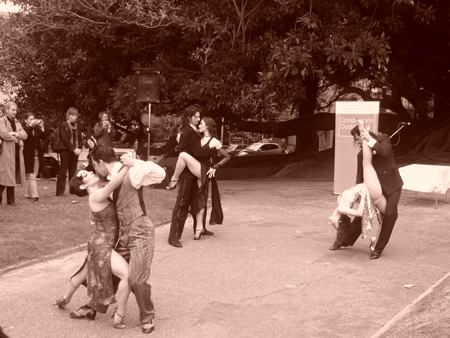
The first picture is a typical postcard from Buenos Aires. I took it in a very nice park and they are three couples dancing tango in a very professional way. I certainly don’t dance it this way!!!

Laura Agosta 1

The second and the third picture are the ones that I’ve taken in San Telmo, one of the nicest “porteño” towns in the city. Every Sunday people gather in Defensa Street and they buy different handcrafts and clothing from sellers that show their stuff there.  The first picture below is a very strange garbage can that I’ve found in the street. Apparently, I was not the only one who was interested in taking a picture of it! The third one is a guy playing a strange instrument. What I love about this picture is that he is very focused on his music, while everyone around him don’t seem to notice his presence.

Laura Agosta 2

Laura Agosta 3

"The most global public policy school, where an international community of students and faculty address world challenges."

—Merit E. Janow, Dean, SIPA, Professor of Practice, International and Economic Law and International Affairs

Boiler Image