November 2016
Bioethics Webinar: Direct-to-consumer advertising of drugs: should we change it, and if so, how?
The Columbia University Bioethics program is pleased to host a series of online webinars examining critical ethical and policy issues that arise in the context of drug and device development and the pharmaceutical industry. Our first webinar will focus on ethical questions posed by Direct-to-Consumer (DTC) pharmaceutical advertising. The United States and New Zealand are the only countries that allow DTC pharmaceutical advertising. Supporters of DTC ads say that these educate consumers and raise awareness of diseases. But others have…
Find out more »Beyond the Hype: “Buddhism and Neuroscience” in a New Key
Scholars from scientific and social science fields examine the idea of a convergence between Buddhism and neuroscience.
Find out more »The State of Eugenics: Documentary Film Screening and Panel Discussion
For much of the 20th century, eugenics was a widely-accepted practice in the US, endorsed by the Supreme Court of the United States in the 1927 Buck v. Bell decision. Thirty states (including New York) sterilized citizens with the aim of reducing poverty and getting rid of "the unfit". North Carolina ran one of the most aggressive eugenics programs, sterilizing more than 7,600 men, women and children between 1933 and 1974. ‘The State of Eugenics’ follows the journey of survivors, legislators, and journalists…
Find out more »Science, Technology, and Society Discussion Series – Racism and Public Health
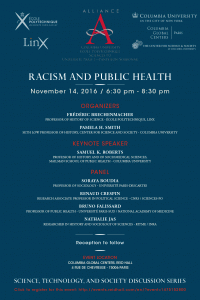
Samuel Kelton Roberts, Professor of History and of Sociomedical Sciences, Mailman School of Public Health, Columbia University : "An Historiographical note on People of Color, Drug Politics and Research, & a Harm Reduction Perspective"
Find out more »M.A. in Climate and Society at Columbia University Information Session
The M.A. Program in Climate and Society at Columbia University is a twelve-month interdisciplinary Master of Arts program that trains professionals and academics to understand and cope with the impacts of climate variability and climate change on society and the environment. Through classes and research, students gain knowledge in both climate science as well as social sciences as they relate to climate. During the information session perspective students will have the opportunity to learn about the program as well as…
Find out more »The Iago Galdston Lecture: When Mexican Physicians Take to the Streets and to Villages
What does it mean to be a physician activist in a middle income or poor country? Since 1917, the Mexican constitution has guaranteed universal healthcare for all workers. Yet making this constitutional promise a reality has been a persistent challenge that remains unresolved today. Mexican physicians have often been caught in the middle of political and policy discussions about the delivery of universal health care. Indeed, in 20th-century Mexico, physicians redefined their roles as healers and became activists, anthropologists, protestors,…
Find out more »Michelle Rogers – A Science-Art Collaboration
This fall, the International Research Institute for Climate and Society (IRI) welcomes a special guest, artist Michelle Rogers, to its offices at Columbia University’s Lamont campus. Rogers will complete a work-in-progress while just a stone’s throw away from hundreds of research scientists and other staff who study climate, geology, oceanography and other earth sciences. Her painting, Eco Venus—an 8x10ft ‘ecological interpretation’ of Botticelli’s The Birth of Venus—will include more than 100 ocean species that the International Union for Conservation of Nature recognizes as endangered. Rogers plans to…
Find out more »18th International Conference on Grey Literature: Leveraging Diversity in Grey Literature
The 18th International Conference on Grey Literature is a two-day conference on grey literature focusing on diversity as an effective way for information professionals to work together to innovate and create change. Diversity enhances creativity and encourages the search for new information and nuanced perspectives, leading to better decision-making and problem solving. Lunch will be provided. The intended audience for this conference is librarians, researchers, policy-makers, and publishers. Please visit the conference's website for more details. Conference topics include: Effectiveness…
Find out more »Characterizing Animals in Science and Fiction
Our panelists approach questions about animals and the human imagination from perspectives in history, literature, evolutionary biology, and neuroscience.
Find out more »What Would it Mean to Understand Climate Change?
Efforts abound to "understand" climate change. But what kind of understanding is needed? Does "understanding" mean the same thing to concerned citizens as it does to scientists, humanities scholars, or policy makers?
Find out more »