October 2016
Algorithm as a Scientific Weltanschauung
Speaker: Christos Papadimitriou, University of California, Berkeley When key problems in science are revisited from the computational viewpoint, occasionally unexpected progress results. There is a reason for this: Implicit algorithmic processes are present in the great objects of scientific inquiry—the cell, the brain, the market—as well as in the models developed by scientists over the centuries for studying them. This unexpected power of computational ideas, sometimes called "the algorithmic lens," has manifested itself in these past few decades in virtually…
Find out more »November 2016
Barbara A. Bernhardt – Receiving Uncertain Genomic Test Result During Pregnancy: Decision-Making and the Aftermath
Through surveys and interviews, scientists the experiences of women having prenatal chromosomal microarray testing and the prenatal genetic counselors who serve them. The offer of genome-wide testing is viewed as an offer "good good to pass up", but positive results may be viewed as "toxic knowledge", complicating decision-making and impacting the parenting of children born with known copy number variants. Study findings will be presented and discussed in light of current and future approaches to prenatal diagnosis. For over 20…
Find out more »Ruha Benjamin – Precision Medicine, Race & Ethnicity
This event is part of the Columbia Precision Medicine Initiative’s series, Precision Medicine: Ethics, Politics, and Culture. Speaker: Ruha Benjamin, Princeton University Precision Medicine—an emerging approach for disease treatment and prevention that takes into account individual variability in genes, environment, and lifestyle for each person—raises a myriad of cultural, political, and historical questions that the humanities are uniquely positioned to address. As part of its overall Precision Medicine Initiative, Columbia is undertaking a broad based exploration of questions that precision…
Find out more »Surgical Transgressions? Michael DeBakey, Denton Cooley, and the Controversial Artificial Heart Case of 1969
Shelley McKellar, Professor of the History of Medicine at Western University in London, Ontario, highlights medical disputes, treatment disappointments, the role of the media, and its reverberating effects on the development of artificial hearts thereafter.
Find out more »Bioethics Webinar: Direct-to-consumer advertising of drugs: should we change it, and if so, how?
The Columbia University Bioethics program is pleased to host a series of online webinars examining critical ethical and policy issues that arise in the context of drug and device development and the pharmaceutical industry. Our first webinar will focus on ethical questions posed by Direct-to-Consumer (DTC) pharmaceutical advertising. The United States and New Zealand are the only countries that allow DTC pharmaceutical advertising. Supporters of DTC ads say that these educate consumers and raise awareness of diseases. But others have…
Find out more »Beyond the Hype: “Buddhism and Neuroscience” in a New Key
Scholars from scientific and social science fields examine the idea of a convergence between Buddhism and neuroscience.
Find out more »The State of Eugenics: Documentary Film Screening and Panel Discussion
For much of the 20th century, eugenics was a widely-accepted practice in the US, endorsed by the Supreme Court of the United States in the 1927 Buck v. Bell decision. Thirty states (including New York) sterilized citizens with the aim of reducing poverty and getting rid of "the unfit". North Carolina ran one of the most aggressive eugenics programs, sterilizing more than 7,600 men, women and children between 1933 and 1974. ‘The State of Eugenics’ follows the journey of survivors, legislators, and journalists…
Find out more »Science, Technology, and Society Discussion Series – Racism and Public Health
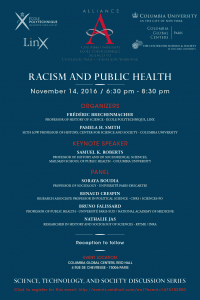
Samuel Kelton Roberts, Professor of History and of Sociomedical Sciences, Mailman School of Public Health, Columbia University : "An Historiographical note on People of Color, Drug Politics and Research, & a Harm Reduction Perspective"
Find out more »M.A. in Climate and Society at Columbia University Information Session
The M.A. Program in Climate and Society at Columbia University is a twelve-month interdisciplinary Master of Arts program that trains professionals and academics to understand and cope with the impacts of climate variability and climate change on society and the environment. Through classes and research, students gain knowledge in both climate science as well as social sciences as they relate to climate. During the information session perspective students will have the opportunity to learn about the program as well as…
Find out more »Michelle Rogers – A Science-Art Collaboration
This fall, the International Research Institute for Climate and Society (IRI) welcomes a special guest, artist Michelle Rogers, to its offices at Columbia University’s Lamont campus. Rogers will complete a work-in-progress while just a stone’s throw away from hundreds of research scientists and other staff who study climate, geology, oceanography and other earth sciences. Her painting, Eco Venus—an 8x10ft ‘ecological interpretation’ of Botticelli’s The Birth of Venus—will include more than 100 ocean species that the International Union for Conservation of Nature recognizes as endangered. Rogers plans to…
Find out more »