November 2016
Ligo Project – Science (as) Culture: The Microbiome – Microbiome in the City (Part 2)
The Microbiome - redefining the biology and culture of what it means be human Are we alone? Depends who you ask! We all have over 100 trillion microbes living in and on our body, so we’re never really alone. The microbiome, which represents the population of all the microbes - bacteria, fungi, protozoa and viruses - that live on and inside the human body, is important in human health and disease. New discoveries about the microbiome are revolutionizing how we…
Find out more »History of Science Society 2016 Annual Meeting
The 2016 HSS Annual Meeting will be held in Atlanta, Georgia, November 3 - 6, 2016. Please save the date. Registration for the 2016 HSS Meeting will open July 1, 2016. See History of Science Society website for more details.
Find out more »Ullyot Public Affairs Lecture – Sir James Fraser Stoddart
In this free lecture 2016 Nobel Laureate in Chemistry Sir James Fraser Stoddart will describe how the culture of science and the culture of art seamlessly nourish each other.
Find out more »Science, Technology, and Society Discussion Series – Racism and Public Health
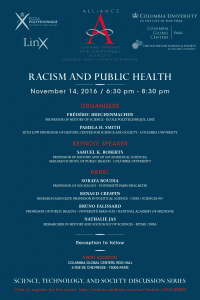
Samuel Kelton Roberts, Professor of History and of Sociomedical Sciences, Mailman School of Public Health, Columbia University : "An Historiographical note on People of Color, Drug Politics and Research, & a Harm Reduction Perspective"
Find out more »18th International Conference on Grey Literature: Leveraging Diversity in Grey Literature
The 18th International Conference on Grey Literature is a two-day conference on grey literature focusing on diversity as an effective way for information professionals to work together to innovate and create change. Diversity enhances creativity and encourages the search for new information and nuanced perspectives, leading to better decision-making and problem solving. Lunch will be provided. The intended audience for this conference is librarians, researchers, policy-makers, and publishers. Please visit the conference's website for more details. Conference topics include: Effectiveness…
Find out more »December 2016
Ligo Project – Science (as) Culture: Microbiome – The 1000-year view and how to get there (Part 3)
The Microbiome – redefining the biology and culture of what it means be human Are we alone? Depends who you ask! We all have over 100 trillion microbes living in and on our body, so we’re never really alone. The microbiome, which represents the population of all the microbes – bacteria, fungi, protozoa and viruses – that live on and inside the human body, is important in human health and disease. New discoveries about the microbiome are revolutionizing how we…
Find out more »February 2017
Understanding Material Loss Across Time and Space
Speculative and exploratory in nature, Understanding Material Loss asserts that in a period marked by ecological destruction, but also economic austerity, large scale migration and increasing resource scarcity, it is important that historians work to better understand the ways in which humans have responded to material loss in the past and how such responses have shaped change. Understanding Material Loss asks: how have humans historically responded to material loss and how has this shaped historical processes? The conference will bring together a range of scholars in an effort more to begin to explore and frame a problem, than provide definitive answers.
Find out more »Critical Histories, Activist Futures: Science, Medicine, and Racial Violence Conference
The History, Science, and Justice Collective at Yale University is pleased to announce the “Critical Histories, Activist Futures: Science, Medicine, and Racial Violence” conference that will take place on February 24 and 25, 2017. Please learn more about the conference, explore the program and find tips for getting to Yale University on the conference website.
Find out more »March 2017
Biodiversity and its Histories, Cambridge
This conference will bring together scholars and researchers in ecology, politics, geography, anthropology, cultural history, and history and philosophy of science to explore how aesthetic, economic, and moral value came to be attached to the diversity of life on earth. We will draw on a rich body of research on hybridity and exchange, habitat and distribution, civilization and extinction from the eighteenth century onwards, bringing renewed attention to a powerful contemporary concept whose historical and disciplinary breadth has yet to be critically examined. This is especially important at a moment when political debates threaten to eliminate the rich valences and values attached to biological diversity by substituting instrumental calculations and impoverished notions such as ‘ecosystem services’.
Find out more »April 2017
Mark Waddell – “Trust Me!” The Problem of Insincerity in Early Modern Medicine
In this talk Mark Waddell will examine the strange medical remedy known as the weapon salve, or the powder of sympathy, and use its contentious history to explore how insincerity, credibility, and trust were interwoven at the dawn of modern science and medicine.
Find out more »