R. Barton Palmer, “Lounge Time” Reconsidered: Spatial Discontinuity and Temporal Contingency in Out of the Past (1947)

October 27, 2025

The chief taxonomic difficulty that haunts film genre study is its dependence on circular reasoning. Discussions of genre, as Robert Stam suggests, are inevitably characterized by a “tautological quality.”

We hardly need reminding that this kind of debate has not raged around the other Hollywood genres (musicals, biopics, melodramas, etc.), and the reason is that these other forms have never been co-opted into a politique des genres whose purpose is to distinguish between dross and artistic gold.

The past, in short, cannot be escaped and,
worse yet, must find renewed expression in the present, which is often doomed, as in
Out of the Past, simply to repeat it.


Francisco De Vitoria, Political Writings

October 26, 2025

This last point is proved by Aristotle, who says with elegant precision: “the lower sort are by nature slaves, and it is better for them as inferiors that they should be under the rule of a master’ (Politics 1254’20).”

On the Right to Debate Colonial Justice

“When we hear subsequently of bloody massacres and of innocent individuals pillaged of their possessions and dominions, there are grounds for doubting the justice of what has been done.”
(Intro., §17)
—A rare acknowledgment, in 1539, that Spanish conquest might not be self-justifying.


On Indigenous Sovereignty

“The barbarians undoubtedly possessed as true dominion, both public and private, as any Christians.”
(1.6, Conclusion)
—This single sentence dismantles the core theological argument for conquest, asserting political equality of non-Christians.


On the Misuse of Aristotle

“Aristotle certainly did not mean that such men thereby belong by nature to others and have no rights of ownership… Such slavery is a civil and legal condition, to which no man can belong by nature.”
(1.6, Conclusion)
—Vitoria rereads Politics to deny natural slavery, recasting Aristotle through Christian humanism.


On Human Rationality

“They have properly organized cities, proper marriages, magistrates and overlords, laws, industries, and commerce… all of which require the use of reason.”
(1.6, §4)
—A proto-anthropological observation: reason inferred from social order rather than faith.


On the Law of Nations

“The Spaniards have the right to travel and dwell in those countries, so long as they do no harm to the barbarians, and cannot be prevented by them from doing so.”
(3.1, First Title)
—Foundational for ius gentium and later international law: the right of peaceful intercourse among peoples.


On Evangelization and Force

“If the barbarians… obstruct the Spaniards in their free propagation of the Gospel… they may take up arms… insofar as this provides the safety and opportunity needed to preach.”
(3.2, Fourth Conclusion)
—An uneasy rationalization: the birth of “humanitarian intervention” in theological dress.


On Moral Limits of Conquest

“They must always be prepared to forego some part of their rights rather than risk trespassing on some unlawful thing, and always direct all their plans to the benefit of the barbarians rather than their own profit.”
(3.2, Final paragraph)
—Vitoria’s ethical hedge: war may be lawful, but justice demands restraint and altruism.


On Tyranny and Human Sacrifice

“In lawful defence of the innocent from unjust death… the Spaniards may prohibit the barbarians from practising any nefarious custom or rite.”
(3.5)
—The earliest theoretical justification for intervention “to protect the innocent.”


On the Limits of Governance

“I say all this merely for the sake of argument; and even then, only if everything is done for the benefit and good of the barbarians, and not merely for the profit of the Spaniards.”
(3.8)
—A revealing caution: Vitoria sees the moral danger in paternalistic empire.


On the Moral Priority of Conscience

“For an action to be good in cases where a person has no other means of certainty, it is a necessary condition that he act in accordance with the ruling and verdict of wise men.”
(Intro., §10)
—His guiding principle: moral legitimacy depends on rational deliberation, not mere power.


Felipe Gyaman Poma de Ayala’s Appeal Concerning the Priests, Peru

October 25, 2025

In Guarnan Poma’s estimation, the priests ultimately suffer in comparison even with the integrity and good examples of pre-Hispanic Andean religious ministers who, in his view, “were Christians in everything but their idolatry.”

Guaman Poma writes, the Indian women become “notorious whores,” and a Mestizo population multiplies while the number of native Andeans diminishes.

In the midst of an often tragic and disturbing narrative, Guaman Poma makes precise recommendations. He somehow sustains a faith in ideals, in a kind of Christianity that could be better than many Christians, and in the inherent justice of higher levels of Spanish Christian authority. He writes that “from fatigue and nightmare, the bishops of this kingdom die because we [Indians] are so cruelly treated.” He calls for harsh punishment of the worst offenders, for the cleansing effect that he believes such punishments might have on Peru. And Guaman Poma, the Andean Christian and would-be royal adviser, grows more specific. These priests should be at least fifty years old, appointed on an interim basis, and carefully monitored, and the Indians’ opinions should be both sought and honored. Moreover, priests should be carefully screened by a succession of able Jesuits and friars for their abilities and preparation as pastors. Usurpers of their holy office, the false priests, must be banished from the Indian parishes.

The aforementioned priests, fathers, and pastors who stand for God and his saints in the parishes of this kingdom of Peru do not act like the blessed priests of Saint Peter and the friars of Our Lady of Mercy, Saint Francis, Saint Dominic, and Saint Augustine, and the hermits of Saint Peter who preceded them. Rather, they give themselves over to greed for silver, clothing, and things of the world, and sins of the flesh, appetites, and unspeakable misdeeds, of which the good reader will learn later so that they can be punished in exemplary fashion.

These parish priests take from every pueblo things belonging to the church, hospital, or members of confraternities, saying that they must help them; and they use them up with impunity. They do so with the help of the corregidor or the visitador [administrative inspector, or inspector and judge of idolatryl; and in this way the Indians are robbed of their belongings and community.

These women and their parents and relations cannot confess [to such a priest], nor is the sacrament of confession valid, nor is he worthy of a salary from them. Because how can he confess and absolve someone with whom he sins mortally, a sacrilegious sin with these Indian women?

All of this deserves great punishment; and even more than punishment, such a sin should be made known to the Inquisition. Properly punished, this will be a good example to the faithful Christians of Jesus Christ in the world and in this kingdom.

The priest should not be allowed to be a shopkeeper or merchant or petty trader on his own account or through anyone else, including his siblings and relatives. When he sells food or clothing, he is already acting like a petty dealer. He does not deserve the name of priest because in this kingdom they [the priests] are shopkeepers and small-time dealers. On the pretext of collecting offerings, he buys and sells, so that every pueblo’s offerings are sold to the poor of Jesus Christ, and with the proceeds he furnishes their churches.


Linda Williams, Film Bodies: Gender, Genre, and Excess

October 22, 2025

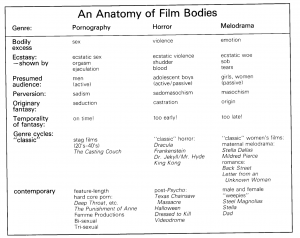
For example, pornography is today more often deemed excessive for its violence than for its sex, while horror films are excessive in their displacement of sex onto violence.

I suggest, however, that the film genres that have had especially low cultural status—which have seemed to exist as ex- cesses to the system of even the popular genres— are not simply those which sensationally display bodies on the screen and register effects in the bod- ies of spectators. Rather, what may especially mark these body genres as low is the perception that the body of the spectator is caught up in an almost involuntary mimicry of the emotion or sensation of the body on the screen along with the fact that the body displayed is female.

Examples of such measure- ment can be readily observed: in the “peter meter” capsule reviews in Hustler magazine, which mea- sure the power of a porn film in degrees of erection of little cartoon penises; in horror films which measure success in terms of screams, fainting, and heart attacks in the audience (horror producer Wil- liam Castle specialized in this kind of thing with such films as The Tingler, 1959); and in the long- standing tradition of women’s films measuring their success in terms of one-, two-, or three-hand- kerchief movies.


Chi-Yun Shin, The Art of Branding: Tartan “Asia Extreme” Films

October 22, 2025

“Asia Extreme” is the first label created to specifically distribute East Asian film titles by
London-based Tartan Films, which operated as Metro-Tartan Distribution between 1992 and
2003, before reverting back to the name Tartan Films.

Starting off as a cult phenomenon, targeting the cult “fan-boys” but soon incorporating the art-
house audiences (or world cinema patrons) to its niche, the Tartan Asia Extreme label has
established itself as an immediately recognizable brand.

Tartan “found the pot of gold at the end of the rainbow
[by identifying] ‘the next big thing’ ahead of your competitors and becoming the early dominant
provider.

Questions, however, have been raised as to the reductive nature of Tartan’s marketing practices, which repackages the films “as exotic and dangerous cinematic thrills.” In addition, the output of the label, and the name of the label itself, invoke and (p.87) in part rely on the Western audiences’ perception of the East as weird and wonderful, sublime and grotesque.

Edward Said

“Asia Extreme” provides a fascinating site to explore how the West consumes East Asian cinema.

Raison d’être: when Nakata Hideo’s Ring and Miike Takashi’s Audition were unleashed upon unsuspecting audiences nationwide, it became apparent that the appetite for such outrageous fare was massive and it made sense to let people know where to find it.

For instance, Peter Bradshaw, who seems to be quite shaken up by the film, wrote for the Guardian that Oldboy “open[ed] up a whole new sick frontier of exotic horror” and ends the
review by declaring “this is cinema that holds an edge of cold steel against your throat.”27 For Harry Knowles of the Ain’t ItCool News, Oldboy is “an engaging, flawless film that successfully pushes all (p.96) the right buttons,” and its director Park is aFigure 5.9 Audition poster image (Courtesyof Tartan Films)genius and “the films coming from Koreaare exceptional” and “light years betterthan any contemporary set film in the US this year or…for many years.”

Oldboy also attracted no less critical condemnation. As Grady Hendrix puts it, the film “became a critical scratching post for even the most timid magazine writers, who fired off all the insults
they’d been saving for a rainy day. “31 Most noteworthy came from New York-based newspapers. Introducing the film as “the frenzied Korean thriller,” Manohla Dargis commented in the New
York Times: “The fact that Oldboy is embraced by some cinephiles is symptomatic of a bankrupt,
reductive postmodernism: one that promotes a spurious aesthetic relativism (it’s all good) and
finds its crudest expression in the hermetically sealed world of fan boys. “32 Rex Reed at the New York Observer asserted that the film is “sewage” and sarcastically questioned: “What else can you expect from a nation weaned on kimchi, a mix of raw garlic and cabbage buried underground until it rots, dug up from the grave and then served in earthenware pots sold at the Seoul airport as souvenirs?” Reed’s hostile and rather reductive response sparked many online

it seems that the success of Tartan Asia Extreme reveals more about Western perceptions and obsessions about East Asian countries than what people or societies are like in these countries.

Just as the West “discovered” Japanese masters in the films of Kurosawa, Mizuguchi Kenji, and Ozu Yasujiro, with the Tartan Asia Extreme label, the world of film in the West “discovered” new master directors, notably Kim Kiduk, Miike Takashi, and Park Chan-wook.

For instance, Tartan Films’ owner McAlpine has referred the label to be a “brand [and] — a genre in itself,”


Joan Hawkins, Sleaze Mania, Euro-trash, and High art

October 22, 2025

The sacralization of culture was an invented phenomenon. There was a time when opera could exist simultaneously as a popular and an elite art form, a time when American audiences might hear a soliloquy from Hamlet and a popular song in the course of one evening’s entertainment at a local venue.

As certain cultural products picked up elite status, they also acquired a certain restrictive class inflection.

cataloguing lists two versions of the film, inadvertently gives the catalogue a curiously academic or scholarly air, which links Sinister Cinema to more upscale serious video companies.

Tag art films as films which require a different reading strategy, also tag certain B movies as films which can be openly appreciated on pure aesthetic grounds.


In addition to these, there is an interesting array of films which, put quite simply, are difficult to categorize. Films with high production values, European art-film cachet, and enough sex and violence to thrill all but the most jaded horror fan

Freaks nearly caused a riot when Dwain Esper showed it to a North Carolina drive-in audience under the sensational title Forbidden Love. Led by the title and advertising to expect a softcore treatment of “love” between “a beautiful woman and a midget,” the crowd had no patience with a movie which Raymond Durgnat later compared to the European art films of Buñuel.” Esper managed to pacify the drive-in patrons by showing them a black-and-white nudist colony one-reeler that he had tucked in the trunk of his car, a film that ap- parently came much closer to satisfying their expectations than did Browning’s creepy classic.* Interestingly enough, Freaks was revived 30 years later as an “art film” and did very well, attracting favorable reviews by Raymond Durgnat and John Thomas, and captivat- ing such notable patrons as Emile de Antonio and Diane Arbus.” By 1967, David J. Skal notes, the film “had made it to the Museum of Modern Art” (21).

Avant-garde cinema is just as divergent in scope and quality as horror cinema. The European art film is so diverse that it is generally not represented as a genre at all.


The Prince, Machiavelli

October 21, 2025

Published posthumously (5 years)

Medici family, a banking dynasty controlling Florence from 1434 to 1737

Political realism: driven by power, self-interest

Machiavelli:

  • focussed on how politics really work, not how it should work
  • one can never escape a war, can only postpone to the enemy’s advantage.

States are divided into: hereditary, new principalities, mixed principalities, nobles vs. commoners, and securing power


Ibn Khaldun, The Muqaddimah

October 14, 2025

Born in Tunis, 1332, born into high class, family escaped Spain after the Reconquista.

Send as an emissary and negotiator from Cairo to meet Timur.

History, social sciences, as opposed to the chronicles of the royalty


Christine de Pizan, The Book of the City of Ladies

October 14, 2025

Similarity to Dante’s Inferno, the guidance and foretelling

Lady Reason, Rectitude, and Justice

Women operate their city in their own way.

Rumour as a way of seeing social intelligence. Upholding women’s knowledge.


The Qur’an

October 7, 2025

Islam: birthed during the time of tribal division

Qur’an: 114 Surahs, meant to be heard just as much as it is meant to be read

One text shaping entire cultures

God appears in Muhammad’s life multiple times

Faith and morality (Meccan Surahs)

Law and community (Medinan Surahs)